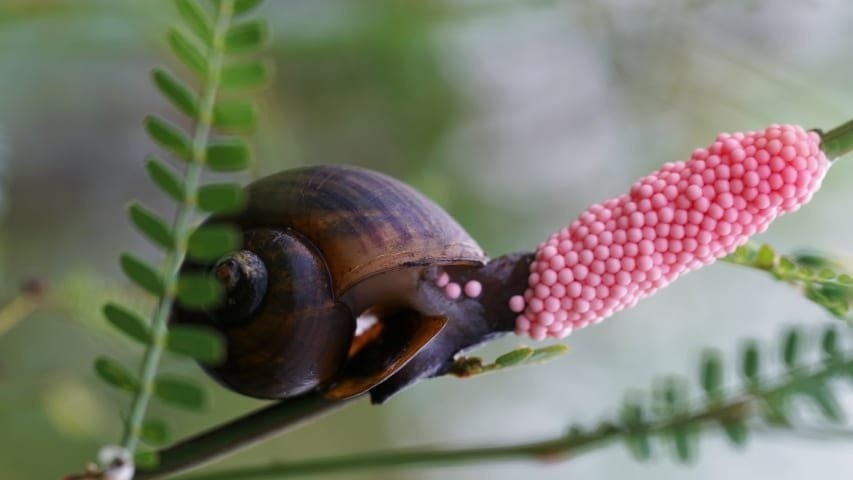
Imagine walking through your garden one morning and noticing a cluster of tiny, bright pink objects attached to a wall, a wooden post, or the stem of a plant near a pond. At first glance, they might look like decorative beads or an unusual group of flower buds. Their vivid color makes them difficult to miss, especially against dark wood or green leaves.
But these unusual clusters may be more than an interesting garden discovery.
In certain parts of the world, bright pink egg masses are associated with apple snails, a group of freshwater mollusks that includes several invasive species. Some of these snails have spread far beyond their original habitats and become serious concerns for wetlands, waterways, and agricultural areas.
Their eggs are particularly noticeable because the snails lay them above the water rather than beneath its surface. A single cluster can contain hundreds of eggs, creating a visible warning that an apple snail may be living nearby.
However, there is an important distinction: finding pink eggs does not automatically mean your house is in danger. Apple snails are primarily freshwater animals, and their presence is most relevant to ponds, rivers, wetlands, irrigation systems, and other aquatic environments.
Understanding what these eggs look like, where they are usually found, and what to do when you encounter them can help protect both your garden and the surrounding environment.
What Are Those Bright Pink Eggs?
The eggs may belong to an apple snail in the genus Pomacea. Two well-known invasive species are the channeled apple snail (Pomacea canaliculata) and the giant apple snail (Pomacea maculata).
These freshwater snails are native to South America, but some species have established populations in other parts of the world. Their ability to reproduce successfully in suitable environments has made them an important concern for conservationists and agricultural authorities.
Unlike many familiar garden snails, apple snails spend most of their lives in freshwater. They can be found in ponds, lakes, marshes, rice fields, canals, and slow-moving waterways.
Their egg-laying behavior is one of their most distinctive characteristics.
Female apple snails climb onto objects that rise above the waterline and attach their eggs to the surface. These objects may include plant stems, tree trunks, rocks, wooden posts, bridge supports, and other structures near the water.
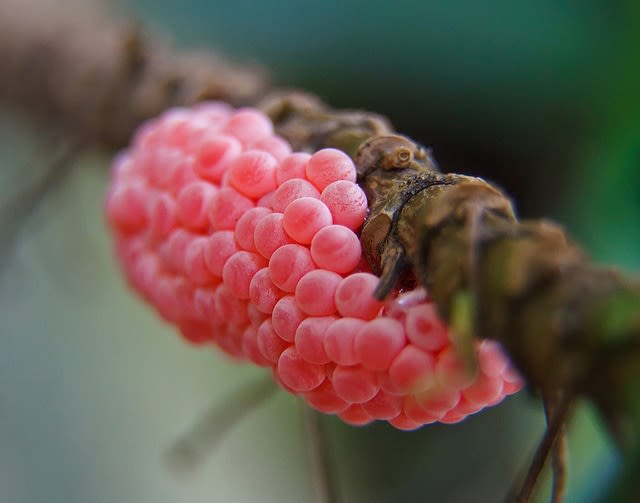
The eggs are usually bright pink or reddish-orange when newly laid. Individual eggs are small, often only a few millimeters across, but hundreds may be grouped together in one cluster.
According to the California Department of Fish and Wildlife, channeled apple snail egg masses commonly contain approximately 200 to 600 eggs. Other apple snail species may produce substantially larger clusters, so the exact number varies depending on the species and environmental conditions.
The color also changes as the eggs develop. Freshly laid clusters are often vivid pink, but they can become paler, whitish, or grayish as hatching approaches.
This unusual appearance makes the egg masses easier to notice than the adult snails themselves, which often remain hidden among aquatic plants or beneath the water.
Why Do Apple Snails Lay Their Eggs Above the Water?
One of the most interesting features of apple snails is that they do not simply release their eggs into the water.
Instead, females climb above the waterline and attach their egg masses to nearby surfaces. This behavior helps protect the developing eggs from conditions that would otherwise affect their survival.
The eggs need an environment above the water to develop properly. When they hatch, the young snails fall into the water below, where they begin their aquatic lives.
This reproductive strategy also explains why pink egg clusters are frequently found on objects that appear to have little connection with snails.
A tree branch extending over a pond, a concrete wall beside an irrigation canal, or a wooden support near a wetland may provide a suitable place for a female to lay eggs.
The bright color is another notable feature. Research on apple snails has identified defensive compounds in their egg masses that can make them unappealing to some potential predators. Their vivid appearance is therefore associated with more than simple decoration.
In suitable warm conditions, the eggs may hatch within roughly one to two weeks, although development time varies with temperature and other environmental factors.
Once the young snails enter the water, they begin feeding and growing. This is why early detection can be important in areas where invasive apple snails are not yet established.
Why Are Invasive Apple Snails a Concern?
Not every apple snail is invasive everywhere. The ecological impact depends on the species and the environment into which it has been introduced.
However, certain non-native apple snails have become significant agricultural and environmental pests.
One reason is their appetite for aquatic vegetation.
Apple snails feed on a variety of plants, including young shoots and submerged vegetation. In wetlands and freshwater habitats, these plants provide food and shelter for other organisms. They also help maintain the structure and balance of aquatic ecosystems.
When large populations of invasive snails consume too much vegetation, the effects can extend beyond the plants themselves.
A reduction in aquatic vegetation may change the habitat available to fish, insects, and other freshwater animals. It can also influence nutrient cycling and the overall condition of wetlands.
The consequences are particularly important in agricultural areas.
In parts of Southeast Asia, invasive golden apple snails have become troublesome pests in rice production. Young rice seedlings are especially vulnerable because the snails can feed on newly planted crops.
Farmers may face additional labor and management costs when snail populations become established in irrigation systems and rice fields.
The problem is not limited to one crop or one country. Depending on the species and local conditions, apple snails can affect other aquatic and wetland plants as well.
Their reproductive ability makes the challenge more complicated. A female can produce repeated egg masses, allowing populations to grow quickly when food, temperature, and habitat conditions are favorable.

Where Have Apple Snails Spread?
Apple snails originally come from the Americas, particularly South America, but human activities have helped some species move into new regions.
The aquarium trade has been one pathway. Apple snails have been kept as ornamental animals because of their unusual appearance and relatively large size. When unwanted pets are released into ponds, rivers, or canals, they may establish populations if the environment is suitable.
They can also spread through the movement of aquatic plants, equipment, boats, and other materials associated with freshwater environments.
In Southeast Asia, invasive apple snails have become familiar agricultural pests, particularly in rice-growing areas.
In North America, populations have been reported in several states, including Florida, Texas, and California. Authorities monitor these species because they can threaten native aquatic habitats and agricultural production.
Europe has also experienced introductions. In July 2018, approximately 60 apple snail egg masses were discovered in a humid area near Fréjus, in southern France. Authorities began eradication measures and continued monitoring the affected area.
According to the European and Mediterranean Plant Protection Organization’s 2026 report, no specimens had been detected in France since 2021, and the outbreak was officially declared eradicated.
This example demonstrates why early reporting and organized monitoring matter. Detecting an invasive species before it becomes widespread can make control efforts more effective.
How to Recognize a Possible Apple Snail Egg Cluster
Bright pink egg masses are a useful warning sign, but identifying a species from its eggs alone is not always possible.
Several apple snail species have similar-looking egg clusters, and their size, color, and number of eggs can vary. Environmental conditions may also affect their appearance.
Still, there are a few characteristics worth observing.
Color: Newly laid apple snail eggs are often bright pink, reddish, or orange. Older clusters may become pale or grayish.
Shape: The eggs are small and rounded, forming a compact mass that resembles a cluster of tiny beads.
Location: They are commonly attached to solid surfaces above the waterline, including plants, rocks, logs, walls, and structures beside freshwater.
Nearby habitat: The presence of a pond, canal, wetland, rice field, or slow-moving stream makes an apple snail identification more plausible.
Adult apple snails are also relatively large compared with many native freshwater snails. Their shells are generally rounded and may have brown, yellowish, greenish, or darker patterns.
However, visual identification can be difficult, especially when several related species occur in the same region. A photograph and expert assessment are more reliable than guessing from color alone.
What Should You Do If You Find Pink Eggs?
If you discover a suspicious cluster near a pond, waterway, or other freshwater habitat, the most useful first step is to document what you have found.
Take a clear photograph of the egg mass and its surroundings. If possible, record the approximate location and the date of discovery. These details can help local wildlife or agricultural authorities determine whether the eggs belong to an invasive species.
Next, check the reporting guidance in your area.
Some authorities have specific procedures for removing or destroying apple snail egg masses. Recommendations can differ depending on the species, local regulations, and whether the population is already established.
Do not assume that every region recommends the same removal method. In some places, officials provide instructions for scraping egg masses from surfaces; in others, they may prefer residents to report the discovery and leave removal to trained personnel.
It is also sensible to avoid touching unfamiliar egg clusters with bare hands. Wear suitable gloves if local authorities instruct you to handle them, and wash your hands afterward.
Never transport suspected snails or their eggs to another pond, garden, or waterway. Moving aquatic animals and contaminated equipment can introduce invasive species to new habitats.
If you keep an aquarium, avoid releasing unwanted snails or aquatic plants into natural waterways. Responsible aquarium management is an important part of preventing the spread of non-native species.
For people who maintain garden ponds, regularly checking plants, rocks, and structures near the waterline can also help identify unusual egg masses early.
Why Awareness Makes a Difference
Invasive species are not always easy to recognize. Some arrive unnoticed, establish themselves in a small area, and become difficult to manage only after their populations have grown.
Apple snails demonstrate how a seemingly small discovery can be connected to a much larger environmental issue.
A cluster of pink eggs may contain hundreds of developing snails. If the eggs hatch in a suitable freshwater habitat, the young animals can contribute to a population that feeds on aquatic plants and potentially affects local ecosystems or crops.
But awareness should be accompanied by accurate information, not unnecessary fear.
These eggs are not evidence that a house is structurally damaged, nor do they mean that every garden has an invasive species problem. Their significance depends on where they are found and whether the species is considered invasive in that particular region.
The best response is to observe carefully, take photographs, and follow local guidance.
A small patch of pink on a waterside wall may seem like an unusual natural curiosity. Yet learning to recognize it can help people notice changes in their local environment and support efforts to protect freshwater habitats.
Sometimes, protecting nature begins with paying attention to the smallest details.