It was supposed to be an ordinary English lesson. The students had opened their notebooks, arranged their pencils on their desks, and prepared themselves for another morning of vocabulary practice.
Their teacher, however, had something different in mind.
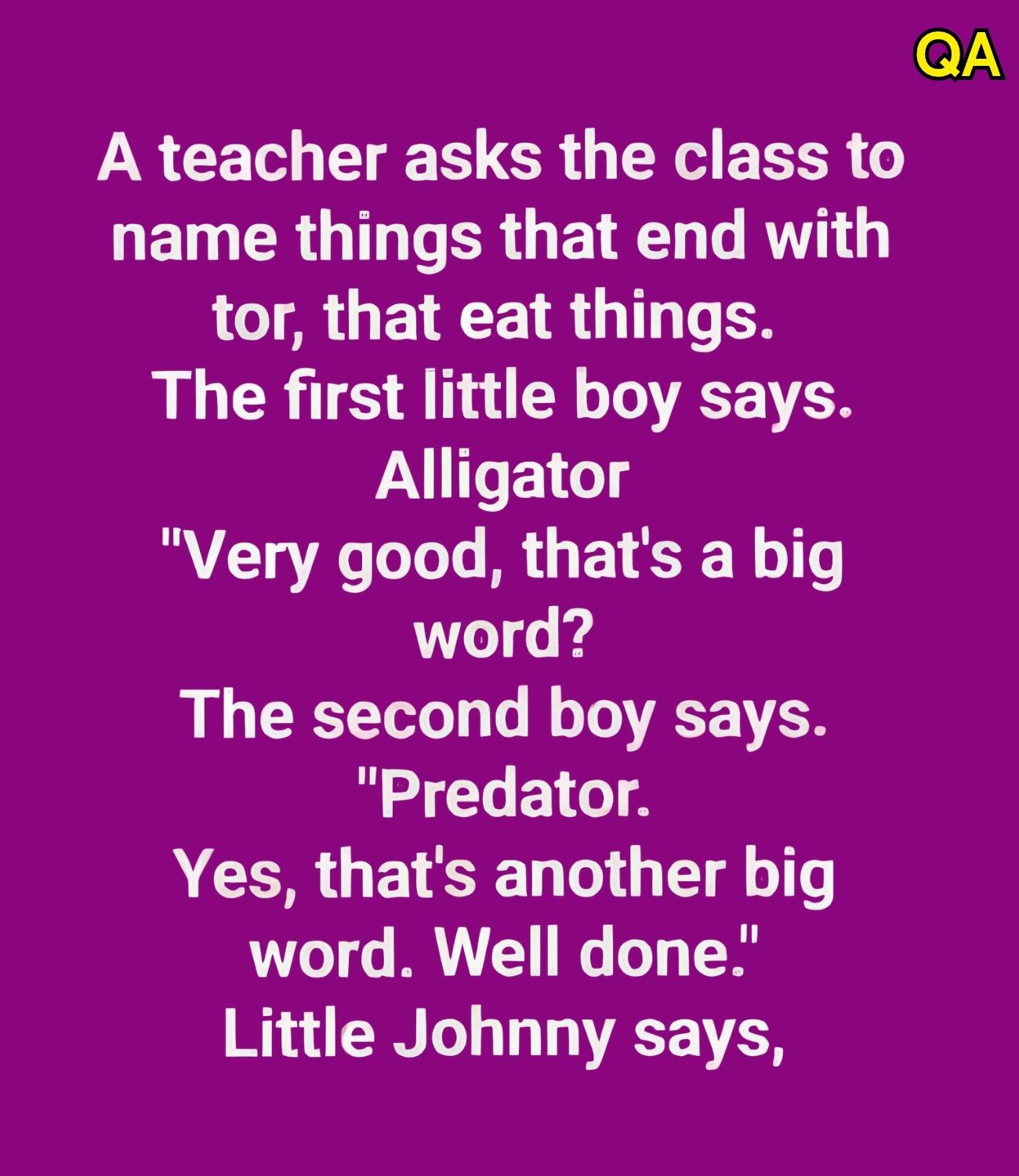
Instead of beginning with a textbook exercise, she walked to the front of the classroom, picked up a marker, and wrote three letters on the board:
T – O – R
Then she turned toward her students with a mysterious smile.
“Today, we’re going to play a little word game,” she announced.
A few students immediately looked interested. Others leaned back in their chairs, wondering whether this meant they could avoid another worksheet.
The teacher continued.
“I want you to think of words that end in ‘-tor.’ But there’s a twist. Your word should describe something or someone that seems to have an endless appetite. It could be hungry for food, power, success, attention, or almost anything else.”
The room became quiet for a moment.
Then several hands began rising.
The teacher smiled.
“All right. Let’s see what you’ve got!”
She had no idea that the answers would soon turn a simple vocabulary exercise into one of the funniest lessons of the week.

The First Answers Set the Tone
A boy sitting near the window raised his hand immediately.
“Alligator!”
The teacher nodded enthusiastically.
“Excellent! An alligator certainly has a reputation for being a powerful predator. It is a great example of an animal that catches its food.”
The boy smiled proudly as a few classmates applauded.
Another student quickly followed.
“Predator!”
“Very good,” the teacher replied. “A predator is an animal that hunts other animals for food. That’s exactly the kind of connection I wanted you to make.”
The students were beginning to understand the challenge.
Some started whispering possible answers to one another. Others searched their memories for words they had encountered in books, films, or previous lessons.
Then a quiet girl in the middle row slowly raised her hand.
“Conqueror?”
The teacher paused.
“Conqueror? That’s a very interesting choice. Can you explain why you chose it?”
The girl thought for a moment.
“Because a conqueror wants to take more land and win more battles. They are never satisfied with what they already have.”
The teacher’s expression brightened.
“Exactly! That’s a creative interpretation. We are not just talking about hunger for food today. Sometimes people can have an endless appetite for achievement, power, or control.”
The girl smiled, clearly pleased that her idea had been accepted.
The game was becoming more interesting than anyone had expected.
When the Answers Became More Creative
A student in the back row suddenly raised his hand.
“Dictator!”
A few classmates laughed before the teacher even responded.
“That’s certainly a strong example,” she said. “A dictator is a ruler who holds great power, often without meaningful limits. Your answer connects the idea of appetite with a desire for control.”
The student nodded proudly.
“That’s what I was thinking!”
The teacher wrote the word on the board.
“Notice something important here,” she told the class. “The word itself doesn’t mean someone who is hungry. We’re using it creatively to describe a person who may have an excessive desire for power.”
The students nodded, although some were clearly enjoying the opportunity to make jokes.
Then a boy wearing a superhero-themed T-shirt jumped into the conversation.
“Terminator!”
The classroom immediately erupted into laughter.
The teacher covered her smile with one hand.
“That’s a memorable answer. The Terminator is a famous fictional character from the movies. It certainly gives us the image of something that keeps moving toward its objective without giving up.”
A student near the door imitated a robotic walk.
Another quietly repeated, “I’ll be back!”
More laughter followed.
“All right, all right,” the teacher said, still smiling. “Let’s keep our attention on the vocabulary. But I have to admit, that was a creative movie reference.”
She added the word to the growing list.
At this point, the students were no longer waiting for the teacher to call on them. Almost everyone wanted a chance to contribute.
The Words Nobody Expected
The next answer came from a student who enjoyed science.
“Innovator!”
The teacher turned toward him.
“Excellent. An innovator is someone who introduces new ideas, methods, or inventions. How does that fit our theme?”
The student answered confidently.
“An innovator is always looking for something new. They’re never satisfied with doing things the same way.”
“Wonderful explanation,” the teacher said. “That is a different kind of appetite: curiosity and the desire to improve things.”
Another student raised her hand.
“Gladiator!”
“Very good. A gladiator was a fighter in ancient Roman entertainment. What do you think makes this word fit?”
“Because gladiators wanted to win,” she replied.
“That’s a reasonable connection. They were known for competing in demanding contests, although their historical experiences were more complicated than simply wanting victory.”
The teacher briefly explained that gladiators were part of ancient Roman public entertainment and that their lives varied depending on their status and circumstances.
The students listened with interest.
What had started as a word game was turning into a miniature history lesson.
Then came another suggestion.
“Incinerator!”
The teacher looked surprised.
“That’s a clever one!”
The student explained that an incinerator burns waste materials at high temperatures, making it seem as though it consumes everything placed inside.
“Exactly,” the teacher replied. “An incinerator is a machine used to burn waste. Your explanation fits the theme through a comparison with consumption.”
The class applauded.
A student in the front row whispered something to her friend, then raised her hand.
“Aviator!”
The teacher smiled.
“An aviator is a pilot. That’s a perfectly good word ending in ‘-tor,’ but how would you connect it to our theme?”
The girl thought for a moment.
“Maybe an aviator has an endless appetite for adventure?”
The teacher laughed.
“That’s not a dictionary definition, but I love the creativity. An aviator may be someone who enjoys exploring the skies and discovering new places.”
The girl looked pleased.
“Then it counts!”
“It certainly counts as a creative answer,” the teacher replied.
The Teacher Turns the Game Into a Vocabulary Lesson
After several minutes, the board was covered with words:
-
Alligator
-
Predator
-
Conqueror
-
Dictator
-
Terminator
-
Innovator
-
Gladiator
-
Incinerator
-
Aviator
The teacher stepped back and looked at the list.
“Now, what do all these words have in common?”
A student answered immediately.
“They all end in ‘-tor’!”
“Correct. But what else can we learn from them?”
The room became quieter.
She explained that many English words ending in “-tor” refer to people, animals, objects, or things associated with a particular action or role.
For example, an aviator flies an aircraft, an innovator introduces new ideas, and an incinerator burns waste.
She also pointed out that the ending “-tor” appears in many words derived from Latin, although not every word ending in those letters follows exactly the same pattern.
“Language is full of patterns,” she explained. “Once you recognize them, you can use them to remember vocabulary and make connections between words.”
One student raised his hand.
“Does that mean we can invent our own words?”
The teacher considered the question.
“You can certainly invent words for fun, but if you’re using them in an essay or formal conversation, you should make sure they are recognized English words.”
The students laughed.
“So I can’t write ‘snackinator’ in my exam?”
“Not unless your examiner is feeling particularly generous,” she replied.
The entire classroom burst into laughter.
One Last Challenge
The teacher glanced at the clock.
The lesson was nearly over, but the students were still eager to continue.
“Before we finish, I have one final challenge,” she announced.
Everyone looked up.
“Can anyone think of another word ending in ‘-tor’ that we haven’t written on the board?”
A student near the window raised his hand.
“Generator!”
“Excellent!” the teacher replied. “A generator produces electricity or another form of energy. That’s a useful word.”
Another student offered:
“Elevator!”
“Very good. An elevator carries people or objects between floors in a building.”
A third student shouted:
“Calculator!”
The teacher nodded.
“Yes! A calculator helps us perform mathematical operations.”
Then someone at the back called out:
“Terminator’s brother… Calculator!”
The class burst into laughter again.
The teacher shook her head, smiling.
“That might be a new character for a science-fiction comedy, but let’s stick to real vocabulary for our list!”
She added the new words to the board and asked the students to think about how each one was used in everyday English.
Before dismissing the class, she gave them a small homework assignment.
“Tonight, find five more words ending in ‘-tor.’ Write down their meanings and create one sentence for each. Tomorrow, we’ll see who discovers the most interesting examples.”
A few students immediately began discussing their ideas.
One wanted to find words related to animals. Another planned to search through a history book. The student who had suggested “Terminator” was already thinking about other movie characters.
The teacher smiled as she watched them pack their bags.
She had planned a short vocabulary activity, but the students had turned it into something much bigger.
A Simple Game With a Lasting Lesson
After the classroom emptied, the teacher looked at the board one more time.
The words were still there, each one representing a different idea, profession, object, or character.
Some were serious. Some were funny. Others had led to unexpected conversations about history, science, and popular culture.
The most valuable part of the activity, however, was not the number of words the students had remembered.
It was the way they had approached the challenge.
They had listened to one another, explained their reasoning, made unusual connections, and learned that a word could be understood in more than one way depending on the context.
They had also discovered that learning did not always need to involve long lectures or complicated exercises.
Sometimes, a simple question was enough to encourage an entire classroom to think differently.
The next morning, the students returned with their homework.
The list included words such as “creator,” “collector,” “instructor,” “inventor,” and “operator.”
Some students had even written short stories using as many “-tor” words as possible.
The teacher was delighted.
“Now this,” she said, looking at their notebooks, “is what I call a successful vocabulary challenge.”
And when one student proudly announced that he had found the word “refrigerator” because it was always hungry for electricity, the classroom once again filled with laughter.
The teacher simply smiled and wrote the word on the board.
After all, the best lessons are sometimes the ones that make students curious enough to keep learning long after the bell rings.