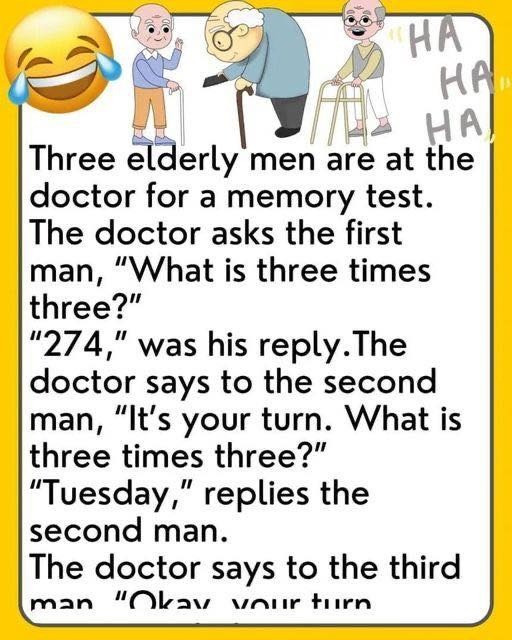
Three Elderly Men Are at the Doctor for a Memory Test
A lighthearted fictional premise can open a useful conversation about memory, healthy aging, cognitive screening, and the importance of treating older adults with respect.
Stories about memory tests have long appeared in jokes, television sketches, and everyday conversations. The familiar setup of several older men visiting a doctor for a memory assessment relies on unexpected answers and wordplay: one person gives an unrelated number, another responds with a day of the week, and a third arrives at the correct answer through an amusingly illogical explanation.
While this type of humor is meant to be playful, it also touches on a real subject that deserves care and context. Memory changes can occur as people grow older, but occasional forgetfulness is not the same as a cognitive disorder. Health professionals evaluate memory concerns using structured methods, medical history, conversations with patients and families, and, when needed, additional testing. A respectful understanding of the topic helps separate harmless humor from inaccurate assumptions about aging.

Why Memory-Test Humor Is So Familiar
The appeal of a memory-test joke often comes from contrast. A simple arithmetic question appears to require a straightforward answer, but the response is surprising and unrelated. The final twist typically gives the impression that the speaker has solved the question, even though the explanation does not follow normal mathematical reasoning.
This comedic structure is common because audiences quickly recognize the expected pattern. A doctor asks a basic question, the listener anticipates a correct answer, and the joke changes direction. The humor depends on misunderstanding, absurdity, and the gap between what a person says and what others expect them to say.
However, jokes that connect memory lapses exclusively with older age can unintentionally reinforce stereotypes. Older adults are a diverse group with different levels of physical health, independence, knowledge, and cognitive ability. Many people remain active in work, family life, volunteering, education, and community leadership well into later life. Aging itself does not erase personality, intelligence, experience, or dignity.
Normal Forgetfulness and Cognitive Health
It is normal for people of many ages to occasionally forget a name, misplace an everyday item, or need a moment to recall a word. Sleep, stress, grief, anxiety, medication effects, illness, and busy routines can all affect concentration and short-term recall. These everyday experiences do not automatically indicate dementia or another serious medical condition.
Clinicians generally become more concerned when memory difficulties are persistent, worsen over time, or interfere with daily activities. Examples may include repeatedly asking the same questions, becoming disoriented in familiar places, struggling to manage tasks that were previously routine, or experiencing notable changes in judgment, communication, or behavior. Even then, memory changes can have many possible causes, some of which may be treatable.
The World Health Organization describes dementia as a syndrome in which cognitive function deteriorates beyond what might be expected from normal aging. It can affect memory, thinking, orientation, comprehension, language, and the ability to carry out everyday activities. Alzheimer’s disease is the most common cause of dementia, but it is not the only cause. Vascular conditions, certain neurological disorders, infections, nutritional deficiencies, medication interactions, depression, and thyroid problems may also contribute to cognitive symptoms.
What Happens During a Memory Assessment
A real medical memory assessment is more comprehensive than a single question such as a multiplication problem. A healthcare professional may begin by asking when the symptoms began, how frequently they occur, whether they have changed, and how they affect everyday life. The clinician may also ask about sleep, mood, medical conditions, alcohol use, medications, recent illness, hearing or vision concerns, and family history.
Brief screening tools may assess areas such as orientation, attention, language, recall, problem-solving, and visual-spatial skills. For example, a clinician might ask a person to remember a short list of words, draw a clock, identify the date, follow a simple instruction, or complete a basic task. These exercises are not intended to embarrass anyone. They offer one part of a broader picture and must be interpreted by qualified professionals in context.
If a screening result suggests further evaluation is appropriate, a doctor may order blood tests, review medications, assess mood, or recommend specialist care. In some cases, brain imaging or formal neuropsychological testing may be considered. A diagnosis should never be based on a joke, a single forgotten detail, or an online quiz.

Why Respectful Language Matters
Humor can be valuable. It may ease tension, strengthen social connection, and make difficult topics feel more approachable. Yet health-related humor works best when it does not reduce people to a diagnosis or portray confusion as a reason to dismiss someone’s humanity. Respectful language recognizes that a person may be living with memory changes while still having meaningful relationships, preferences, abilities, and a full personal history.
Families and caregivers can help by listening carefully when an older relative expresses concern about memory. Rather than immediately correcting, teasing, or assuming the issue is inevitable, it can be helpful to document examples and encourage a conversation with a healthcare professional. Approaching the subject calmly may reduce fear and make it easier for the person to participate in decisions about their care.
Public-health organizations also emphasize the importance of reducing stigma. Fear of judgment can discourage people from seeking advice early. Open, factual conversations about brain health and aging can support timely assessment, practical planning, and access to services.
Supporting Brain Health Throughout Life
There is no guaranteed way to prevent every cause of cognitive decline, and no supplement or single activity can promise protection. Still, research and public-health guidance consistently point to lifestyle factors that support overall health and may benefit brain health as well. These measures are useful across adulthood, not only in later years.
Regular physical activity is associated with benefits for cardiovascular health, mobility, mood, and overall well-being. The Centers for Disease Control and Prevention recommends that adults aim for regular movement suited to their health status and abilities. Walking, cycling, swimming, strength training, chair-based exercises, and balance activities can all be adapted to individual needs.
Managing blood pressure, diabetes, cholesterol, and other cardiovascular risk factors is also important. The brain depends on healthy blood vessels, and conditions affecting circulation can influence cognitive health. People should discuss personal targets and treatment plans with a qualified clinician rather than relying on general advice alone.
Social connection matters, too. Staying connected with friends, family, neighbors, faith communities, clubs, or volunteer organizations can support emotional well-being. Meaningful activities such as reading, learning a skill, playing music, gardening, discussing current events, or participating in group classes may help people remain engaged and motivated.

The Role of Sleep, Hearing, and Mental Well-Being
Memory is closely linked to sleep. During sleep, the brain processes information and supports learning. Persistent sleep problems can affect attention, mood, and recall. Conditions such as sleep apnea may also require medical evaluation, especially when symptoms include loud snoring, pauses in breathing, daytime fatigue, or difficulty concentrating.
Hearing and vision also influence how people perform in conversation and on cognitive assessments. A person who cannot clearly hear a question may appear forgetful or confused when the real issue is untreated hearing loss. Ensuring access to appropriate hearing and vision care can improve communication and quality of life.
Depression, anxiety, bereavement, and isolation can affect concentration and memory. These concerns deserve attention in their own right. Seeking support from a doctor, mental-health professional, trusted community member, or caregiver can be an important step. Emotional well-being and cognitive health are connected, but neither should be oversimplified.
When to Speak With a Healthcare Professional
Anyone worried about their memory—or concerned about a loved one—should consider contacting a healthcare professional, particularly if changes are new, progressive, or affecting daily life. Preparing for the appointment can be useful. Patients and family members may write down specific examples, note when symptoms began, bring a medication list, and mention changes in sleep, mood, appetite, mobility, or general health.
It is also important to seek prompt medical advice for sudden confusion, abrupt changes in speech, weakness, severe headache, or other acute neurological symptoms. Sudden changes are different from gradual age-related concerns and may require urgent assessment.
Early evaluation does not necessarily mean a serious diagnosis. It can identify reversible factors, offer reassurance, connect individuals with support, and help families plan appropriately if further care is needed. The most useful approach is compassionate, evidence-based, and free from assumptions.

Humor, Aging, and a More Balanced Perspective
The fictional memory-test scenario remains recognizable because it is built around a classic comedic formula: a simple question, an unexpected answer, and a final punchline. Read as harmless wordplay, it can offer a brief moment of amusement. At the same time, the underlying theme provides an opportunity to think more carefully about how society talks about aging and memory.
A balanced perspective makes room for humor without treating cognitive changes as trivial or inevitable. It recognizes that older adults should not be defined by a moment of forgetfulness. It also acknowledges that memory concerns can be stressful for individuals and families, and that reliable medical information is more helpful than stereotypes.
As populations age around the world, conversations about cognitive health are becoming increasingly important. Communities, health systems, and families all have a role in promoting accessible care, reducing stigma, supporting caregivers, and encouraging habits that protect overall well-being. A thoughtful response begins with listening, seeking credible information, and treating every person with patience and respect.

Key Takeaways About Memory Tests and Aging
Memory-test jokes are fictional and should not be used to judge someone’s health. Real cognitive assessments involve more than simple arithmetic or word-recall questions and are interpreted alongside medical history and daily functioning. Occasional forgetfulness can happen at any age, while persistent or worsening changes deserve professional attention.
Healthy aging is not one-size-fits-all. Physical activity, social engagement, quality sleep, cardiovascular care, mental-health support, and attention to hearing and vision can all contribute to overall well-being. Most importantly, people experiencing memory concerns deserve understanding rather than embarrassment.

Sources
- World Health Organization: Dementia fact sheet
- Centers for Disease Control and Prevention: Healthy Brain Initiative
- National Institute on Aging: Alzheimer’s Disease and Dementia
- Mayo Clinic: Memory loss and when to seek help
- Alzheimer’s Association: What Is Dementia?

Disclaimer: This content is intended for entertainment purposes only and is not based on real events.