Foods You Should Never Cook in an Air Fryer
Air fryers have become one of the most popular kitchen appliances in recent years, offering a quick way to cook foods with a crisp exterior while using little or no added oil. Their compact size, rapid heating, and convenience have made them useful for preparing everything from frozen foods and roasted vegetables to chicken, fish, and reheated leftovers.
Despite the name, an air fryer does not fry food in the same way as a traditional deep fryer. It is essentially a compact convection oven. A heating element creates hot air, while a powerful fan circulates that air around the food at high speed. The movement of heat can help brown and crisp surfaces, especially when food has a naturally dry exterior or a light coating of oil.
However, an air fryer is not the best appliance for every ingredient or recipe. Some foods can create a mess, cook unevenly, produce disappointing results, or present a safety concern if they come into contact with the appliance’s heating element. Understanding the limits of an air fryer can help households use it efficiently while protecting both food quality and kitchen safety.
How Air Fryers Work and Why Food Choice Matters
Most air fryers work by circulating very hot air in a relatively small chamber. This can cook small portions quickly and can reduce preheating time compared with a conventional oven. Yet the same design also means that lightweight foods, loose ingredients, wet coatings, and oversized dishes may not behave as expected.
The basket or tray in many models has openings that allow air to move underneath the food. That airflow is important for crisping, but it can also cause small pieces to blow around inside the unit. Manufacturers commonly advise users to follow their model’s instructions, avoid overfilling the basket, and ensure food cannot touch the heating element.
For best results, air fryers tend to suit foods that cook quickly in a single layer: potato wedges, small cuts of chicken, firm vegetables, breaded frozen products, and leftovers that need reheating. By contrast, recipes involving liquid batter, large quantities, delicate ingredients, or foods that need to simmer often require another cooking method.
Popcorn Can Be Unsafe in an Air Fryer
Popcorn kernels are among the foods most frequently discouraged for air fryer use. Unlike purpose-built popcorn makers, microwave popcorn products, or stovetop pans, an air fryer is not designed to contain kernels as they heat and pop. The kernels can move through the basket, become lodged in openings, or potentially reach areas close to the heating element.
Several appliance safety guides warn against putting loose popcorn kernels in air fryers because they may not reach the consistent temperature needed to pop reliably. More importantly, loose kernels can be blown around by the fan. If a kernel comes into contact with the heating system, it may burn or create smoke. As with any countertop appliance, smoke or an unusual smell should be treated seriously: switch off and unplug the appliance if it is safe to do so, then consult the manufacturer’s safety instructions.
For popcorn, a microwave-safe popcorn bowl, a dedicated hot-air popper, or a covered pan on the hob is generally more appropriate. These methods are designed to keep kernels contained while allowing them to heat evenly.
Why Wet Batter Does Not Work Well
Wet batter is another poor match for most air fryers. Traditional battered foods, such as tempura or some styles of fried chicken and fish, are usually cooked by being submerged in hot oil. The oil rapidly sets the batter, creating a crisp shell that protects the food inside.
In an air fryer, wet batter has no hot oil to seal it immediately. Instead, the batter can drip through the basket openings before it has a chance to firm up. This can leave food with an uneven coating and create residue that is difficult to clean. The result may be soggy rather than crisp, while drips can smoke if they fall onto hot surfaces below.
A better air fryer alternative is a dry breading. Cooks can use flour, beaten egg, and breadcrumbs, panko, crushed cereal, or another dry coating. A light spray or brushing of oil may encourage browning, although the exact results depend on the recipe and appliance. Frozen breaded foods also generally perform well because their coating is already set.
Very Lightweight Foods May Blow Around
Air fryers generate strong circulation, which can be a problem for very light ingredients. Loose leafy greens, herbs, thin tortilla pieces, and small pieces of bread can move around the cooking chamber. If they are not weighed down securely, they may cook unevenly or rise toward the heating element.
Leafy vegetables can still be used carefully for recipes such as kale chips, but they should be prepared in small batches and checked frequently. Some models include racks or accessories that can help hold lightweight food in place. It is important to use only accessories approved by the air fryer manufacturer, as unsuitable materials or oversized inserts could interfere with airflow or touch hot components.
Cooking instructions should also be adapted to the food. Delicate ingredients often need lower temperatures and shorter cooking times than heartier vegetables or frozen foods. Shaking a basket can be useful for fries or chopped vegetables, but it may damage fragile ingredients.
Large Roasts and Overcrowded Baskets Can Cook Unevenly
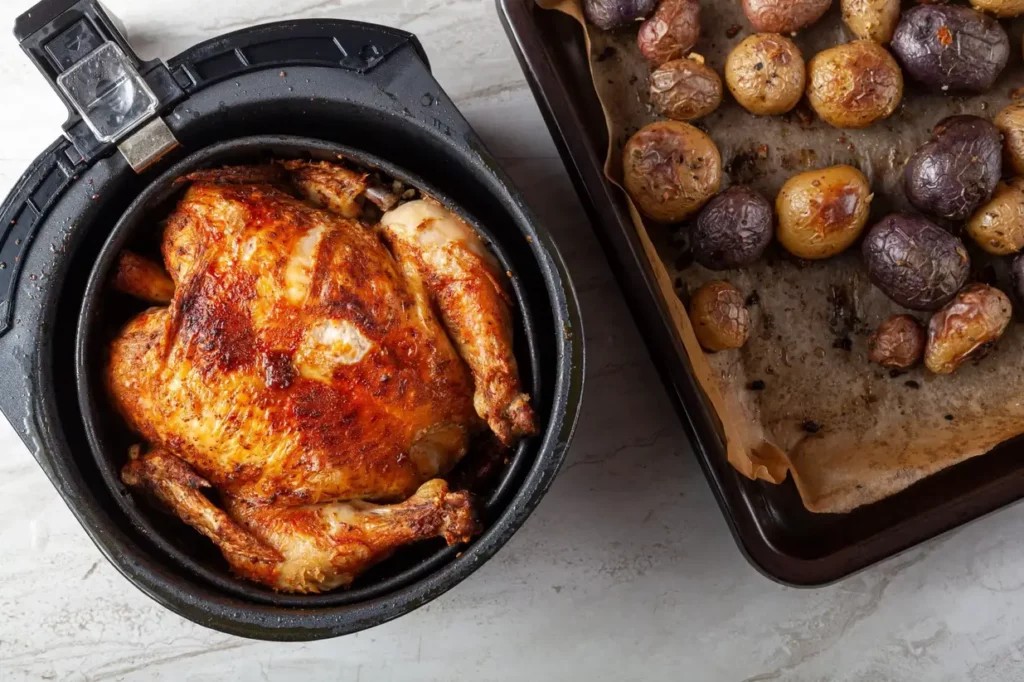
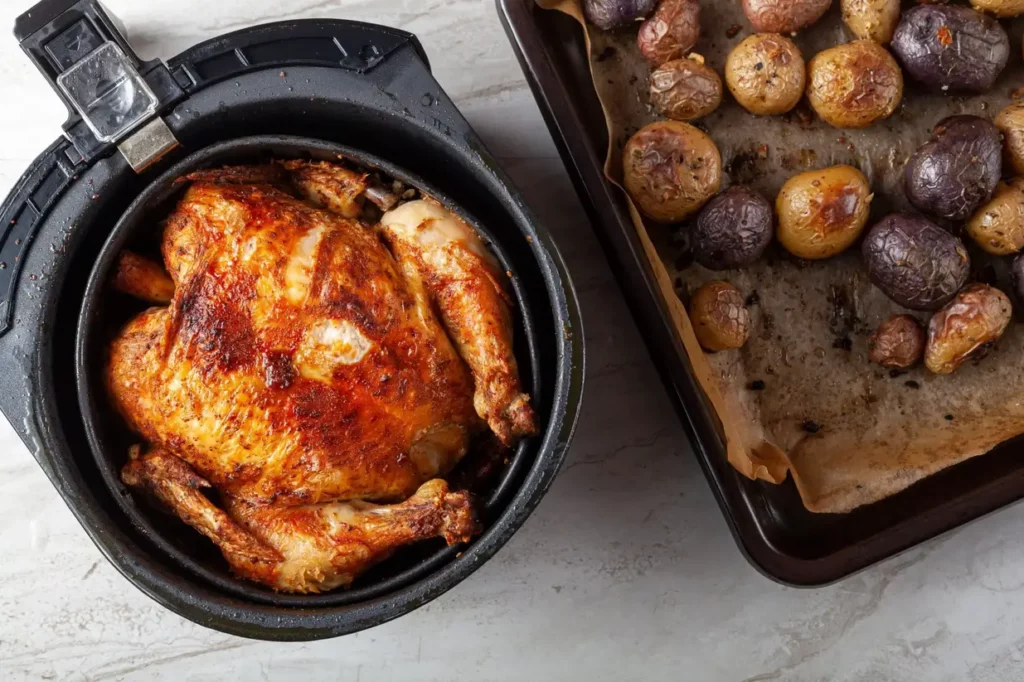
An air fryer’s small capacity is one of its greatest advantages for speed, but it can be limiting when cooking for a family or preparing a large meal. Large roasts, whole poultry, or bulky casseroles may not fit safely in many units. Even when they do fit, restricted airflow can result in uneven cooking.
Food safety matters especially when cooking meat and poultry. The United States Department of Agriculture advises using a food thermometer to confirm that foods have reached a safe internal temperature. Poultry should reach 165°F (74°C), while other meats have different recommended temperatures depending on the type of meat and whether it is ground or whole.
Overcrowding the basket can slow cooking and reduce browning because hot air cannot circulate freely around each piece. It may be tempting to fill the basket to save time, but cooking in a single layer or in smaller batches generally produces more reliable results. For a large family meal, a conventional oven, hob, or multi-burner cooking setup may be more practical.
When an Oven May Be More Energy Efficient
Air fryers are often promoted as an economical alternative to a standard oven. In many situations, that can be true. A small appliance usually heats a smaller volume of air, and it can be efficient when cooking a modest portion of food quickly. The potential savings depend on the appliance’s wattage, cooking time, electricity prices, and the amount of food being prepared.
Consumer experts, including researchers at Which?, have noted that the calculation changes when food must be prepared in multiple batches. If an air fryer needs to run repeatedly to cook a full dinner, its convenience and energy advantage can decline. A larger oven may be the more sensible option when preparing several dishes at once, baking for a group, or cooking food that requires more space.
Personal finance commentator Martin Lewis has similarly highlighted the importance of matching the appliance to the task. Small, fast-cooking items can suit an air fryer well, while cooking many separate batches can take more time and may not offer the savings people expect. His broader point is practical: the cheapest method is not always the same for every meal.

Microwaves, Hobs, and Ovens Still Have Important Roles
A microwave can be the most efficient option for foods that need rapid heating rather than crisping. Baked potatoes, steamed vegetables, soups, and leftovers can often be heated much faster in a microwave than in an oven. A potato can be started in the microwave and finished briefly in an air fryer if a crisp skin is desired.
Traditional ovens remain valuable for baking, large trays of food, casseroles, pizzas, and meals that need to cook simultaneously. They also provide more room for dishes that need stable, even heat over a longer time. Hobs are still the appropriate choice for boiling pasta, making sauces, simmering soups, and cooking foods that require stirring.
Rather than replacing every appliance, an air fryer is best viewed as one useful tool in a broader kitchen. Choosing the right method can improve flavour, reduce waste, save time, and help ensure food is cooked safely.
Foods That Require Extra Care
Some foods are not necessarily forbidden in an air fryer, but they need close attention. Cheese can melt through basket openings unless it is contained in a suitable oven-safe dish. Foods with sauces may dry out or create splatters. Fresh vegetables with high water content may steam rather than brown unless they are dried and spaced apart.
Raw grains, rice, pasta, and dried beans also require liquid to soften properly, so they are generally unsuitable for a standard basket-style air fryer. These foods are better prepared in a saucepan, rice cooker, pressure cooker, or another appliance designed for boiling or steaming.
It is also wise to avoid putting loose parchment paper into a preheated air fryer without food on top of it. The circulating air can lift the paper toward the heating element. If parchment liners are used, they should be designed for air fryers, properly weighted by food, and used according to the manufacturer’s instructions.
Safe and Practical Air Fryer Tips
To get the most from an air fryer, read the manual for the specific model and follow its guidance on capacity, temperature, accessories, and cleaning. Place the appliance on a stable, heat-resistant surface with adequate space around vents. Keep it away from walls, cabinets, towels, and other items that could obstruct airflow.
Clean the basket, tray, and interior regularly to prevent a buildup of grease and food particles. Never use metal utensils that could damage a non-stick basket coating, and do not immerse electrical components in water. If a fire occurs, do not use water on an electrical appliance; switch off power if it is safe and follow local fire safety advice.
Above all, use the appliance for foods it is designed to handle. Air fryers can provide convenient, satisfying meals, but they are not a universal substitute for ovens, microwaves, saucepans, or deep fryers. Knowing when to use each method is the key to better results and safer cooking.
Conclusion: Use an Air Fryer for the Right Job
Air fryers can be a practical choice for small portions, quick meals, and foods that benefit from dry circulating heat. They can help people use less oil than traditional deep frying and may reduce cooking time for suitable dishes. Still, loose popcorn kernels, wet batter, excessively lightweight foods, overcrowded baskets, and large meals can lead to poor results or avoidable safety issues.
The most effective kitchen routine is not about relying on one appliance for every meal. It is about selecting the right tool for the recipe, the number of people being served, and the desired result. Used thoughtfully and according to manufacturer instructions, an air fryer can remain a useful part of everyday cooking.

Sources
Disclaimer: This content is intended for entertainment purposes only and is not based on real events.