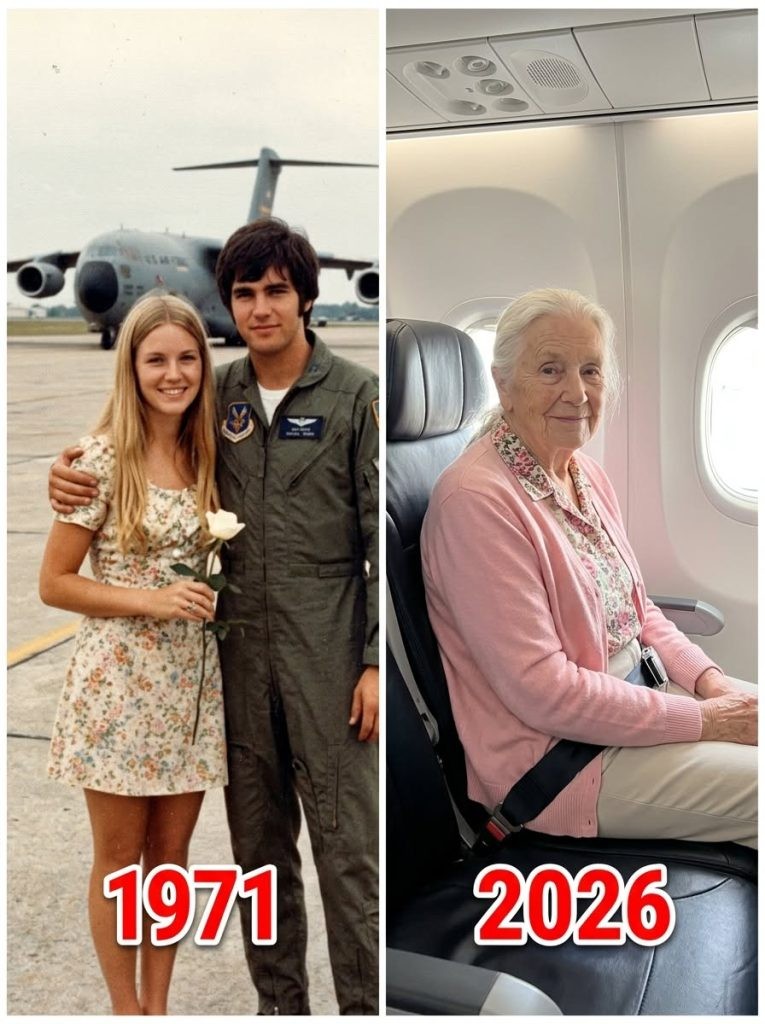
I Waited 55 Years for My College Sweetheart to Return From the Vietnam War—Then His Grandson Found Me at the Airport
I was twenty-one years old when the man I planned to marry disappeared during the Vietnam War. For more than half a century, I lived with the belief that he might never come home. I never married, never completely let go of our memories, and every year on his birthday, I placed a white rose at a memorial for missing servicemen.
I was seventy-six when a stranger approached me at the airport, holding an old photograph of two college students standing together beneath an oak tree.
One of them was me.
The other was Thomas, the young man I had loved more than anyone in the world.
The stranger looked at me with nervous eyes and said five words that would change everything I thought I knew about my life.
“My grandfather asked me to find you.”
I stared at him, confused.
“His name is Thomas,” he continued. “And he’s alive.”
For a moment, the airport seemed to disappear around me. I could hear the announcements overhead and the rolling suitcases passing behind us, but his words made no sense.
Thomas was supposed to be dead.
Or at least, that was what I had believed for fifty-five years.
The Young Man Who Promised to Come Home
Thomas and I met during our second year of college. He was an engineering student with untidy brown hair, a crooked smile, and an irritating habit of correcting my arithmetic whenever I tried to split a restaurant bill.
I studied English literature and believed that the world could be understood through stories. Thomas believed almost everything could be explained with numbers, diagrams, and a sufficiently detailed blueprint.
We disagreed about nearly everything, which was probably why we enjoyed each other’s company so much.
He called me his favorite impossible puzzle. I told him engineers made terrible boyfriends because they always wanted to fix things that weren’t broken.
He would laugh, reach across the table, and steal a sip of my coffee.
We were young enough to believe that love could overcome almost anything. We planned to marry after graduation, find a small house, and fill it with books, plants, and the sort of ordinary happiness neither of us had experienced enough to appreciate.
Then Thomas received his deployment orders.
I still remember the afternoon he told me. We sat on a bench outside the engineering building, watching students cross the courtyard with their books tucked beneath their arms. Thomas held my hand so tightly that my fingers began to ache.
“I’ll come back,” he said.
“You’d better,” I replied, trying to sound playful.
He smiled, but there was fear behind it.
“When I get home, I’ll buy you a proper engagement ring. Something beautiful. No more borrowing my mother’s old ring for photographs.”
I laughed and leaned against his shoulder.
“You don’t have to buy me anything expensive.”
“I know,” he said. “But I want to.”
That was the last promise he ever made to me in person.
Six months later, military officers arrived at my parents’ house.
They told us that Thomas’s aircraft had disappeared during a mission over Vietnam. No body had been recovered. There was no definitive explanation for what had happened.
His status was listed as missing in action.
I remember asking the officer whether there was any possibility Thomas had survived.
He gave me the answer people give when they have nothing certain to offer.
There was always a possibility.
And so I waited.
Fifty-Five Years of Living With an Unanswered Question
At first, I believed Thomas would return within weeks.
Then I thought it might take months.
Eventually, I began counting the years.
I checked the mail obsessively. Whenever the telephone rang unexpectedly, my heart raced. Every unfamiliar voice sounded, for a fraction of a second, like the beginning of the news I had been waiting to hear.
But no news came.
Life continued around me, even when I felt as though mine had stopped.
I finished college and became an English teacher. I discovered that I loved helping young people find their voices, especially those who believed they had nothing worth saying.
My students grew up, graduated, married, and brought their own children to visit me. I watched generations of young people begin their lives while I carried the same old photograph in my purse.
People occasionally asked whether I had ever considered marrying.
A kind colleague once introduced me to her widowed brother. He was thoughtful, funny, and perfectly decent. We went to dinner twice.
On the second evening, he asked whether I was still in love with someone.
I looked down at my hands.
“I think part of me always will be,” I admitted.
He nodded. He didn’t ask for an explanation, and I was grateful to him for that.
I never married.
It wasn’t because I believed I had to remain faithful to a dead man. It was because I could never quite imagine building the future I had once planned with Thomas beside anyone else.
I built a good life anyway. I traveled with friends, read thousands of books, attended school reunions, and learned to enjoy my own company. I had a small apartment filled with plants and photographs, and I became the sort of woman who could spend an entire Sunday reading without feeling lonely.
But every year, on Thomas’s birthday, I visited a memorial honoring American service members whose remains had never been recovered.
I brought a single white rose.
I also brought our college photograph.
I would stand quietly for a few minutes, then tell him about the year that had passed. I told him about my students, the books I had loved, the friends I had lost, and the small joys that had kept me going.
Sometimes I cried.
Sometimes I laughed at something ridiculous he would have appreciated.
And every year, before leaving, I asked the same question.
“Thomas, where are you?”
I never expected an answer.
The Stranger at the Airport
The morning I met Daniel, I was returning from visiting my younger sister. I had spent several days with her, helping sort through old family photographs and arguing about whether either of us should finally get rid of our collection of outdated kitchen appliances.
I was tired and looking forward to going home.
I had just collected my suitcase when a young man approached me.
“Excuse me,” he said. “Are you Eleanor?”
I nodded cautiously.
He pulled a photograph from the inside pocket of his jacket.
It was the picture Thomas and I had taken during our final year of college. I wore a pale dress and had my head tilted toward him. Thomas stood beside me, smiling as though he had just told a joke.
My hands began to tremble.
“Where did you get that?”
“My grandfather gave it to me,” the young man replied. “He asked me to find you.”
I looked at him more carefully. He was perhaps in his late twenties, with dark hair and a serious expression.
“What is your grandfather’s name?”
“Thomas.”
I felt the blood drain from my face.
“No,” I whispered.
“His full name is Thomas Whitaker,” Daniel said. “He served in Vietnam. His aircraft disappeared in 1968.”
I gripped the handle of my suitcase.
“That’s impossible.”
Daniel’s eyes filled with emotion.
“My grandfather survived. He was captured, and he eventually came home. He has been alive all these years.”
I wanted to demand an explanation, but I couldn’t find the words.
“How long?” I finally asked.
Daniel lowered his gaze.
“He returned in 1973.”
Fifty-five years of birthdays, unanswered questions, white roses, and quiet conversations with a memorial suddenly collapsed into a single unbearable truth.
Thomas had come home.
He had been alive while I waited.
And somehow, he had never found his way back to me.
The Life Thomas Built Without Me
Daniel offered to drive me to his grandfather’s house.
I should have refused. I should have asked for time to think, called my sister, or gone home and allowed myself to absorb what I had just learned.
Instead, I followed him.
Perhaps I needed to see Thomas with my own eyes. Perhaps some foolish part of me still believed there had to be an explanation that would make the years of silence less painful.
During the drive, Daniel told me what he knew.
His grandfather had survived the crash and spent time as a prisoner of war. After returning home in 1973, Thomas struggled with his physical injuries and the psychological effects of his experiences.
During his recovery, he met a nurse named Margaret.
She helped him through a difficult period, and eventually, they fell in love.
They married.
They had two children.
Thomas built a career, raised a family, grew older, and watched his children have children of their own.
He became a grandfather.
He attended birthdays and school events. He sat beside his wife during ordinary evenings and watched the seasons change outside their windows.
He had lived an entire lifetime.
And throughout those years, I had been visiting a memorial, believing that the man I loved had vanished forever.
I turned toward the car window.
“Did he ever talk about me?”
Daniel hesitated.
“Yes,” he said. “But not as much as you might expect.”
I waited.
“He told my father that he had loved someone before the war. He said he had lost touch with her and that she had eventually moved on.”
My stomach tightened.
“Moved on?”
Daniel nodded reluctantly.
“He told his parents that you knew he had survived and that you had asked him not to contact you.”
For several seconds, I couldn’t speak.
Thomas had not merely remained silent.
He had rewritten our history.
He had taken the truth—that he had chosen not to return to me—and replaced it with a story in which I had rejected him.
His parents had believed him. They had never contacted me because they thought I wanted nothing more to do with their son.
I wondered how many times his mother had thought about me. Whether she had ever looked at an old photograph and questioned what Thomas had told her.
I would never know.
The Moment I Saw Him Again
Thomas lived in a quiet house with a small garden and a wide window overlooking the backyard.
Daniel led me inside.
The rooms were filled with ordinary evidence of a long life: framed family photographs, books, a clock on the mantel, and a collection of children’s drawings preserved behind glass.
I noticed a photograph of Thomas with Margaret on their wedding day.
He looked older than I remembered, of course, but the smile was unmistakable.
Then I saw him.
Thomas sat beside the window in a comfortable chair. His white hair had grown thin, his shoulders were narrow, and his hands trembled slightly as he reached for the blanket across his knees.
He turned toward the sound of our footsteps.
For a moment, neither of us moved.
Then he said my name.
“Eleanor.”
His voice was frail, but I recognized it immediately.
And his eyes—
Those were the eyes of the young man who had once stolen my coffee, teased me about poetry, and promised to buy me an engagement ring.
I had imagined this moment thousands of times. In some versions, I ran toward him. In others, I struck his chest with my fists and demanded to know why he had taken so long.
Sometimes, in my private fantasies, he explained everything, and I forgave him before he had even finished speaking.
Reality was nothing like those imaginings.
I remained standing near the doorway.
Thomas reached out a trembling hand.
“Eleanor,” he whispered again. “I never thought I would see you.”
I looked at the man who had occupied a corner of my heart for fifty-five years.
“You’ve been home for more than fifty years,” I said. “Why did you let me believe you were dead?”
He closed his eyes.
For a moment, I thought he might deny it. Perhaps he would offer some complicated explanation involving the war, his injuries, or the circumstances of his return.
Instead, he began to cry.
The Truth He Had Avoided for Decades
“I was ashamed,” Thomas said.
I waited.
“When I came home, I wasn’t the same person who left. I had been through things I couldn’t explain. I didn’t know how to return to my old life.”
He told me about the hospital, the recovery, and the people who had helped him rebuild his strength.
Then he told me about Margaret.
“She was kind to me,” he said. “She understood that I was struggling. I started looking forward to seeing her. Before I knew it, I had fallen in love with her.”
I glanced at the wedding photograph on the mantel.
“Then what happened?”
Thomas stared at his hands.
“I thought about contacting you. Many times. I wrote letters I never sent. I told myself I would reach out when I could explain everything properly.”
“And when was that supposed to be?”
He flinched.
“I don’t know.”
“You had years, Thomas. Decades.”
“I know.”
“You knew I was waiting.”
His silence answered me.
He explained that once he had married Margaret, the truth became more difficult to confront. He feared hurting her, disrupting his family, and facing the consequences of what he had done.
Each year that passed made the first letter harder to write.
So he delayed.
He convinced himself that I had recovered from losing him, that I had found someone else, and that contacting me would only reopen an old wound.
Then, to protect his silence, he told his parents that I had asked him to stay away.
I listened until he had nothing more to say.
There was no dramatic revelation left to soften the truth. Thomas had survived the war, but when faced with the difficult work of explaining his choices to the woman he had once promised to marry, he had chosen avoidance.
And every year he spent avoiding me became another year I spent mourning him.
“I am sorry,” he whispered.
I believed that he was sorry.
But I also understood something I had never fully considered during all those years of waiting: regret does not return the time someone has taken from you.
His Family Discovered the Secret
Daniel told me that the truth had emerged only recently, after his grandfather’s health began to decline.
Thomas had asked him to help locate me. He had kept the old photograph and some of the letters he had written but never sent.
When Daniel’s father learned what had happened, he was horrified.
His entire understanding of his father’s past had been built around a lie.
The family had believed that Thomas’s college sweetheart had known he was alive and had chosen to move on. Now they discovered that she had spent decades believing he had died.
Daniel said his father confronted Thomas and demanded to know why he had never told the truth.
Thomas had no convincing answer.
He could explain his fear, his shame, and the difficult circumstances of his return. But he could not make those things erase the choices he had made.
Now, with his health failing, he wanted to see me before it was too late.
“He wants to apologize properly,” Daniel told me. “He wants to make peace with you.”
I looked toward Thomas.
He was watching me with the helpless expression of someone who had finally reached the end of his excuses.
“Please,” he said. “I know I don’t deserve it. But I need you to understand that I never forgot you.”
For one brief moment, I remembered the boy on the college bench.
I remembered his crooked smile, his teasing voice, and the way he used to take my hand when he thought I was worried.
I remembered the life we had planned.
Then I remembered the birthdays I had spent alone, the questions that had never been answered, and the years I could never recover.
Both memories were true.
But only one described the man standing before me now.
“I Can Forgive You Without Pretending Nothing Happened”
Thomas reached for my hand again.
This time, I let him hold it for a moment.
His skin was thin and cool. His fingers trembled against mine.
“I loved you,” I said quietly. “I loved you for a very long time.”
Tears slipped down his face.
“But you let me mourn you while you lived your life. You let me believe there was no answer, when you had one all along.”
“I know.”
“No, Thomas. I don’t think you do.”
I took a breath.
“I spent years wondering whether you had suffered, whether you had been afraid, whether you had thought about coming home. I made room for you in my life because I believed you had never been given the chance to return.”
I looked toward the family photographs.
“You were given that chance. You came home. You built a life. And you let me keep waiting.”
Thomas lowered his head.
“I was a coward,” he whispered.
I could have told him that I hated him. I could have demanded that he explain every birthday, every missed opportunity, and every year in which his silence had shaped my decisions.
But I was seventy-six years old.
I had spent enough of my life trying to understand an absence.
I did not want to spend whatever time remained to me punishing myself by holding on to anger.
So I squeezed his hand once before letting go.
“I can forgive the past,” I told him. “But forgiveness doesn’t mean pretending it didn’t happen.”
He looked at me with desperate hope.
“Will you come back?”
I stood slowly.
“I don’t know.”
It was the only honest answer I could give him.
I did not promise another visit. I did not tell him that everything was all right. And I did not pretend that the love I had carried for so many years could simply be restored because he had finally told the truth.
Then I walked toward the door.
Thomas called my name one last time.
I paused, but I did not turn around.
“Goodbye, Thomas,” I said.
And for the first time in fifty-five years, I left without wondering when he would come home.
The White Rose I Finally Kept
That afternoon, I went to the memorial.
The sky was pale, and a cool breeze moved through the trees. I had visited the place so many times that I could have found my way there with my eyes closed.
As always, I carried a white rose.
But this time, I did not bring the old photograph.
It remained inside my purse.
I stood before the memorial and placed the rose at its base. I looked at the names and inscriptions, thinking about all the people whose stories had ended without clear answers.
For years, I had come here to remember Thomas as a man who never returned.
Now I knew the truth.
He had returned, but he had not returned to me.
That distinction hurt more than I could explain. Yet beneath the pain, I felt something unfamiliar.
Relief.
I no longer had to wonder whether Thomas was alive. I no longer had to imagine the moment he might walk through a doorway, carrying the years between us like a burden he was ready to put down.
The waiting was over.
I took the photograph from my purse and studied it one final time.
Two young people stared back at me. They were full of plans, certain that life would unfold according to the promises they made each other.
I felt tenderness for that young woman.
She had loved honestly. She had hoped faithfully. She had done the best she could with the information she had been given.
She had nothing to be ashamed of.
I slipped the photograph back into my purse.
For the first time, I did not feel that I was abandoning Thomas by taking it with me.
The photograph belonged to my life. It was part of my story, but it did not have to dictate the rest of it.
I could remember the good years without waiting for them to return.
I could acknowledge the love without excusing the betrayal.
And I could forgive him without giving him the power to decide how my story ended.
At Seventy-Six, I Finally Chose Myself
When I returned home, my sister called to ask how the trip had gone.
I sat by the window for a while before answering.
Then I told her everything.
She listened without interrupting. When I finished, she was quiet for a moment.
“What are you going to do now?” she asked.
It was a simple question, but I realized I had not thought about it in years.
For so long, my life had contained an invisible question: What if Thomas comes back?
Every possibility seemed to leave room for that question. Every birthday, every visit to the memorial, every old photograph had kept a small part of me tied to an unfinished story.
Now the question was gone.
I looked out at the trees beyond my window.
“I want to see the ocean,” I said.
My sister laughed softly.
“The ocean?”
“Yes. I want to take a train somewhere along the coast. I want to walk on the beach in the morning, eat fish and chips from a paper wrapper, and stay somewhere with a balcony.”
“You’ve wanted to do that for years.”
“I know.”
“Then why haven’t you?”
I smiled.
For once, I didn’t have a complicated answer.
“I think I was waiting for something.”
She understood.
A few days later, we began looking at places to visit. We talked about train schedules, small seaside hotels, and the possibility of spending an entire afternoon doing absolutely nothing.
It felt wonderfully ordinary.
And perhaps that was the point.
At seventy-six, I did not need a dramatic new beginning. I did not need to fall in love again or prove that the years had not changed me.
I only needed to understand that my life still belonged to me.
Thomas would always be part of my history. I would remember the young man I loved, the promises we made, and the future we never shared.
But I would also remember the truth.
Love can remain meaningful even when the person you loved disappoints you. Forgiveness can release you from bitterness without restoring trust. And remembering someone does not mean you owe them the rest of your life.
I had waited long enough.
The ocean was waiting, too.
And this time, I was going somewhere because I wanted to—not because I hoped someone might finally come home.
Note: This story is presented as a personal narrative. Its events have not been independently verified.