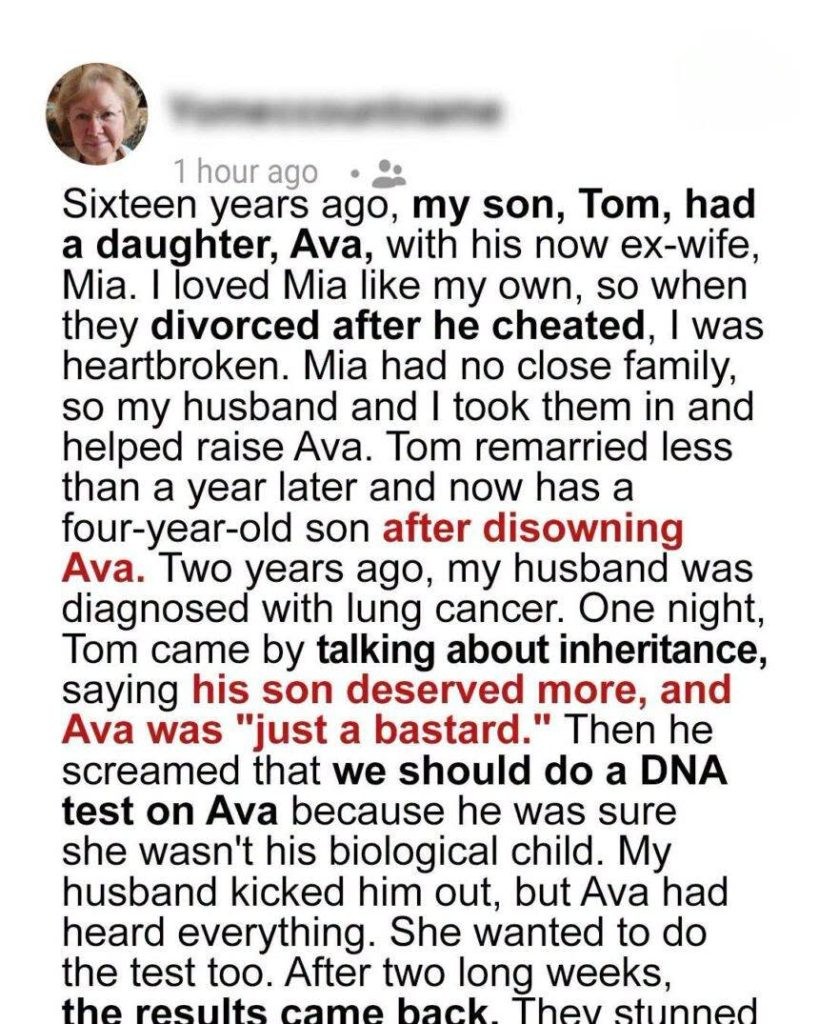
When Tom walked away from his wife, Mia, and their newborn daughter, Ava, he left behind more than a broken marriage. He left a little girl who would grow up without the presence of the father who had once been expected to protect and care for her.
Fortunately, Ava was not left alone.
Her grandparents, Gary and his wife, welcomed Mia and the baby into their home. They offered them stability, affection, and the reassurance that they would not have to face the difficult years ahead without support.
As Ava grew, her grandparents became the people she turned to for comfort, encouragement, and guidance. They celebrated her achievements, helped her through disappointments, and made sure she knew she was loved.
For years, they kept the full story of her father’s departure from her. They believed that withholding the truth would protect her from a painful rejection she was too young to understand.
But time has a way of bringing difficult truths to the surface.
As Ava approached college age, she was becoming a determined young woman with plans for her future. At the same time, Gary was facing terminal cancer, and every remaining day together had become precious.
The family was already dealing with the possibility of losing someone they loved. None of them expected that another painful confrontation would soon test the bonds that had held them together for so long.
The Son Who Returned When Money Was at Stake
Tom’s sudden return might have offered an opportunity for reconciliation. After years away, he could have come to acknowledge the harm caused by his departure, learn about the daughter he had missed raising, and attempt to rebuild a relationship.
Instead, according to the story, his attention was focused on Gary’s will.
Tom wanted more money from his father’s estate. When Gary and his wife explained that Ava would also receive a share, the conversation quickly became hostile.
The disagreement revealed a deeper problem. Ava had been raised as part of the family, and Gary wanted to recognize her place in it. Tom, however, appeared unwilling to accept that decision.
Then he made a cruel declaration.
“She isn’t even my daughter,” he snapped.
The words hung in the air, turning an argument about inheritance into a direct attack on Ava’s identity.
For years, she had been protected from the full details of her father’s departure. Now she was hearing him question whether she belonged to him at all.
The accusation was especially painful because it came from the very person whose absence had shaped so much of her childhood.
Yet Ava did not respond by shouting or pleading for acceptance.
She stepped forward and offered a simple answer.
“Then let’s do the test.”
Ava Demanded the Truth
Ava’s response changed the direction of the confrontation.
Rather than allowing Tom’s accusation to remain an unresolved question, she proposed a DNA test. If he genuinely believed he was not her biological father, the test could provide evidence.
The decision required courage. The results might confirm what she already knew, but they would not erase the years of absence or guarantee that Tom would finally show remorse.
Still, Ava was prepared to face the truth.
Two weeks later, the results arrived. According to the story, the DNA test indicated a 99.9999% probability that Tom was Ava’s biological father.
The finding contradicted his claim.
Tom reportedly went pale, unable to find an explanation that could defend his accusation. The evidence established the biological relationship he had attempted to deny.
But for Ava, the most important part of the moment was not the number printed on the report.
It was the realization that she no longer needed to spend her life wondering whether she had somehow deserved her father’s rejection.
The Words That Finally Set Her Free
Ava could have used the results to humiliate Tom in return. She could have shouted at him, demanded an apology, or reminded him of every year he had missed.
Instead, she remained calm.
“You didn’t disappear because you doubted me,” she told him. “You left because it was easier. And I’ve stopped needing anything from you.”
Her words were not a declaration that the past no longer hurt. Years of absence cannot be undone by a single conversation, and discovering the truth does not automatically resolve every emotion connected to it.
Rather, Ava was drawing a boundary.
She could acknowledge that Tom was her biological father without allowing his choices to determine her sense of worth. She could recognize the pain of his abandonment without spending the rest of her life trying to persuade him to become someone he had never chosen to be.
That distinction matters.
Children who experience parental rejection may struggle with questions about their value, belonging, or responsibility for what happened. But a parent’s decision to leave is not proof that a child is unworthy of love.
Ava’s strength lay in understanding that she could not rewrite Tom’s past behavior. She could, however, decide how much power that behavior would hold over her future.
For the first time, the truth was no longer something she needed to fear.
Gary’s Love Had Already Given Ava What She Needed
While Tom struggled to respond, Gary watched the confrontation unfold.
He was battling terminal cancer, and the family knew that their time together was limited. His illness had made ordinary moments more meaningful, from conversations at home to quiet evenings spent in one another’s company.
Seeing Ava stand up for herself brought a mixture of pride and sadness.
Gary had helped raise her, offering the kind of steady affection that her biological father had failed to provide. He had watched her grow from a newborn into a young woman preparing to begin the next chapter of her life.
Now he could see that the love given to her had become part of her strength.
That evening, he pulled Ava close, tears filling his eyes.
“You’re the bravest person I know,” he whispered.
Ava rested her head against his shoulder.
“I just wanted to make you proud.”
Gary kissed her forehead and answered, “You always have been, sweetheart. Always.”
Their exchange carried a meaning that no DNA report could capture. Tom’s biological connection to Ava was a matter of genetics. Gary’s connection to her had been built through years of care, sacrifice, encouragement, and presence.
He had been there for the ordinary days, the difficult moments, and the milestones that made up her childhood.
And as he faced the end of his life, he wanted Ava to understand that she had never needed to earn his love by proving herself to anyone.
She already had it.
What Makes Someone a Parent?
Ava’s story raises a question that many families understand in different ways: Is parenthood defined by biology, or by the choices a person makes over time?
Biology can establish a genetic relationship. It may answer important questions about ancestry, identity, and certain medical risks. But it cannot, by itself, describe the quality of a family relationship.
Parenting involves responsibilities that continue long after a child’s birth. It can mean providing safety, meeting everyday needs, offering emotional support, and remaining dependable when life becomes difficult.
Gary and his wife took on those responsibilities when Ava needed them. They gave her a home and helped her develop the confidence to pursue her future.
Tom, by contrast, had a biological relationship with Ava but had chosen to remain absent for much of her life.
That does not mean every estranged family relationship is beyond repair. People can change, acknowledge past mistakes, and make sincere efforts to reconnect. Rebuilding trust, however, requires more than appearing unexpectedly or insisting that a relationship should be restored.
It requires honesty, accountability, patience, and respect for the other person’s boundaries.
Ava was under no obligation to offer immediate forgiveness simply because the DNA results confirmed Tom’s paternity. Nor did she have to reject the people who had raised her in order to acknowledge the biological truth.
Her family history could contain both facts at once: Tom was her biological father, and Gary was the grandfather who had helped give her the security she needed to grow.
The Painful Question of Inheritance
Tom’s return also exposed how grief and money can complicate family relationships.
When a loved one is seriously ill, discussions about wills and estates can become emotionally charged. Questions about fairness, responsibility, and who should receive an inheritance may bring longstanding tensions to the surface.
In this story, Tom’s focus on the estate appeared to intensify the conflict when he learned that Ava would receive a share.
However, an inheritance is not a simple measure of who deserves love or belongs in a family. The legal distribution of an estate depends on the will, applicable law, and the circumstances of the estate. A person’s biological relationship to the deceased does not necessarily settle every question about entitlement.
For families facing similar disputes, it is important to separate emotional disagreements from legal decisions. A qualified estate lawyer can explain the relevant rules and help ensure that a will is handled appropriately.
More importantly, financial disagreements should not become a reason to undermine a young person’s identity or turn a family conflict into a contest over affection.
Gary’s decision to include Ava in his plans reflected the relationship they had built. Whatever legal arrangements ultimately applied, Tom’s anger could not erase the years of love Ava had received from her grandparents.
Protecting Children From Difficult Family Truths
Gary and his wife had kept Tom’s abandonment from Ava for years because they wanted to protect her. Their intention was understandable, but the story also illustrates how difficult it can be to decide when and how to share painful family information.
Adults may fear that telling a child about rejection, separation, or conflict will damage the child’s sense of security. Yet discovering a major family secret unexpectedly can create its own distress.
Age-appropriate honesty can help children understand their history without forcing them to carry adult responsibilities. In sensitive situations, family counselors may help caregivers choose language that is truthful while remaining supportive.
Children should not be made to feel responsible for a parent’s decisions. They also should not be pressured to forgive an absent parent or maintain contact when doing so feels unsafe or emotionally harmful.
Every family is different, and there is no single conversation that resolves every complicated history. What matters is creating an environment in which questions can be asked, feelings can be expressed, and the child knows that the adults caring for them will not withdraw their love because of the truth.
Ava’s experience suggests that the most important protection was never the permanent concealment of her father’s behavior. It was the dependable love that allowed her to face the truth without facing it alone.
A Future That Belongs to Ava
As the confrontation ended, Tom was left outside the family relationships he had neglected for years.
Ava, meanwhile, had college ahead of her and a future that did not need to revolve around convincing him to accept her.
Her story was not suddenly free of sadness. Gary’s illness remained, and the years without her father could not be returned. The DNA results did not restore the birthdays, conversations, or milestones Tom had missed.
But Ava had reached a different understanding of herself.
She was not defined by the person who left. She was shaped by the people who stayed, the challenges she had survived, and the choices she would make for herself.
The love she had received from Gary and her grandmother was not a substitute that made her biological history irrelevant. It was an enduring part of her life that no accusation could take away.
And as Gary held her close that evening, Ava had a reminder of what mattered most: she had already made him proud.
Conclusion: Family Is Built Through Love, Not Just Biology
Ava’s confrontation with Tom began with an accusation about her identity and ended with a clearer understanding of where she belonged.
The DNA test established a biological connection, but it could not create the relationship Tom had neglected to build. Nor could it erase the love Gary and his wife had given Ava throughout her childhood.
Her story offers a powerful reminder that a parent’s rejection is not a verdict on a child’s worth. Children deserve care, stability, and affection, regardless of the decisions their parents make.
It also shows that courage does not always require anger or revenge. Sometimes courage means asking for the truth, recognizing what cannot be changed, and refusing to let another person’s choices dictate the rest of your life.
Gary’s final words to Ava were simple, but they carried the reassurance she needed most. She had always been loved, and she had always been enough.
Family is not measured only by who shares your DNA. It is also revealed by who shows up, who stands beside you when life becomes difficult, and who continues to love you without asking you to prove that you deserve it.
Editorial note: This article is based on the supplied narrative. The characters and events have not been independently verified, and the DNA probability is presented as reported in the story rather than as an independently assessed test result.