The Importance of Order of Operations in Solving Math Puzzles
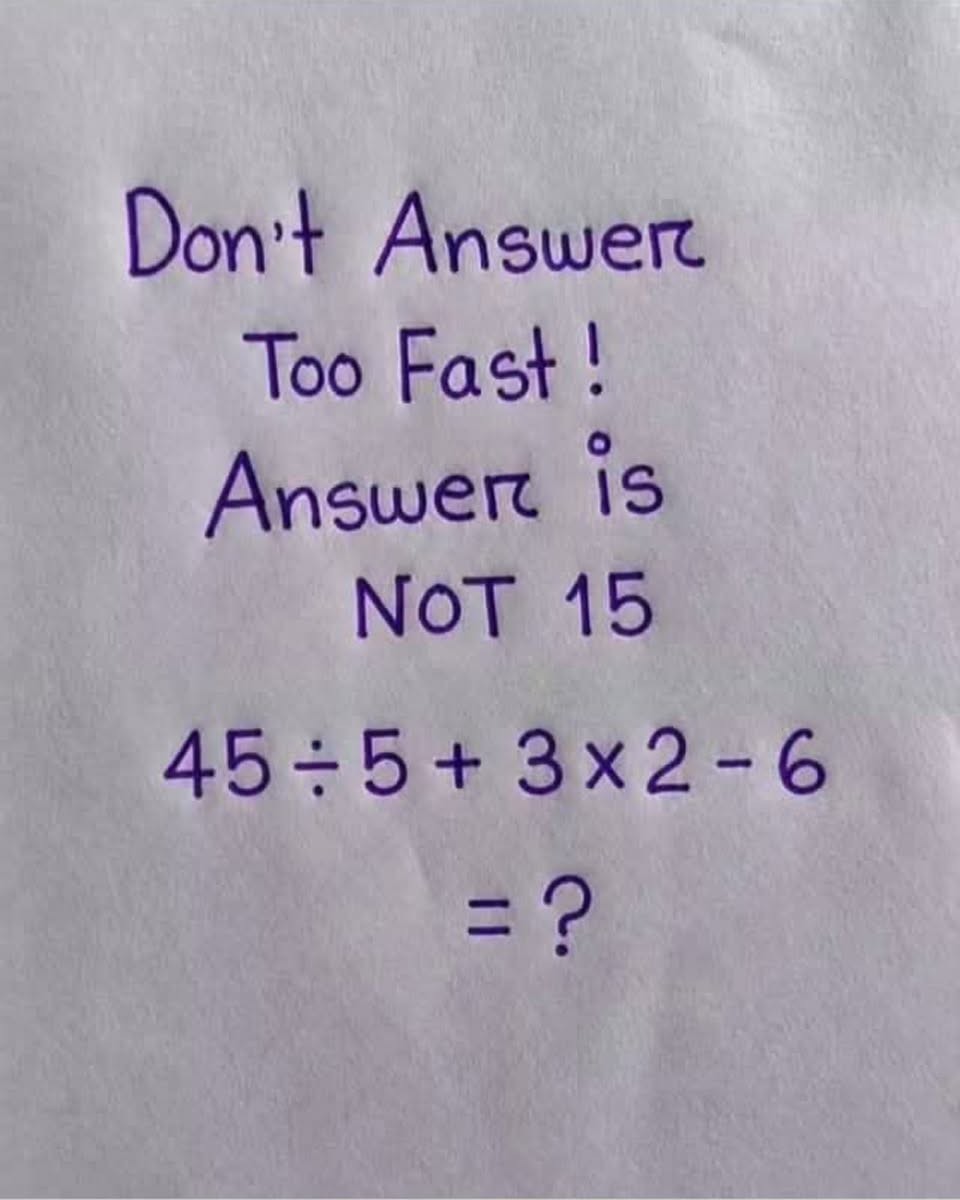
Mathematical puzzles often entice us with their apparent simplicity and encourage quick, instinctive calculations. However, even the most straightforward-looking equations can be misleading if we do not pay close attention to the rules underlying mathematical operations. A prime example of this is the puzzle:
45 ÷ 5 + 3 × 2 − 6
First Impressions and Common Mistakes
At first glance, many people will see the numbers and basic arithmetic symbols and begin calculating immediately. It is common for someone to mentally perform the first division and multiplication, add the results, and assume the answer is 15. This approach, though seemingly logical, misses a crucial aspect of mathematical problem-solving: the order of operations, a set of rules universally recognized in mathematics for ensuring consistent and accurate results.
The warning “Don’t Answer Too Fast!”—often accompanying such puzzles—serves as an essential reminder. The challenge of this puzzle is not simply in performing the calculations, but in knowing which steps to take and when. It is a classic mistake to ignore the order of operations and perform each calculation sequentially from left to right.
Understanding the Standard Order of Operations
The order of operations is a foundational principle in mathematics that dictates the sequence in which calculations should be made. This rule is sometimes summarized with the acronym PEMDAS (Parentheses, Exponents, Multiplication and Division, Addition and Subtraction), or BIDMAS (Brackets, Indices, Division and Multiplication, Addition and Subtraction). The principle ensures that equations are solved systematically and without ambiguity.
According to the order of operations:
- First, any calculations inside parentheses or brackets are completed.
- Second, exponents or indices are handled, though they do not appear in our puzzle.
- Third, multiplication and division are performed from left to right.
- Lastly, addition and subtraction are performed from left to right.
The rule gives multiplication and division priority over addition and subtraction because these operations produce significantly different outcomes and can alter the values in an equation. Ignoring this rule results in incorrect answers, a mistake that is widespread among people who solve such puzzles quickly.
Solving the Sample Puzzle Step by Step
Let us apply this systematic approach to the puzzle:
45 ÷ 5 + 3 × 2 − 6
Following the order of operations, we start with the division and multiplication:
- 45 ÷ 5 = 9
- 3 × 2 = 6
Now, substitute these results back into the equation:
9 + 6 − 6
Proceeding with addition and subtraction from left to right:
- 9 + 6 = 15
- 15 − 6 = 9
The final answer is 9.
Why the Mistake Happens
This math puzzle is designed to tempt the solver into overlooking the final subtraction and to misapply the order of operations. Many people mentally add the results of division and multiplication and stop, failing to account for the last subtraction. The warning not to answer too quickly is valid because making snap decisions often leads to inaccurate results.
The brain’s tendency to approach equations in a left-to-right manner explains why this error is so common. In many educational systems, rote calculation from left to right is how early arithmetic is taught, before students are introduced to the standard rules for more complex equations. This puzzle demonstrates how ingrained habits can override analytical thinking.
The Mathematical Context: The Role of Symbols
Mathematical notation is not just arbitrary decoration—it is a precise language for conveying relationships between numbers. The placement and type of symbols dictate the relationship between terms and the sequence of operations. This is why equations must be interpreted methodically according to established conventions.
Expert mathematicians and educators consistently emphasize the importance of teaching and adhering to order of operations. According to the National Council of Teachers of Mathematics, learning these rules is critical for building mathematical competence and problem-solving ability. Failure to use correct procedures, especially in more complex problems, can result in significant misunderstandings and errors.
Global Perspectives and Educational Impact
The order of operations is a universally accepted standard in mathematics education worldwide. Regardless of geographic region, curricula in countries such as the United States, United Kingdom, Japan, and many others incorporate these rules from an early age. The BBC Bitesize learning platform, for example, offers interactive lessons explaining PEMDAS/BODMAS for UK students.
Many international math competitions, including the International Mathematical Olympiad (IMO), require students to demonstrate precise calculation skills, including mastery of the order of operations. Standardized tests around the globe—such as the SAT, GCSE, and university entrance exams—include questions that test not only basic operations but also the solver’s ability to apply rules correctly and efficiently.
Research published by educational psychologists shows that puzzles like the one above serve as effective tools for reinforcing mathematical concepts. Engaging with such brain teasers encourages students to slow down, check their work, and develop deeper reasoning skills, which are essential for mathematics and other problem-solving disciplines.
The Societal Value of Mathematical Literacy
Beyond academics, understanding the order of operations is crucial for many real-life scenarios. Financial calculations, engineering designs, and logical programming all require precise execution of operations. A miscalculation in these fields can lead to tangible economic loss or technical malfunction.
In the realm of finance, for example, order of operations is foundational to accounting, budgeting, and tax calculation. Engineers rely heavily on correct sequential mathematics for blueprint designs, structural computations, and software algorithms. Even in computing, programming languages like Python and JavaScript are built upon mathematical precedence rules, demonstrating the universality and necessity of these concepts.
Encouraging mathematical literacy at a societal level helps produce citizens who are capable of making sound decisions, interpreting data, and participating in technological advances. It also prevents misunderstandings in critical communications—whether in business transactions, policymaking, or healthcare.
Expert Insights and Best Practices
Leaders in mathematics education recommend a deliberate, patient approach to solving math puzzles. Dr. Jo Boaler, a professor at Stanford University and advocate for innovative math teaching, stresses the importance of “math fluency” over speed. Boaler’s research shows that slowing down and understanding the steps involved leads to deeper learning and better long-term retention.
Other experts recommend using visual tools, such as parentheses and color-coded steps, to reinforce proper sequencing. Educational technology apps now alert students to errors related to operation order, and classroom strategies increasingly focus on problem-based learning, where students are challenged to explain their reasoning and identify possible mistakes.
For adults and professionals, continual practice and refresher lessons ensure that the order of operations remains a familiar and reliable method. Mathematics is a living discipline, and like language, fluency depends on ongoing engagement.
A Fun Challenge for All Ages
Puzzles like 45 ÷ 5 + 3 × 2 − 6 are not simply exercises in calculation but tools for sharpening critical thinking skills. They encourage us to:
- Read carefully.
- Follow established rules, even when the answer appears obvious.
- Double-check each step before concluding.
Everyone makes mistakes now and then, especially with enticingly simple puzzles. The key lesson is that deliberate, thoughtful problem-solving is more valuable than speed. By following the order of operations, we can avoid common pitfalls and arrive at the correct answer every time.
So, if you solved the puzzle correctly and arrived at 9, you have demonstrated good mathematical discipline. If your initial answer was 15, the puzzle has served its purpose—to remind you of the importance of slowing down and reviewing every operation.
Conclusion: The Lasting Impact of Mathematical Rules
The math puzzle 45 ÷ 5 + 3 × 2 − 6 is a compelling example of why the order of operations matters. It is not just a classroom lesson but a principle underpinning mathematics, science, finance, engineering, and everyday decision-making. Mastery of mathematical rules lays the foundation for lifelong learning and practical success in a variety of fields.
Always remember: Slow down, follow the rules, and approach every equation—with caution and confidence.
Sources
- BBC Bitesize
- National Council of Teachers of Mathematics
- International Mathematical Olympiad
- Stanford University
Disclaimer: This content is intended for entertainment purposes only and is not based on real events.