Visual Word Riddle: Discovering Country Names through Picture Puzzles
Welcome to an engaging exploration of visual word riddles tailored for puzzle lovers and language learners alike. This article delves deeply into the world of word-based picture puzzles, highlighting their benefits, how they function, and how participating in such puzzles can boost your English language skills and mental agility. Let us take a close look at a specific country name picture puzzle and unravel its intricacies step by step.
The Appeal of Word Riddles and Visual Puzzles
Word riddles, particularly those that incorporate images, present a creative and stimulating way to exercise the mind. Such puzzles enhance cognitive flexibility, sharpen attention to detail, and reinforce vocabulary retention. By challenging participants to make connections between objects, letters, and words, these brain teasers foster problem-solving skills and linguistic intuition—a process both educational and enjoyable for learners of all levels.
Educational studies suggest that word games and puzzles can have a positive impact on memory and general language acquisition. These activities push our minds to think beyond conventional patterns, stimulating different cognitive pathways as we try to decipher the clues.
Introducing the Country Name Picture Puzzle
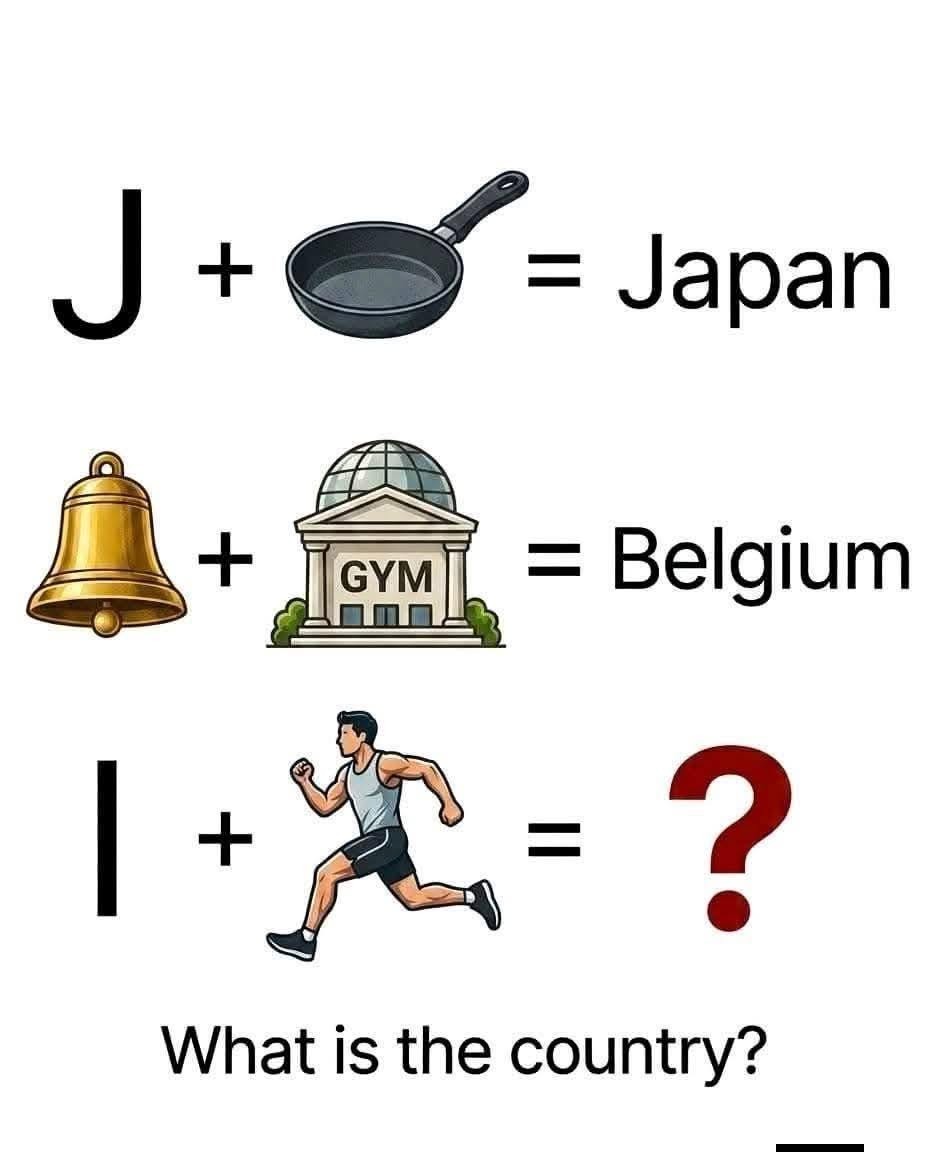
This particular puzzle presents a visual challenge that incorporates a succession of letter-and-image combinations. Each row in the visual contains clues that, when decoded, combine to form the name of a country. Let’s break this process down and analyze how the solution emerges, reinforcing both vocabulary and deductive thinking.
Here is the image that sets the stage for our puzzle adventure:

Breaking Down the Puzzle: Step by Step
Let us proceed through each line of the puzzle, analyzing the clues and uncovering the answers with careful reasoning.
First Line: Decoding “Japan”
The first line of the puzzle presents a clear starting point. On the left is the capital letter “J.” Next to it, there is a picture of what appears to be a flat cooking pan—an object instantly recognizable in most households.
To solve this clue, participants are encouraged to combine the letter “J” with the word “PAN.” Phonetically, “J” + “PAN” creates the sound “Japan.” This clever merger of a single letter and a familiar object leads straight to the answer: Japan. The solution demonstrates the power of imaginative wordplay, transforming simple visual cues into real-world references.
Second Line: Unpacking “Belgium”
In the next line, the puzzle increases in complexity while maintaining the same combinatory principle. The first visual clue is an image of a golden bell, a universally recognized symbol often associated with alertness or celebration. Adjacent to the bell is a building labeled “GYM,” a nod to athleticism and public fitness facilities.
By putting together “BELL” and “GYM,” the solver forms the word “BELL-GYM.” When you pronounce this compound quickly, it sounds strikingly similar to the European country Belgium. This solution relies on the participant’s ability to recognize familiar objects and mentally blend their sounds into a geographical term. The use of common objects in such puzzles helps participants anchor new vocabulary to tangible experiences.
Third Line: The Main Challenge—Solving for “Iran”
The third line presents the puzzle’s pivotal challenge, marked distinctly by a bold red question mark, inviting deeper analysis. The leftmost clue is the capital letter “I.” Beside it, there is an illustration of a person dressed in athletic clothes, running energetically. The key here is to determine the action being performed: “run.” However, to fit typical country naming conventions, we should use the past tense, which is “ran.”
Combining the letter and the action, we get “I” + “RAN” = “Iran.” This answer cleverly employs grammatical understanding (verb tense) and the phonetic blending of clues. It’s a prime example of how visual puzzles can deepen a learner’s engagement with English vocabulary, grammar, and geography.
The Revealed Solution: Iran
Through methodical analysis and creative thinking, we unravel the solution: the country represented in the final line is Iran. This revelation underscores the puzzle’s ability to make learning interactive and memorable.
The Science and Benefits of Solving Visual Word Puzzles
Engaging regularly with brain teasers and visual word riddles builds a wide range of cognitive and educational benefits. Research published by educational psychologists has found that puzzle-solving enhances executive functions such as attention, working memory, and mental flexibility. These activities require the solver to simultaneously process visual cues, recall relevant words or objects, and manipulate language elements with creativity.
Moreover, puzzles that blend visual and linguistic skills have been demonstrated to support second-language acquisition and promote better retention of new vocabulary. As learners are challenged to see beyond the literal meanings of objects and become comfortable with wordplay, their mental adaptability improves—an essential skill for mastering any language.
Socially, picture riddles often spark friendly competition and collaboration, as peers gather to attempt solving the same brain teaser. This communal aspect encourages communication, discussion, and shared learning, making the process enjoyable for groups and individuals alike. Visual word puzzles, such as the country-name riddle discussed here, are thus valuable tools in both classroom and recreational settings.
Incorporating Visual Word Games into English Learning
Visual word games are exceptionally effective supplements to formal English instruction. Teachers and learners can integrate them into study routines to provide a playful break from traditional drills while still reinforcing critical vocabulary and pronunciation skills.
- Vocabulary Expansion: Associating unfamiliar words with commonly known objects or actions helps learners internalize new terms more rapidly.
- Pronunciation Practice: Combining letters and object names demands quick vocalization, supporting improved fluency and phonetic awareness.
- Contextual Memory: Gamified learning anchors vocabulary in visual and contextual memory, leading to longer-lasting recall.
- Confidence Building: Successfully solving a word riddle stimulates motivation and fosters a sense of achievement.
Online platforms, classroom worksheets, and mobile apps increasingly use image-word riddles to engage language learners at all levels. Integrating these puzzles into regular study habits can build greater confidence in both written and spoken English.
Expert Opinions on Puzzle-Based Learning
Language education experts highlight the value of contextualized, interactive learning methods. According to linguists from the British Council and cognitive psychologists from educational institutions, combining images and words in playful ways leverages multiple learning modalities—auditory, visual, and kinesthetic.
Such holistic approaches lead to deeper comprehension and stronger neural connections. As one expert at the British Council notes, “Word riddles and picture puzzles, if designed appropriately, can stimulate both hemispheres of the brain, making language learning more comprehensive and effective.” Beyond the classroom, experts from brain health organizations encourage adults to engage in puzzle solving regularly to support lifelong mental fitness.
International and Societal Interest in Word Puzzles
Globally, word puzzles have become widespread, transcending linguistic and cultural barriers. In many countries, such games are used as part of national education systems, as recreational activities in print media, and in digital formats on social media and learning apps.
With increased international connectivity, communities of puzzle enthusiasts have formed online, sharing riddles, competing for the highest scores, and collaborating on complex linguistic challenges. This has helped foster cross-cultural exchange and elevated interest in educational game design worldwide.
Language learning platforms continue to evolve, often incorporating AI-powered puzzle generators that cater to specific levels and cultural contexts. The enduring popularity of visual word riddles reflects a universal human desire to play, learn, and grow.
Next Steps: Practicing with Picture Puzzles
Whether you are a passionate word game enthusiast or a new English learner, regular engagement with visual word puzzles can dramatically boost both your vocabulary and your mental sharpness. Here are some tips for maximizing their benefits:
- Start with simple puzzles and gradually attempt more challenging riddles.
- Encourage friends, classmates, or family members to solve puzzles together for collective learning.
- Try creating your own picture-word riddles to practice creativity and reinforce learning.
- Keep a vocabulary journal to record new words and their visual clues for ongoing review.
By embedding these activities into your learning routine, you not only improve your English skills, but also develop important cognitive abilities that are valuable across all fields of study.
Conclusion: The Power of Creative Learning
Visual word riddles are more than just a fun diversion—they are powerful educational tools that make learning English, geography, and creative problem-solving accessible and enjoyable. By exploring puzzles like the country-name picture riddle, learners expand their vocabularies, hone their linguistic intuition, and form memorable associations between words and the world around them.
Embrace the challenge of these brain teasers, share them with others, and take pleasure in the process of discovery. Your journey through language learning becomes more vibrant and rewarding with each new puzzle you solve.
Sources
Disclaimer: This content is intended for entertainment purposes only and is not based on real events.