The Morning Before Halloween: A Story of Calm, Responsibility, and Resolution
Introduction: An Unexpected Start to Halloween
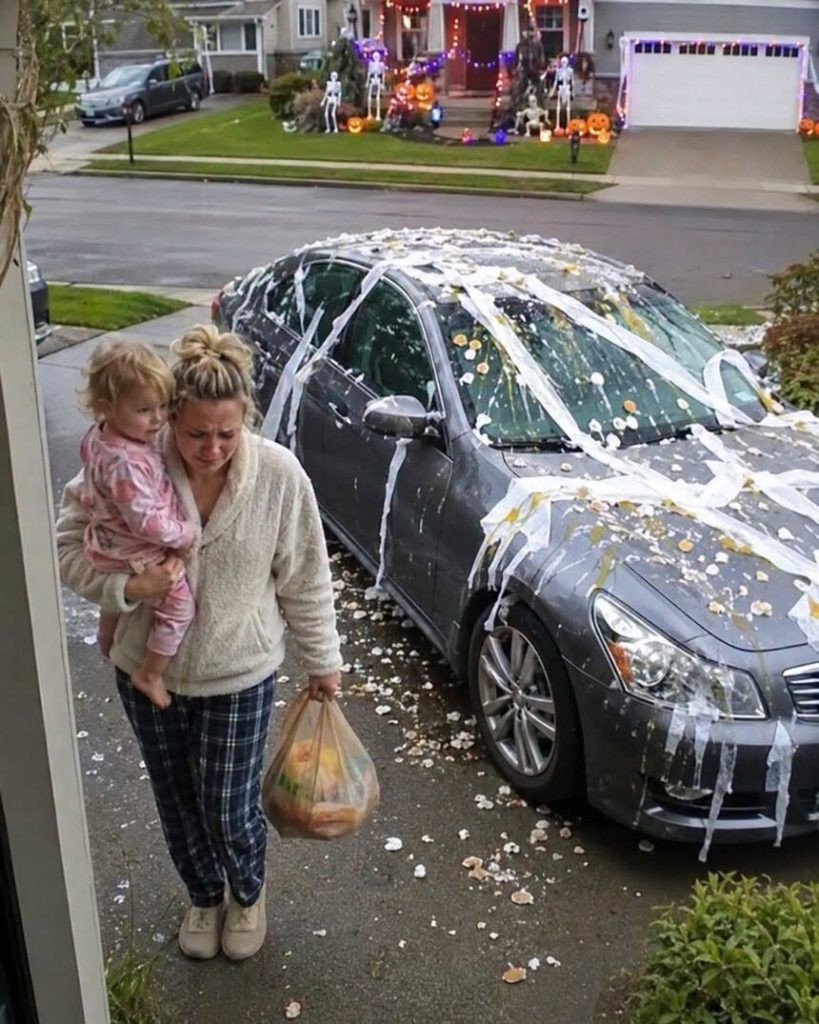
The morning preceding Halloween—a day often filled with excitement and anticipation—turned unexpectedly stressful for Emily, a 36-year-old nurse and single mother of three. Upon stepping outside with her young child, she found her car vandalized with eggs and toilet paper, a situation that left her children confused and herself feeling a mix of exhaustion and concern. In answering her three-year-old’s innocent question, “Mommy… is the car sick?”, Emily faced yet another test of patience and resilience amid the daily pressures of balancing work, childcare, and financial responsibilities.
Understanding the Incident: Neighborhood Dynamics and a Moment of Conflict
The source of the vandalism was quickly identified: Derek, a neighbor renowned in the community for his elaborate Halloween decorating. The night prior, Emily had parked her car in front of Derek’s residence. Her usual parking spot had been blocked, and with three sleepy children to attend to and groceries in hand, she chose the most practical solution available. The next morning, Derek openly admitted to the act, explaining that Emily’s car had obstructed his decorations—a point of pride for him. His lack of empathy was apparent as he commented that having children was Emily’s choice, leaving her frustrated but determining to respond with composure and responsibility rather than confrontation.
Staying Calm and Documenting Evidence
Rather than engage in a heated exchange, Emily chose a careful, measured approach. She documented the damage with photographs, recorded video evidence, and made notes with precise time and date stamps. This process not only provided a factual record of events but also helped Emily maintain her sense of control in a situation where emotions could easily escalate. Experts in neighborhood disputes and legal response frequently recommend such documentation as critical both for rental property matters and for insurance or law enforcement follow-up, especially in cases involving repeated or serious incidents.
Building a Community of Support
Recognizing the importance of independent witnesses, Emily reached out to her neighbors, Marisol and Rob. Both had observed Derek near her car on the night in question. Rob, in particular, recalled hearing Derek complain about “view blockers,” suggesting a motive consistent with Derek’s own admission. With their agreement, both neighbors provided written accounts of their observations. These statements, when combined with her own documentation, established a multi-source record crucial for any later investigation or proceedings.
Taking Reasoned Action: Law Enforcement and Formal Steps
The following day, Emily contacted the local police via their non-emergency line, choosing a formal but non-confrontational path. Officer Bryant handled her report, gathering all relevant details and advising Emily to seek a professional repair estimate. At a local detailing shop, she received a quote exceeding $500—an amount substantial enough to impact her already tight budget. All related materials, including photographs, the police report, witness statements, and the repair estimate, were organized into a single folder. By creating a well-documented file, Emily further prepared herself should the case escalate to small claims court or require negotiation through her homeowner’s association (HOA).
Accountability and Restitution: Holding the Responsible Party to Task
With evidence collected and the repair estimate in hand, Emily drafted a formal demand letter to Derek, clearly outlining the damages, the support from neighbors, and the need for payment. She personally delivered the letter and also provided a copy to her HOA—ensuring transparency and the involvement of local governance structures. Within two days, Derek returned to Emily’s door. His demeanor was initially defensive, but ultimately, he provided a receipt verifying full payment for the car’s repair. This gesture signaled an acknowledgment of responsibility, albeit following a process driven by facts, documentation, and community accountability.
Rebuilding Respect and Community Trust
The resolution did not end with financial compensation. Later that weekend, Derek approached Emily again—this time carrying cleaning supplies and an offer to help address any lingering damage to the car. He expressed genuine remorse and proposed to help clean up what remained. Emily, choosing to accept his apology and assistance, quietly reaffirmed the value of community and accountability. Her children, observing from a window, watched with fascination as Derek—the neighbor previously known for his spectacular Halloween decorations—did his part to rectify the situation. Through these actions, Emily used the moment as an educational opportunity, explaining to her children the importance of taking responsibility for one’s actions and the reality that everyone makes mistakes that sometimes need cleaning up, both literally and figuratively.
Lessons for Conflict Resolution and Neighborhood Harmony
This Halloween was different for Emily’s family. Rather than focusing on external festivities, they enjoyed time together indoors, making cupcakes and caramel apples. Derek’s typical display was more subdued, perhaps out of renewed sensitivity to his neighbors and their needs. For Emily, the experience reinforced several critical lessons applicable not just for her family, but for neighbors everywhere:
- Documentation is Powerful: By recording events and gathering witness statements, individuals can protect themselves and ensure that the facts, and not emotions or hearsay, shape the resolution process.
- Community Matters: Reaching out to neighbors for support and validation can strengthen one’s position and also build shared understanding within a neighborhood.
- Patience Over Anger: Resisting the urge to retaliate or escalate allows for solutions based on dialogue, empathy, and community standards.
- Restorative Action: Encouraging responsible parties to make amends, both financially and through service, can help rebuild trust and demonstrate the value of accountability.
- Educational Opportunity: Events like these provide important lessons for children about conflict, honesty, and restoring relationships after mistakes.
Expert Insights: Navigating Neighbor Disputes Constructively
Experts in conflict resolution and community management highlight the successes in Emily’s approach. According to the American Psychological Association and neighborhood mediation services, the use of nonviolent communication, thorough documentation, and involving neutral third parties (such as local police or the HOA) are all considered best practices in de-escalating disputes. Law enforcement professionals often suggest starting with informal resolution and documentation before advancing to formal legal action, a pathway Emily demonstrated with carefulness and forethought.
Community sociologists also emphasize the critical role of shared norms and communication in maintaining harmonious neighborhoods. By seeking support from neighbors and choosing patience, Emily not only protected her property but also contributed to a culture of respect and understanding, even after conflict.
The Broader Implications for Neighborhood Life
This incident, while specific to Emily and Derek, echoes wider trends in urban and suburban communities where celebrations and parking can sometimes ignite tensions. For many, the pressures of daily life, the desire to maintain traditions, and the need for shared space create challenges that call for empathy, communication, and practical problem-solving. While Halloween is a time for fun and creativity, it can also reveal underlying issues about boundaries, respect, and the way neighbors view each other.
Across the globe, cities and towns invest in civic education and neighborhood programs precisely to address such challenges, encouraging mediation, education, and community-building activities that help prevent and resolve conflicts before they escalate. Experts recommend that neighbors get to know one another, set clear expectations around shared spaces, and always seek peaceful, well-documented solutions to disputes. In some communities, mediation services are available for free or at low cost, making it easier to prevent minor disagreements from turning into long-standing feuds.
Conclusion: Finding Strength in Calm, Responsibility, and Compassion
Emily’s experience reminds us that strength often resides not in quick reactions or confrontation, but in thoughtful action, thorough documentation, and a willingness to forgive. By turning an unpleasant Halloween morning into an opportunity for growth and resolution, Emily set a powerful example for her children and her community. Her story highlights the importance of patience, respect, and accountability in overcoming conflict and maintaining peaceful neighborhoods. As families across the world celebrate holidays and encounter the everyday complexities of community life, stories like this encourage everyone to resolve differences with empathy, evidence, and a focus on rebuilding trust.
Sources
Disclaimer: This content is intended for entertainment purposes only and is not based on real events.