Can You Find the Four Hidden Objects in This Bed
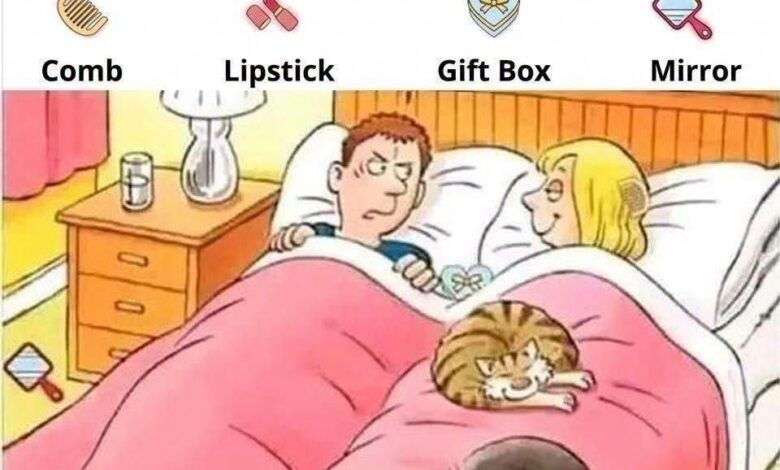
Visual puzzles and hidden object challenges have captivated audiences for generations, engaging people’s curiosity and testing perception skills. One recent illustration that has gained significant attention features a bedroom scene where viewers are encouraged to discover four cleverly concealed objects. These items—a comb, a small gift box, a mirror, and a tube of lipstick—are artfully hidden within the scene, prompting both casual viewers and puzzle enthusiasts to sharpen their observational abilities. In this article, we delve into the methods behind such visual riddles, explore the cognitive science at play, and examine why these activities remain popular across cultures and age groups.
The Puzzle: A Detailed Look at the Bedroom Illustration
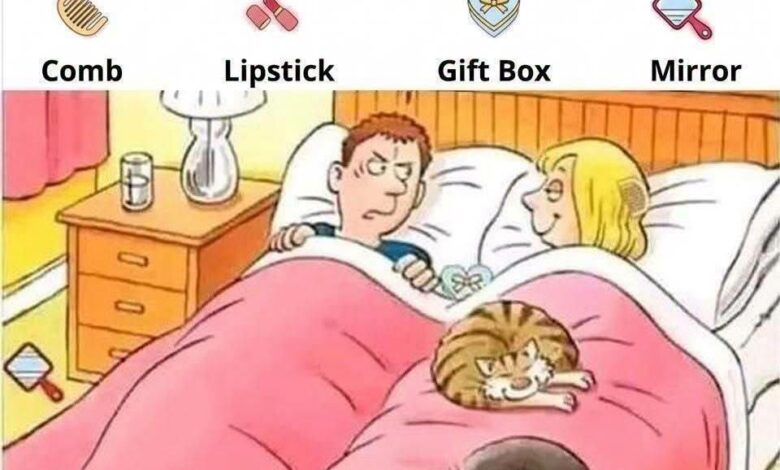
The centerpiece of this challenge is a meticulously illustrated bedroom. The image includes a couple relaxing amid bedding, furniture, and a patterned floor, evoking a familiar and realistic atmosphere. However, the true focus lies not on the everyday setting, but rather on the challenge: identifying four objects hidden so expertly, none appear in their expected locations.
Each object—the comb, the small gift box, the mirror, and the lipstick—has been integrated into different parts of the drawing, defying viewers’ assumptions and prompting a more nuanced approach to problem solving. This technique leverages visual blending, where the lines, colors, and textures of an object are manipulated to merge seamlessly into an unrelated background element. For instance, the comb is camouflaged in the woman’s hair, its teeth closely mimicking the strand patterns. This forces observers to look beyond the obvious and reconsider where such a grooming tool might be hidden, rather than defaulting to searching surfaces like the bedside table.
How Hidden Object Puzzles Work
Hidden object puzzles rely on the natural tendencies of human vision and attention. Artists skilled in such illustrations use several techniques:
- Camouflage: Objects are colored or textured to match their environment.
- Pattern Integration: The shapes align with existing patterns in the illustration, drawing less attention.
- Unexpected Placement: Items are placed in areas where the viewer would not logically search.
- Perspective Tricks: Angles or lighting create optical illusions, causing objects to blend in with the background.
Through these strategies, artists exploit cognitive biases, such as the tendency to search for items in typical contexts (like a comb on a table), prompting viewers to miss cleverly disguised clues.
The Challenge of Finding the Four Objects
In the bedroom illustration puzzle, viewers are tasked to find:
- The Comb: Hidden within the textured strands of the woman’s hair. Its teeth overlap with the hairstyle, effectively disguising its distinctive outline.
- Small Gift Box: The shape and coloring are adapted to fit seamlessly onto a section of furniture or bedding, avoiding logical hiding places.
- A Mirror: Integrated into surroundings—possibly mimicking a frame or window—so it doesn’t immediately draw focus as a reflective object.
- Tub of Lipstick: Positioned away from nightstands or dressers, its shape and color mimic shadows or patterns on the fabric or floor.
Beyond encouraging careful scrutiny of visual detail, the challenge provides an enjoyable yet educational exercise that hones concentration and pattern recognition skills.
The Psychology of Visual Perception in Puzzles
Studies in cognitive psychology reveal that hidden object puzzles tap into several visual and mental processes:
- Selective Attention: Our brains prioritize certain visual information based on expectations and experience, which can lead to objects being overlooked if placed in unusual contexts.
- Figure-Ground Perception: The brain’s ability to distinguish objects (figures) from their background (ground) can be manipulated through clever illustration, blending figures into the background so effectively they become invisible at a glance.
- Gestalt Principles: These principles explain how humans naturally group visual elements by similarity, proximity, or continuity, which puzzle artists frequently use to mask objects.
As a result, solving such puzzles is more than just a test of eyesight; it’s a demonstration of cognitive flexibility and the ability to break free from mental shortcuts.
Why Hidden Object Challenges Are So Popular
The enduring popularity of hidden object puzzles can be attributed to several factors:
- Accessibility: Anyone can participate, regardless of age or skill level.
- Instant Engagement: The sense of a challenge immediately draws in viewers, often becoming a social or familial activity.
- Sense of Achievement: Discovering a well-hidden object triggers a reward response in the brain, eliciting satisfaction and motivation to continue.
- Educational Value: Such puzzles enhance observation, patience, and even abstract reasoning, making them valuable tools in classrooms and therapy settings.
- Stress Relief: Engaging in focused, low-stakes visual tasks has been shown to relax and distract from everyday worries.
Techniques to Improve Your Hidden Object Skills
Experts and puzzle creators recommend several approaches for increasing your effectiveness when tackling visual challenges like this bedroom illustration:
- Change your perspective—zoom out and then zoom in, or rotate the image if possible.
- Look for recurring lines, shapes, or colors that break the natural symmetry of the illustration.
- Ignore the expected locations and search in places where objects would be unlikely.
- Take breaks; stepping away and returning later can provide a fresh look.
- Engage with others. Often, a second set of eyes will notice what you have missed.
Historical and Cultural Context of Hidden Object Artwork
The concept of embedding items within a larger picture is not new. Famous artists have employed visual puzzles since the Renaissance. For example, Giuseppe Arcimboldo in the 16th century crafted portraits from images of fruits, vegetables, or objects, a precursor to modern hidden object artistry. Hidden object books, like the “I Spy” and “Where’s Waldo?” series, evolved in the 20th century, now enjoyed globally in print and digital forms. Online communities regularly share new challenges, furthering their reach and appeal.
The Role of Visual Puzzles in Education and Cognitive Training
Educators and psychologists recognize the utility of visual puzzles in developing critical thinking. In classrooms, such activities can nurture focus, logic, and persistence. Occupational therapists use visual search tasks to aid patients’ recovery from neurological injury by rebuilding pattern recognition and memory skills. Digital versions have broadened accessibility, allowing children and adults to benefit from these exercises via apps and games.
How This Bedroom Puzzle Compares to Other Viral Challenges
The bedroom illustration’s viral spread echoes that of previous popular puzzles. Digital media enables rapid dissemination, and the challenge prompts discussion and collaboration. Compared to earlier analog puzzles, digital artwork allows for greater complexity and interactivity, utilizing subtle gradients and shading that can further mask concealed elements. As with other viral optical illusions or brain teasers, participants often share solutions on social media, sparking debates and encouraging friendly competition.
Societal and International Reactions to Hidden Object Puzzles
Globally, the enjoyment of hidden object puzzles transcends cultural barriers. While specific themes or objects may reflect local traditions, the fundamental challenge remains the same. Educational experts note that such visual activities are valuable in early childhood development in Asia, the Americas, and Europe alike. Online forums, puzzle blogs, and social networks bring together enthusiasts from around the world, making these challenges a form of universal entertainment.
Expert Views on Visual Puzzles
Psychologists, educators, and neuroscientists have commented extensively on the value of hidden object puzzles. According to an analysis by BBC Future, engaging with these challenges stimulates the brain’s search and reward circuitry. The Mayo Clinic, in research on cognitive training, points out the potential role of visual puzzles in maintaining cognitive health as people age. Teachers cite such exercises as tools to motivate and include learners with varying abilities.
Conclusion
The bedroom illustration challenge not only entertains but also educates. By inviting viewers to search for four objects hidden with artistic flair, it highlights the intricacies of human perception and cognition. Whether you solve the puzzle alone or with friends, the enduring popularity of such challenges lies in their perfect blend of fun, learning, and the thrill of discovery—a tradition now thriving in the digital age.
Sources
Disclaimer: This content is intended for entertainment purposes only and is not based on real events.