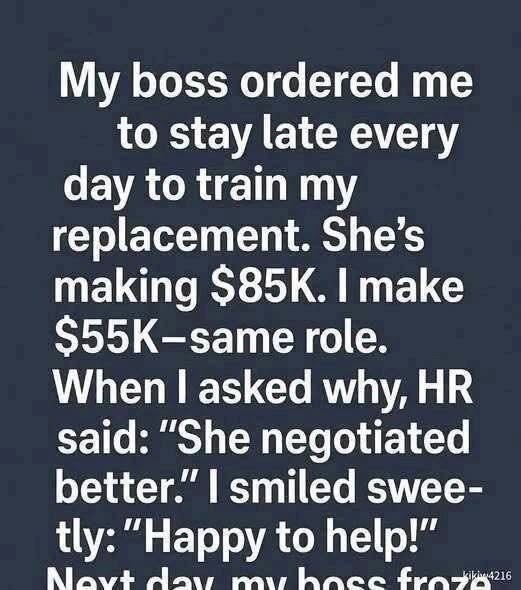
I Was Asked to Train My Replacement—Then I Discovered What They Were Paying Her
For nearly six years, I believed I understood my place at the company.
I knew which clients needed extra attention, which reports deserved a second review, and which deadlines were truly urgent. I knew where the important files were, how the internal systems worked, and what problems were likely to appear before anyone else noticed them.
When a frustrated customer called, I usually knew how to handle it.
When a complicated project started going off track, I was often the person asked to fix it.
I had built my reputation on being dependable.
What I didn’t realize was that my employer had a very different idea of what that experience was worth.
I was earning $55,000 a year.
The woman hired to take over my position would be earning $85,000.
Same general role.
Similar responsibilities.
A difference of $30,000.
And I didn’t discover it through a leaked payroll document or an office rumor.
I discovered it because my manager asked me to train her.
“You’re Going to Train Our New Hire”
It happened on a Friday afternoon.
My manager, Karen, stopped beside my desk.
“Starting Monday, I’ll need you to stay until at least seven.”
I looked up from my computer.
“Every day?”
“For the next few weeks.”
I assumed there was an important project coming up.
Then she explained.
“You’re going to train our new hire.”
I glanced toward the conference room. A woman I’d never seen before was sitting inside with someone from HR.
I looked back at Karen.
“What position is she taking?”
There was a brief pause.
“Yours.”
For a moment, I honestly didn’t know what to say.
“So I’m training my replacement?”
Karen nodded.
“You’ve been here long enough to know the systems. You’re the best person to teach her.”
She said it as though it were a compliment.
And perhaps, in another situation, it would have been.
The company trusted me because I knew the job.
But I couldn’t ignore the obvious question.
If I was experienced enough to train the person replacing me, why hadn’t that experience been reflected in my compensation?
Still, I kept my response professional.
“Sure. I’ll help.”
Karen smiled with relief.
“Great. I knew you’d be cooperative.”
I smiled back.
“Happy to help.”
But that weekend, I couldn’t stop thinking about it.
The Number That Changed Everything
I’d started at the company in an entry-level administrative position.
Over the years, I took on more responsibilities and eventually moved into a senior operations coordinator role.
My workload increased.
My knowledge increased.
My responsibilities increased.
My salary increased too—but nowhere near as quickly.
I’d asked for a raise twice.
The first time, I was told the budget was tight.
The second time, management said the company was restructuring and that compensation decisions would have to wait.
I’d accepted those explanations because I had no reason to believe otherwise.
Until now.
On Monday morning, I met Emily.
She was the new employee.
She was friendly, intelligent, and a little nervous about starting the position.
During lunch, she admitted that she felt overwhelmed by the opportunity.
“It’s a big step for me,” she said. “I really hope I can learn everything quickly.”
“You will,” I told her.
Then she mentioned something that caught my attention.
The company had offered her a salary that was better than she expected.
I hesitated.
“How much?”
She looked slightly embarrassed.
“Eighty-five.”
I thought I’d misheard her.
“Eighty-five thousand?”
She nodded.
“I negotiated a little.”
I smiled and congratulated her.
And I genuinely meant it.
Emily hadn’t done anything wrong.
She had negotiated an offer and accepted the compensation the company was willing to provide.
But inside, something had shifted.
For years, I’d been told there wasn’t enough room in the budget.
Now I knew the position itself had been budgeted at $85,000.
I Went to HR With One Simple Question
That afternoon, I went to the HR department.
I wasn’t looking for a confrontation.
I wasn’t asking anyone to reveal Emily’s private information.
I simply wanted to understand how the company had determined the compensation for the position.
“I have a question about the salary range for my position,” I said.
The HR representative checked the information.
“The position is currently budgeted at $85,000.”
I nodded.
“My current salary is $55,000.”
“Yes.”
“It’s the same title?”
“Yes.”
“And generally the same responsibilities?”
“Generally.”
I took a breath.
“So what accounts for the difference?”
She explained that compensation could be influenced by several factors, including market conditions, experience, hiring needs, and negotiation.
I listened carefully.
“So negotiation can make a significant difference?”
“It can be one factor.”
I thanked her and returned to my desk.
I wasn’t furious.
I was actually calmer than I expected.
Because for the first time, I understood that the problem wasn’t necessarily that the company couldn’t afford to pay more.
There were other factors involved.
And that realization changed the way I looked at my career.
I Started Documenting My Own Value
That evening, I opened my résumé.
Then I started making a list.
Not confidential company information.
Not private client details.
Just my own professional accomplishments.
I wrote down the projects I’d managed.
The processes I’d improved.
The customers I’d helped retain.
The recurring problems I’d solved.
The additional responsibilities I’d taken on.
The systems I’d learned.
The situations where I’d stepped in because nobody else knew how to handle them.
For years, I’d assumed my employer already understood all of this.
That was my mistake.
I realized that knowing your value and being able to demonstrate your value are two different things.
So I updated my résumé.
Then I researched the market.
Then I started applying for positions elsewhere.
At the same time, I continued training Emily.
I showed her the systems.
I explained the workflows.
I introduced her to recurring problems.
I gave her the notes I’d accumulated over the years.
I wanted her to succeed.
She wasn’t responsible for the decisions my employer had made about my salary.
Then Emily Asked Me a Difficult Question
One afternoon, Emily asked if she could speak with me privately.
“Why are you leaving?”
I looked at her.
“I didn’t say I was leaving.”
She smiled.
“You didn’t have to.”
She had apparently begun to notice the strange situation too.
She knew she was taking over responsibilities I’d handled for years.
She also knew I’d been the person responsible for training her.
Eventually, she asked the question directly.
“I don’t want you to think I did this to you.”
“I don’t,” I said.
And I meant it.
Emily had negotiated the offer she received.
There was nothing wrong with that.
The real issue was what my experience had taught me about how the company valued existing employees compared with new hires.
Then I Started Getting Calls
A few weeks passed.
My résumé began generating responses.
One company offered me $72,000.
Another offered $78,000.
Then I interviewed with a competitor.
This time, I approached the process differently.
Instead of simply describing my responsibilities, I explained what I had accomplished.
I talked about the systems I had improved.
The problems I’d solved.
The responsibilities I’d gradually taken on.
The experience I’d developed over nearly six years.
Then came the question I had always found uncomfortable.
“What salary are you looking for?”
I paused.
For years, I would have given a cautious answer.
Something reasonable.
Something I thought the interviewer wanted to hear.
This time, I gave an honest number.
“Eighty-five thousand.”
The hiring manager smiled.
“That sounds reasonable.”
Two days later, I received an offer.
$92,000.
I stared at the number for several minutes.
It was $37,000 more than I had been earning.
I hadn’t suddenly become a different employee.
My skills hadn’t appeared overnight.
The difference was that another company was willing to place a different value on the experience I’d already developed.
I accepted.
But I didn’t tell my employer immediately.
I waited until everything was official.
The contract was signed.
The start date was confirmed.
The benefits were clear.
Only then did I walk into Karen’s office.
“I’d Like to Give You My Notice”
It was Thursday morning.
“I’d like to give you my notice.”
Karen’s expression changed.
“For what reason?”
“I’ve accepted another position.”
“When are you leaving?”
“Two weeks.”
She looked concerned.
“We’re in the middle of training.”
“I know.”
“You can’t leave right now.”
I explained that I had documented the procedures and would do everything possible during my remaining time to make the transition smooth.
Then she asked something I had imagined hearing months earlier.
“What would make you stay?”
Six weeks earlier, my answer might have been different.
Maybe I would have asked for $70,000.
Maybe $75,000.
Maybe I would have been grateful for almost any meaningful increase.
But things were different now.
I’d already accepted the new position.
“I’ve already accepted the offer.”
Karen then suggested that the company might be able to match it.
I paused.
“That’s interesting.”
She asked what I meant.
I explained that I had spent years asking about a salary adjustment.
Yet only after I had accepted another job did the possibility of a much higher salary suddenly become available.
There wasn’t much more to discuss.
My decision had already been made.
My Resignation Started a Bigger Conversation
My departure raised questions within the department.
Emily had questions too.
She wanted to understand how someone with years of experience in the position could have been earning considerably less than the person hired to replace them.
Eventually, she raised her own concerns with management.
My resignation hadn’t been intended to create a workplace controversy.
I wasn’t trying to punish anyone.
I wasn’t trying to embarrass my manager.
I simply wanted to find an opportunity that better reflected my experience and professional goals.
But sometimes one person’s decision can make other people reconsider their own situations.
By the time I finished my final week, it was clear that compensation had become a much bigger topic inside the department.
A Completely Different Beginning
My new job started the following Monday.
The salary was $92,000.
The benefits were better.
The working environment suited me better.
But the most meaningful difference wasn’t actually the paycheck.
It was the way my experience was viewed.
During my first month, my new manager asked me what I thought my work was worth.
I gave her an honest answer.
She listened.
That simple interaction meant more to me than I expected.
A month later, Emily contacted me.
She told me she had negotiated an adjustment to her own compensation.
She also said the company had begun reviewing the salary structure within the department.
I don’t know exactly what happened after that.
And honestly, I didn’t need to.
I’d already moved forward.
What I Learned
For years, I thought loyalty meant staying.
I thought being a good employee meant accepting the company’s decisions without questioning them.
I thought if I worked hard enough, my employer would automatically recognize what I was worth.
I’ve learned that those assumptions aren’t always true.
Being loyal to a company doesn’t mean ignoring your own career goals.
Being a team player doesn’t mean accepting less than you believe your skills are worth.
And doing excellent work doesn’t guarantee that the organization you work for will automatically adjust your compensation to match your growing value.
Sometimes you need to step back.
Research the market.
Document your accomplishments.
Understand your options.
And then make a decision based on what you learn.
The most important thing that happened to me wasn’t receiving a $92,000 offer.
It was realizing that my professional value wasn’t determined by one company’s willingness—or unwillingness—to recognize it.
I didn’t leave because I wanted revenge.
I didn’t leave because I wanted to make anyone feel bad.
I left because I found an opportunity that better matched my experience, skills, and expectations.
And perhaps that’s the most important lesson of all:
You don’t always need a dramatic confrontation to change your career.
Sometimes, you simply need to understand what you bring to the table, prepare carefully, and have the confidence to explore what comes next.