For most people, standing for a few hours can leave their legs feeling tired.
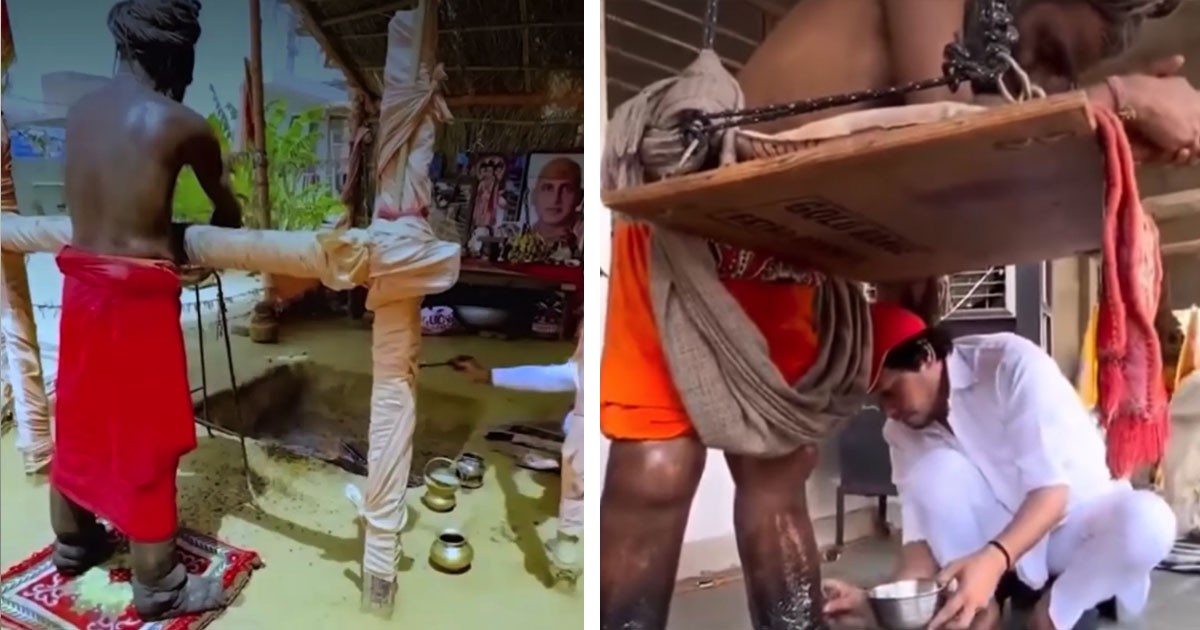
For Daulat Giri Ji Maharaj, standing has become a way of life.
Since 2021, the Indian monk has reportedly remained upright as part of a 12-year spiritual vow. He has committed himself to completing the entire practice, meaning he still has years to go before his vow is scheduled to end.
But photographs and reports about his condition have raised questions about the extraordinary physical demands of remaining on his feet for such a long period.
His legs have reportedly become swollen and discolored, and he now relies on harnesses and specially arranged supports because his legs are no longer strong enough to support him normally.
For Maharaj, however, the physical hardship is part of a much larger spiritual commitment.
Who Is Daulat Giri Ji Maharaj?
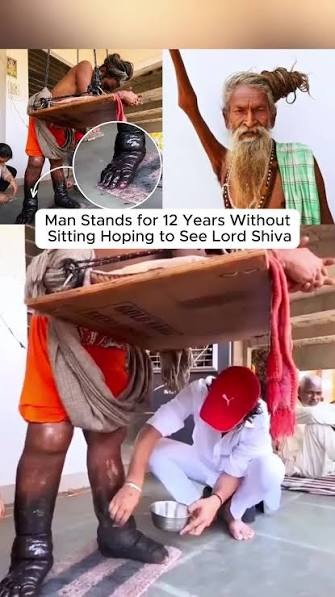
Daulat Giri Ji Maharaj is an Indian Hindu monk who has gained attention for undertaking an unusual spiritual practice: remaining standing and avoiding sitting for 12 years.
He is associated with a group sometimes referred to as the Khareshwari, or “Standing Babas.”
Members of this tradition undertake prolonged standing as an act of religious devotion and spiritual discipline.
For Maharaj, the practice reportedly began in 2021.
His goal is to continue until he has completed the full 12-year period.
That would mean remaining committed to the vow until approximately 2033.
Why Would Someone Choose to Stand for 12 Years?
The practice is rooted in spiritual devotion rather than physical fitness.
For ascetics who undertake extreme religious disciplines, enduring physical discomfort can be viewed as a form of devotion, self-discipline, sacrifice, or purification.
Maharaj’s practice is therefore very different from simply choosing to stand more during the day.
He has reportedly made the avoidance of sitting a central part of his spiritual life.
Such practices are difficult for most people to imagine because sitting, resting, and changing position are basic parts of everyday human movement.
The human body is designed to shift between different positions.
Standing.
Walking.
Sitting.
Lying down.
Each movement changes how muscles, joints, and the circulatory system work.
Removing one of those ordinary forms of rest for years places extraordinary demands on the body.
His Body Has Begun Showing the Strain
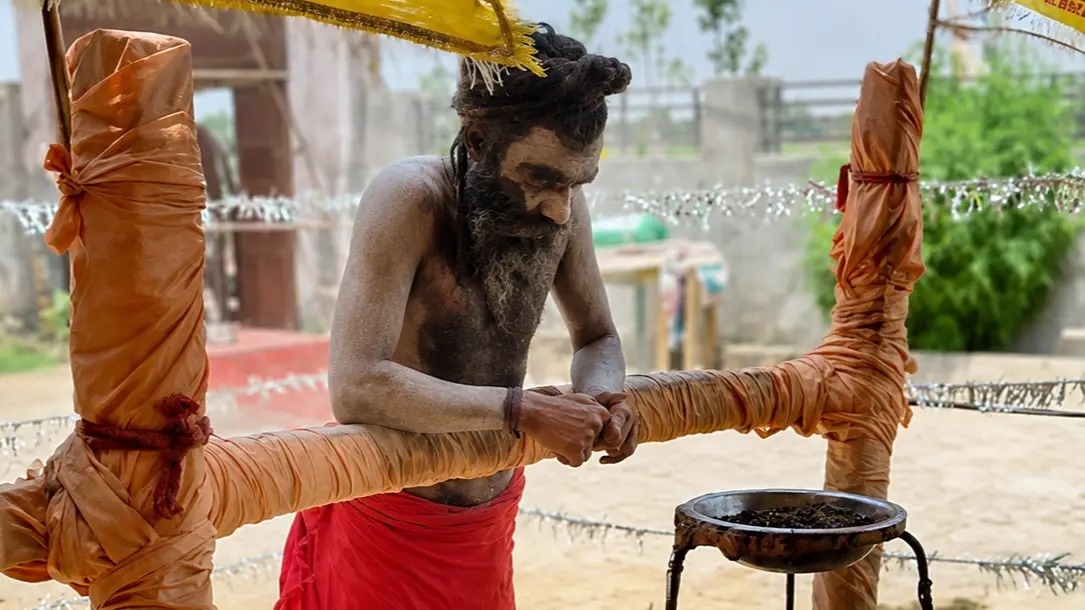
One of the most striking aspects of Maharaj’s story is the reported condition of his legs.
After years of remaining upright, his legs have reportedly become swollen and discolored.
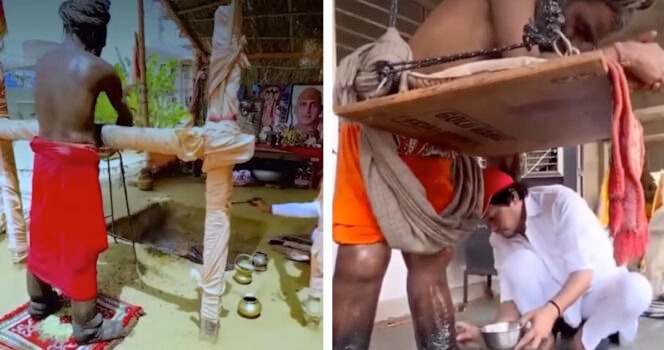
He also appears to need harnesses, swings, and other forms of support to remain upright.
This is particularly significant because standing requires the body to continually work against gravity.
Blood returning from the legs has to travel upward toward the heart.
The muscles in the legs normally contribute to this process when a person moves around.
Walking activates muscles that help push blood through the veins.
Sitting and lying down also change the gravitational demands placed on the circulation.
When someone remains upright for prolonged periods, blood can accumulate in the lower portions of the legs.
This can contribute to swelling and discomfort.
Why Standing for Long Periods Can Cause Leg Swelling
The circulatory system has to work against gravity whenever a person stands.
Blood in the veins of the lower legs needs to travel upward toward the heart.
The calf muscles play an important role in helping return blood upward.
Everyday movement activates this system.
Walking, for example, repeatedly contracts the muscles of the legs and helps push venous blood upward.
Remaining stationary for long periods removes much of that muscular assistance.
As a result, fluid can accumulate in tissues around the lower legs and ankles.
This can produce a familiar sensation of heavy, tired, or swollen legs after prolonged standing.
Maharaj’s situation is obviously far more extreme than an ordinary day spent standing at work.
The Difference Between Standing and Walking
Standing and walking may seem similar, but they place very different demands on the body.
When walking, the muscles of the legs repeatedly contract and relax.
That movement helps support circulation and also distributes mechanical forces across different parts of the body.
Standing still is different.
The muscles must maintain posture while the legs remain under continuous load.
For someone who has avoided sitting for years, the cumulative strain can be substantial.
This helps explain why prolonged standing is associated with discomfort, swelling, fatigue, and other physical problems in some circumstances.
Could Prolonged Standing Increase the Risk of Blood Clots?
Long periods of immobility can contribute to problems with circulation.
One condition doctors are particularly concerned about is deep vein thrombosis, commonly called DVT.
DVT occurs when a blood clot develops in a deep vein, most often in the leg.
Prolonged immobility is one recognized risk factor because reduced movement can slow blood flow in the legs.
However, it is important to distinguish between a general medical risk and Maharaj’s individual condition.
There is no basis for saying that he has developed DVT unless his medical records or doctors have confirmed it.
His reported swelling and discoloration may have many possible causes and should not automatically be interpreted as evidence of a blood clot.
Warning Signs People Should Know
Although Maharaj’s situation is unusual, the broader medical lesson is relevant to everyone.
Sudden or unexplained swelling in one leg can be a warning sign that requires medical attention.
Other possible symptoms associated with DVT include leg pain or tenderness, warmth, and changes in skin color.
A blood clot can become particularly dangerous if part of it travels to the lungs, causing a pulmonary embolism.
Symptoms such as sudden difficulty breathing, chest pain, coughing up blood, or fainting require urgent medical attention.
These symptoms should never be ignored.
The Physical Cost Goes Beyond His Legs
Remaining upright for years doesn’t affect only circulation.
The musculoskeletal system is also placed under continuous stress.
The feet, ankles, knees, hips, and lower back all help maintain the body’s position while standing.
Normally, people regularly change posture and give different parts of the body opportunities to rest.
Maharaj’s vow removes much of that ordinary recovery.
Over time, maintaining the same basic posture can create significant strain.
His reported dependence on harnesses and supports illustrates just how difficult the practice has become physically.
Why Does He Continue Despite the Difficulties?
For Maharaj, the vow appears to have a spiritual purpose that outweighs the physical hardship.
Religious ascetic traditions around the world include practices involving fasting, silence, isolation, difficult postures, or other forms of physical discipline.
From the outside, such practices can seem extreme.
For those who undertake them, however, they can represent faith, sacrifice, discipline, and devotion.
Maharaj reportedly intends to complete all 12 years of his vow.
That means the difficulties he has already experienced have not persuaded him to abandon the practice.
He Reportedly Gave Up His Education
Reports from India have also suggested that Maharaj abandoned his university education in order to pursue his spiritual path.
That decision highlights how significant the vow became in his life.
Rather than treating the practice as a temporary challenge, he reportedly made it central to his identity and religious devotion.
His commitment has also required assistance from other people.
Volunteers reportedly help him with daily needs as his physical abilities have become increasingly limited.
How Does He Remain Upright?
As his legs have become weaker, simply standing independently has reportedly become increasingly difficult.
Maharaj therefore relies on harnesses and suspended supports.
These allow him to remain in an upright position while reducing some of the weight his legs would otherwise have to carry.
The arrangement also illustrates an important distinction.
Although he has pledged not to sit, he still needs ways to support his body.
His spiritual vow has therefore evolved alongside his physical limitations.
The body has changed.
The commitment has remained.
The Human Body Wasn’t Designed for This
The story raises a fascinating question about the limits of human endurance.
The human body is remarkably adaptable.
Muscles can become stronger.
Bones respond to mechanical stress.
The cardiovascular system adjusts to physical demands.
People can train themselves to tolerate conditions that would initially seem impossible.
But adaptation has limits.
Rest and changes in posture are also important parts of maintaining physical function.
Maharaj’s experience demonstrates the tension between extraordinary human determination and the biological needs of the body.
A Spiritual Commitment With a Physical Price
There is no question that Maharaj’s vow represents an extraordinary level of commitment.
Whether people view the practice through a religious, cultural, medical, or philosophical lens, remaining upright for years is an exceptional physical challenge.
At the same time, his reported symptoms serve as a reminder that spiritual discipline can have real physical consequences.
Swelling, discoloration, weakness, pain, and reduced mobility are not simply abstract possibilities.
They are signs that the body is experiencing substantial strain.
His Story Has Captured Global Attention
Images of Maharaj standing with his supports have circulated widely online.
For many viewers, the first reaction is disbelief.
How can someone remain standing for years?
How does the body adapt?
Why would someone voluntarily accept such physical hardship?
Those questions help explain why his story has attracted so much attention.
It combines religion, endurance, human physiology, and an extraordinary personal commitment.
But behind the striking images is also a very real human body dealing with the consequences of an unusual lifestyle.
What His Story Teaches Us About Standing
Most people will never attempt anything remotely similar.
Still, there is a useful lesson in understanding what prolonged standing can do to the body.
People who work on their feet for long periods may experience swollen legs, foot pain, muscle fatigue, and discomfort.
Taking regular opportunities to move, change position, and rest can help reduce strain.
Movement is particularly important because the muscles of the legs contribute to normal circulation.
This is one reason health professionals often encourage people to avoid remaining in one position for excessively long periods.
The Remaining Seven Years
Maharaj reportedly began his vow in 2021 and intends to complete 12 years without sitting.
If he follows that timeline, the commitment would continue for several more years.
By then, his practice will have lasted longer than a decade.
Whether his body will tolerate the remaining years is impossible to predict from photographs or media reports alone.
Only qualified medical professionals who have examined him can properly assess his health.
What is clear is that his body has already undergone substantial physical changes.
A Story of Faith, Endurance, and Human Limits
Daulat Giri Ji Maharaj’s story is difficult to understand through an ordinary perspective.
For most people, sitting down after a long day is something so natural that it barely registers.
For Maharaj, sitting is something he has deliberately removed from his life for more than five years.
His reported swollen and discolored legs show that such a commitment comes with a physical cost.
Yet he continues, supported by volunteers and specialized equipment, because he believes completing the vow is worth the sacrifice.
His story ultimately raises a larger question about the relationship between faith and the human body.
How far can determination take a person?
And where does spiritual discipline meet the biological limits of human health?
There may be no simple answer.
What we can say is that Maharaj’s extraordinary vow offers a remarkable glimpse into the lengths to which some people are willing to go in pursuit of spiritual devotion.
And while his journey is deeply personal, the physical warning signs surrounding it provide an important reminder for everyone: the human body can adapt to extraordinary demands, but it still needs movement, circulation, recovery, and care.