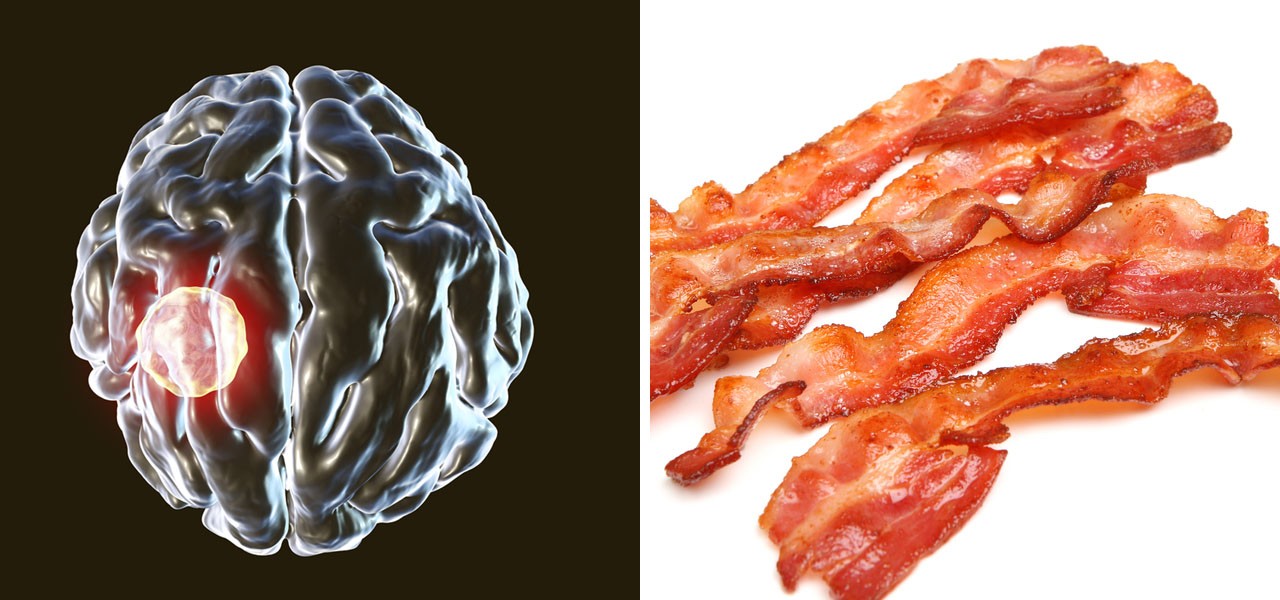
A 52-year-old man was admitted to hospital after suffering from severe migraines and intense back pain for weeks.
At first, doctors had no obvious explanation for what was happening.
Then medical scans revealed something highly unusual.
His brain contained multiple cyst-like lesions.
Further testing showed that the lesions were actually associated with tapeworm larvae, leading doctors to diagnose him with a form of infection known as neurocysticercosis.
The unusual case eventually led physicians to investigate the man’s eating habits—and one lifelong preference stood out.
He liked his bacon soft and lightly cooked.
Doctors Found Something Unexpected in His Brain

The patient had been experiencing severe migraine-like headaches along with significant pain across his back.
Because his symptoms persisted, doctors ordered a series of tests to determine what was causing them.
Brain imaging revealed multiple cyst-like abnormalities.
Initially, the appearance of the lesions made the diagnosis difficult.
Further examination, however, showed that the cysts were consistent with cysticercosis, an infection caused by the larval stage of the pork tapeworm Taenia solium.
When the larvae affect the nervous system, the condition is known as neurocysticercosis.
It can produce lesions in the brain and may cause symptoms such as headaches, seizures, confusion, or other neurological problems depending on where the lesions develop.
What Is Cysticercosis?
Cysticercosis is a parasitic infection caused by Taenia solium, commonly known as the pork tapeworm.
The infection occurs when a person accidentally ingests microscopic tapeworm eggs.
Those eggs can develop into larvae, which may travel through the body and form cysts in tissues.
When the larvae reach the brain or central nervous system, the condition becomes neurocysticercosis.
This is different from simply having an adult tapeworm living in the intestine.
The distinction is important because people can develop cysticercosis by swallowing tapeworm eggs through contaminated food, water, or hands.
The Connection to Pork Is More Complicated Than It Sounds
The patient’s preference for undercooked bacon attracted attention because Taenia solium is associated with pigs.
However, it is important to understand the transmission process correctly.
Eating undercooked pork can cause taeniasis, meaning an adult pork tapeworm can develop in the intestine if the meat contains viable cysticerci.
But neurocysticercosis occurs when a person ingests T. solium eggs.
In other words, simply saying that “undercooked pork causes brain cysts” is an oversimplification.
The patient’s eating habits were considered a possible risk factor in the reported case, but the exact route by which the infection was acquired cannot automatically be determined from a preference for lightly cooked bacon alone.
His Bacon Preference Became an Important Clue
According to the case report, the man had a lifelong preference for bacon that was soft rather than crispy.
He reportedly preferred it lightly cooked, with the meat remaining close to its original texture.
Once doctors identified the parasitic infection, his dietary history became particularly relevant.
The case authors noted that undercooked pork consumption represented a theoretical risk factor.
The unusual diagnosis was especially noteworthy because infected pork has historically been considered uncommon in the United States.
That made the case medically interesting beyond the individual patient.
Why Can a Tapeworm Affect the Brain?
After Taenia solium eggs are swallowed, the microscopic larvae can enter the bloodstream.
From there, they may travel to different parts of the body.
In some cases, larvae can reach the nervous system and develop into cysts.
The immune system can react when those cysts begin to degenerate, producing inflammation around the affected area.
That inflammation can contribute to neurological symptoms.
Depending on the number, size, and location of the lesions, patients may experience headaches, seizures, vision problems, balance difficulties, or other neurological symptoms.
Some people may have few or no noticeable symptoms.
Others can become seriously ill.
The Condition Can Be Difficult to Diagnose
Neurocysticercosis can be challenging to identify because its symptoms are not necessarily unique.
Headaches, for example, are extremely common and can have countless causes.
A doctor therefore has to consider a patient’s symptoms alongside imaging results, medical history, laboratory testing, and other evidence.
Brain scans can provide important clues because the appearance of cystic lesions can change depending on the stage of the parasite’s development.
In some cases, additional tests are needed to confirm the diagnosis.
The man’s case demonstrates why unusual symptoms sometimes require doctors to look beyond the most obvious explanations.
He Required Intensive Treatment

The patient reportedly spent several weeks receiving intensive medical care.
Treatment included antiparasitic medication designed to target the infection.
He also received anti-inflammatory medication to help manage inflammation associated with the lesions.
Treatment for neurocysticercosis varies depending on factors such as the number and location of cysts, whether the parasites are alive or degenerating, and the symptoms they are causing.
Doctors may also prescribe medications to control complications such as seizures or swelling.
Because treatment can itself trigger inflammation as parasites die, medical supervision is particularly important.
Why Properly Cooking Pork Matters
Although the patient’s case should not be reduced to a simple “bacon causes brain worms” story, food safety remains important.
Raw or undercooked pork can carry harmful organisms, including parasites and bacteria.
Cooking meat thoroughly reduces the risk of foodborne illness.
Bacon can be somewhat difficult to judge by appearance alone because it is thin and changes texture quickly during cooking.
For that reason, following reliable food-safety guidance is safer than relying entirely on whether bacon looks crispy or soft.
People should also prevent cross-contamination by washing their hands and cleaning utensils and surfaces that have come into contact with raw meat.
Bacon Texture Isn’t a Medical Test
The case may make some people wonder whether soft bacon is automatically dangerous.
It isn’t that simple.
The texture of cooked bacon does not tell you whether it contains a particular parasite.
Likewise, eating crispy bacon does not guarantee protection against every foodborne illness.
The safest approach is to follow established food-safety practices when preparing pork and other meats.
This includes appropriate cooking, refrigeration, hygiene, and preventing raw meat from contaminating ready-to-eat foods.
A Rare Case With a Bigger Lesson
What makes this medical story so striking is the combination of ordinary behavior and an extraordinarily unusual diagnosis.
The man had enjoyed bacon prepared a certain way for much of his life.
He probably had no reason to believe that his breakfast preference could become relevant to a neurological investigation.
Yet when doctors were trying to understand the unusual lesions in his brain, his dietary history became an important piece of the puzzle.
It is a reminder that doctors often need to consider seemingly unrelated details when investigating unexplained symptoms.
Diet.
Travel history.
Living conditions.
Animal exposure.
Medications.
And everyday habits can all provide useful clues.
Don’t Panic Over Bacon
Stories involving parasites can understandably sound frightening.
But there is no reason for people to panic simply because they occasionally eat bacon.
Neurocysticercosis is not something that can be diagnosed by looking at a person’s diet alone.
The infection involves a specific parasite and a specific route of transmission.
People should focus on practical food-safety habits rather than becoming alarmed by one unusual medical case.
Cooking pork appropriately, maintaining good kitchen hygiene, washing hands, and preventing cross-contamination are sensible precautions.
When Should You Seek Medical Attention?
Persistent or severe headaches should not automatically be blamed on food.
Most headaches are caused by conditions unrelated to parasitic infections.
However, severe headaches accompanied by neurological symptoms—such as seizures, confusion, significant vision changes, weakness, or difficulty speaking—require prompt medical evaluation.
A healthcare professional can determine whether additional testing is necessary.
Trying to diagnose a neurological condition based on symptoms or internet stories alone can be misleading.
The Mystery Was Finally Solved
For weeks, doctors had been faced with a puzzling medical problem.
A middle-aged man was experiencing severe headaches and back pain.
Brain imaging revealed unusual cyst-like lesions.
Further investigation showed that the abnormalities were associated with tapeworm larvae.
His medical team then learned about his lifelong preference for lightly cooked bacon, which provided a possible clue to the patient’s exposure history.
The diagnosis was unusual enough to attract medical attention because such infections are considered uncommon in the United States.
But the case also illustrates why medical stories involving food should be interpreted carefully.
The relationship between pork, Taenia solium, taeniasis, and cysticercosis is real—but it is more complicated than simply eating undercooked pork and developing parasites in the brain.
The Takeaway
The man’s unusual diagnosis serves as a powerful reminder that the human body can sometimes present doctors with unexpected mysteries.
His severe headaches led to brain imaging.
The scans revealed lesions.
Further investigation identified a parasitic infection.
And his dietary history provided doctors with an important potential clue.
The story is certainly a reminder to take food safety seriously, particularly when preparing pork.
But it is equally important not to turn a rare medical case into an inaccurate health warning.
Undercooked pork can carry health risks, but neurocysticercosis is specifically associated with infection by the eggs of Taenia solium, not simply with eating bacon that isn’t crispy.
For anyone experiencing persistent or unusual neurological symptoms, the safest response isn’t to guess at the cause—it’s to speak with a qualified healthcare professional.
And when it comes to bacon, the simplest rule remains the most useful one: prepare pork safely, maintain good kitchen hygiene, and don’t rely on appearance alone to determine whether meat is safe to eat.