
When people first saw Matilda Rose Callaghan, they often noticed her face before they noticed her smile.
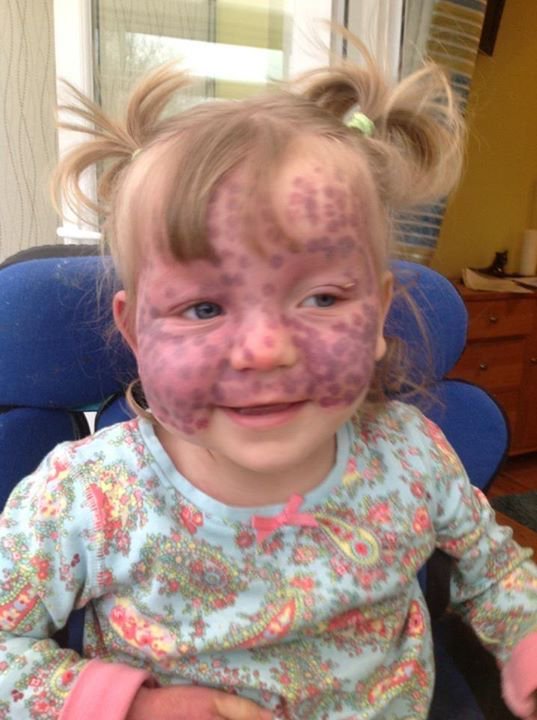
Her appearance was different from what many people expected to see in a young child. Distinctive marks covered parts of her face, and later, medical treatments left temporary patterns on her skin.
For Matilda’s parents, however, those marks were never the most important thing about their daughter.
They saw a brave little girl who had already overcome enormous challenges and who deserved to be treated with the same kindness and curiosity as any other child.
But when the family went out in public, they sometimes encountered strangers who stared, whispered, or made assumptions without knowing anything about Matilda’s medical history.
Her parents eventually decided that instead of allowing those reactions to define their daughter’s story, they would explain what was really happening.
Their message was simple: look beyond the appearance and see the person.

A Difficult Beginning
Matilda’s story began before she was even born.
Her pregnancy had been complicated, and she was delivered prematurely. At the time, neither her parents nor the medical team fully understood the challenges their daughter would face.
When Matilda was born, doctors noticed unusual dark red and blue markings on her face.
At first, the marks were thought to be related to the circumstances surrounding her birth.
It soon became clear that there was more to the story.
Further medical evaluation revealed that Matilda had Sturge-Weber syndrome, a rare neurological condition that can be associated with distinctive port-wine stains on the skin.
The condition can affect different parts of the body and may involve neurological or eye-related complications, although experiences vary considerably from person to person.
For Matilda’s family, learning about the condition meant entering a world of medical appointments, treatments, and uncertainty.

Understanding Sturge-Weber Syndrome
Sturge-Weber syndrome is a rare condition that affects blood vessels and can involve the skin, brain, and eyes.
One of its most recognizable features is a port-wine stain.
These birthmarks are caused by an abnormal development of tiny blood vessels near the surface of the skin.
They are not bruises, and they are not caused by something a parent has done.
Their appearance can range from light pink to deeper red or purple, and they may become more noticeable over time.
Importantly, having a port-wine stain does not automatically mean that a person has Sturge-Weber syndrome.
A medical professional must evaluate the individual and consider other signs and symptoms before making a diagnosis.
This distinction is important because a visible birthmark can tell only a small part of someone’s story.
Treatment Became Part of Matilda’s Childhood
Matilda’s parents worked closely with doctors to manage her condition.
Laser treatment was among the approaches used to treat the appearance of her birthmarks.
For some people with port-wine stains, laser therapy can gradually lighten the affected skin.
Treatment usually requires multiple sessions rather than producing an immediate change.
For Matilda, the treatments became a regular part of her childhood.
After some sessions, temporary spots could appear across her face.
The marks eventually faded, but because treatments were repeated, there were periods when the pattern was particularly noticeable.
To someone unfamiliar with the treatment, her appearance could be confusing.
To her parents, however, the spots represented something completely different.
They were evidence of a family doing everything possible to support their daughter’s health and well-being.
When Strangers Made Assumptions
This was one of the hardest parts for Matilda’s parents.
People sometimes stared at her face.
Some appeared confused by the markings.
Others made assumptions about what they were seeing.
The problem was not simply that people noticed that Matilda looked different.
It was that some people formed conclusions without knowing anything about her.
Her parents feared that such reactions could eventually affect Matilda’s confidence as she grew older.
A child should be able to walk through a store, visit a park, or spend time with family without feeling that everyone is judging her appearance.
The Callaghans wanted people to understand that there was a medical explanation for what they saw.
More importantly, they wanted strangers to remember that there was a person behind the appearance.
A Father’s Message
Matilda’s father expressed his frustration with people who immediately assumed the worst.
His message was essentially a plea for people to pause before judging.
A stranger looking at Matilda could see a birthmark.
Her parents saw their daughter.
They knew her personality, her challenges, her favorite moments, and all the small things that made her special.
That difference in perspective is at the heart of Matilda’s story.
A person’s appearance may be the first thing we notice, but it is never the complete story.
More Than a Birthmark
For children with visible medical conditions, public reactions can become an unexpected part of everyday life.
A child may notice people staring long before they understand why.
As they grow older, they may begin asking questions about their appearance or wondering why they receive attention from strangers.
Parents cannot control every reaction their child encounters.
What they can do is provide reassurance and help the child understand that being different does not make them less valuable.
For Matilda, her family became her strongest source of support.
They advocated for her care and tried to give her opportunities to experience childhood as fully as possible.
The Challenges Extended Beyond Her Skin
Matilda’s medical journey involved more than her visible birthmarks.
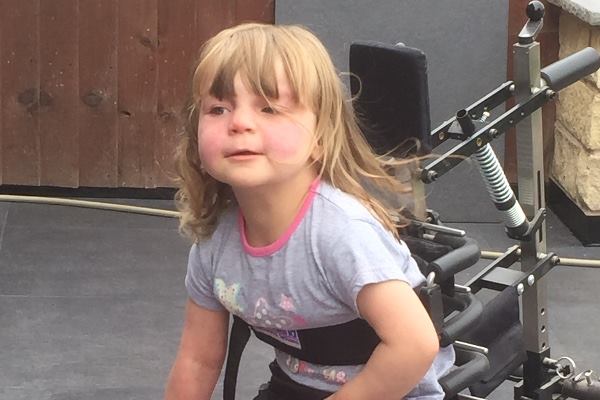
According to her family’s account, she also experienced significant developmental and physical challenges.
At one point, she had difficulty walking independently and communicating.
These challenges meant that ordinary activities could require additional patience and support.
Yet her parents remained focused on what she could do rather than defining her entirely by what was difficult.
That approach can make an enormous difference for children growing up with disabilities or medical conditions.
Support does not mean pretending that challenges do not exist.
It means making sure those challenges do not become the only thing people see.
Why Children With Visible Differences Deserve Understanding
Human beings naturally notice things that are unfamiliar.
A distinctive birthmark, wheelchair, medical device, or unusual physical feature may attract attention simply because it is different from what someone is accustomed to seeing.
Noticing something is not necessarily wrong.
The important question is what happens next.
Do we stare?
Do we whisper?
Do we make assumptions?
Or do we simply continue treating the person with dignity?
A little curiosity is natural.
Compassion should come before judgment.
If someone wants to explain their condition, listen.
If they do not, respect their privacy.
And when a child is involved, remember that the child may already be aware of every glance directed toward them.
What Matilda’s Story Teaches Us
Matilda’s story is not simply about a rare medical condition.
It is about perception.
We often believe we understand a situation after seeing only a few details.
But appearances can be misleading.
A mark that looks unusual may have a medical explanation.
A child who communicates differently may have a great deal to say.
A person who moves differently may still share the same hopes, humor, curiosity, and dreams as everyone else.
The lesson is remarkably simple: we should never assume that what we see tells us everything we need to know.
How Parents Can Support Children With Visible Differences
Families facing similar situations may find that preparation and communication can help.
Children can be given age-appropriate explanations about their condition so they understand why their appearance or abilities may be different.
Parents can also teach children that questions from other people do not determine their worth.
At the same time, children should never be expected to educate every stranger they meet.
It is perfectly reasonable to protect personal privacy.
Parents can also work with teachers and caregivers to create supportive environments where differences are treated respectfully.
The goal is not to make every child look or behave the same.
The goal is to make sure every child has the opportunity to feel accepted.
Looking Beyond the Surface
Matilda’s parents shared her story because they wanted people to understand what their family was experiencing.
Their hope was not simply that strangers would stop staring.
They wanted people to become more thoughtful about how quickly they judge someone based on appearance.
A child with a visible difference does not need pity.
They need understanding.
They need encouragement.
And most importantly, they need the freedom to be seen as a complete person rather than as a diagnosis or a birthmark.
Matilda’s journey also reminds us that medical conditions are often much more complicated than what can be seen from the outside.
The visible part may be only one small piece of a much larger story.
A Reminder to Pause Before We Judge
The next time you see someone who looks different, there is no need to immediately search for an explanation.
You may not know their story.
You may not know what their family has experienced.
You may not know how hard they have worked simply to reach an ordinary day.
And you certainly cannot know someone’s character from their appearance.
Matilda’s parents wanted the world to see the child behind the birthmark.
That message remains relevant far beyond her particular story.
Every person carries experiences that strangers cannot see.
Sometimes the kindest thing we can do is simply pause, avoid assumptions, and remember that there is always more to a person than what appears on the surface.
In the end, Matilda’s story is not really about a mark on her face.
It is about a little girl surrounded by people who love her, a family learning to navigate challenges together, and a reminder that compassion begins when curiosity stops becoming judgment.
And perhaps that is the most important lesson of all: look a little longer, judge a little less, and remember the person behind what you see.