
At first glance, the photograph seems perfectly ordinary.
Six young women are sitting together on a couch, smiling for the camera. Nothing appears unusual until you start counting their legs.
One pair.
Two pairs.
Three.
Four.
Five.
Wait… where is the sixth pair?
That simple observation is what turned this photograph into an enduring internet puzzle. Viewers have spent years looking closely at the image, pointing at different knees, socks, shoes, and crossed legs while trying to work out how six people can apparently have only five visible pairs of legs.
The answer is much less mysterious than it first appears.
It is a classic example of how our brains interpret incomplete visual information. When people are sitting close together, overlapping limbs, similar clothing, shadows, and unusual body positions can make separate objects appear connected.
So why does this particular photograph confuse so many people?
What Is an Optical Illusion?

An optical illusion occurs when what we perceive does not perfectly match the physical arrangement of the objects in front of us.
That does not mean our eyes are malfunctioning.
Instead, our visual system is constantly interpreting information and making rapid assumptions about what we see.
The Queensland Brain Institute explains that optical illusions can occur when the brain and eyes process visual information in ways that produce an unexpected interpretation.
Our brains are not simply cameras recording every detail.
They organize shapes, colors, edges, movement, distance, and patterns to create a useful picture of the world.
Most of the time, this happens so efficiently that we never notice the process.
Optical illusions give us a rare opportunity to see that process in action.
Six Girls, Five Visible Pairs of Legs
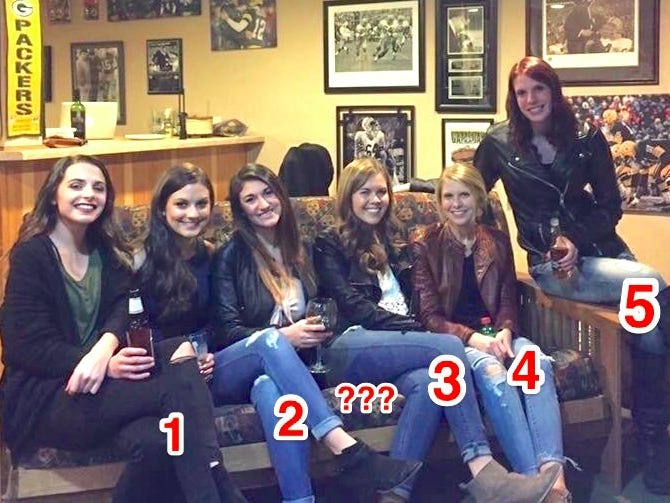
The photograph that inspired this puzzle shows six girls sitting closely together on a couch.
At first, the most obvious feature is the apparent mismatch between the number of people and the number of visible pairs of legs.
Because everyone is positioned close together, several legs overlap.
Some are crossed.
Others are angled in unusual directions.
The clothing also creates visual confusion because neighboring legs can appear to belong to the same person.
This makes the brain’s first interpretation surprisingly convincing.
The photograph isn’t necessarily showing five pairs of legs.
Rather, one person’s legs are partially hidden or visually blended with another person’s legs.
Once you understand the arrangement, the photograph suddenly looks completely different.
Where Are the “Missing” Legs?
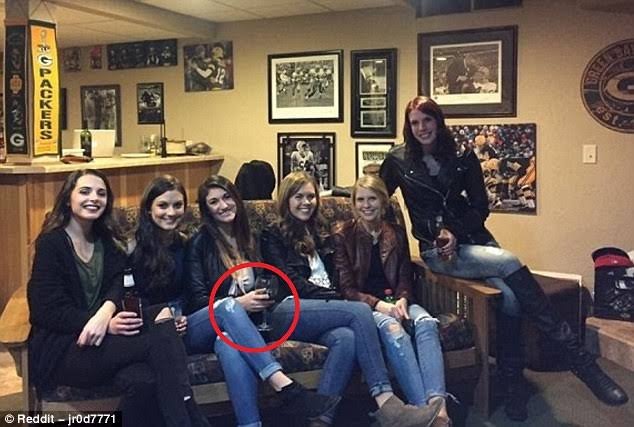
The most commonly proposed solution focuses on the women toward the middle of the photograph.
The second woman from the left appears to have only one obvious leg.
However, the other leg is positioned behind or overlaps with the legs of the woman beside her.
Because the colors, positions, and edges blend together, the brain naturally groups parts of the image incorrectly.
This is particularly effective because we generally expect each person to have two visible legs when seated in a group photograph.
When one leg is hidden, the brain attempts to complete the picture.
That is where the illusion becomes convincing.
The Important Clue Is in the Clothing
One of the easiest ways to understand the photograph is to stop looking at the entire group.
Instead, focus on individual details.
Look closely at the knees, clothing patterns, tears in the fabric, socks, and changes in texture.
These small details can help identify where one person’s leg ends and another person’s begins.
The apparent single leg in the middle of the image contains visual clues that separate the overlapping limbs.
Once you trace those details carefully, the illusion starts to fall apart.
This is a useful lesson in visual perception.
Sometimes the information needed to solve an optical illusion is right in front of us.
We simply don’t know which details are important.
Why Does the Brain Get Confused?
Our brains are constantly trying to organize visual information.
Imagine looking at six people sitting together in a dimly lit room.
You would not consciously calculate the exact boundaries of every arm, leg, shoe, and piece of clothing.
Instead, your brain would quickly create a general interpretation.
That efficiency is useful in everyday life.
But when a photograph contains unusual overlaps, the same system can produce an unexpected result.
The brain may assume that two connected-looking shapes belong to the same person.
It may also ignore boundaries that are difficult to see.
In the “missing legs” photograph, these effects work together.
Gestalt Principles Help Explain the Illusion
Psychologists studying perception have identified several principles that help explain how humans organize visual information.
One of the best known is the Gestalt approach.
Gestalt psychology emphasizes that people tend to perceive objects as organized wholes rather than as collections of completely separate pieces.
Several principles are particularly relevant to optical illusions.
Proximity
Objects positioned close together are often perceived as belonging together.
In this photograph, the girls are sitting extremely close to one another.
Their legs naturally overlap within the same small area of the image.
That makes it more difficult to determine which limb belongs to which person.
Similarity
Objects that look alike can also be grouped together.
The women are wearing similar types of clothing, and several legs have similar colors and textures.
That makes visual separation more challenging.
Continuity
The brain tends to interpret lines and shapes as continuing smoothly rather than abruptly changing direction.
Overlapping legs can therefore appear to form a continuous shape.
The result is a visual puzzle that feels more complicated than it really is.
Why Counting Makes the Illusion Worse
There is another reason this photograph is so effective.
Once someone tells you there are six girls but only five pairs of legs, you immediately begin counting.
That changes the way you look at the photograph.
Instead of simply seeing six people, you start searching for an error.
Your attention moves from face to face, then downward toward knees, shoes, and socks.
Every ambiguous shape suddenly becomes suspicious.
This is a classic example of how expectations influence perception.
You are no longer simply observing the photograph.
You are actively trying to prove that something is wrong.
The Internet Made the Puzzle Even More Interesting
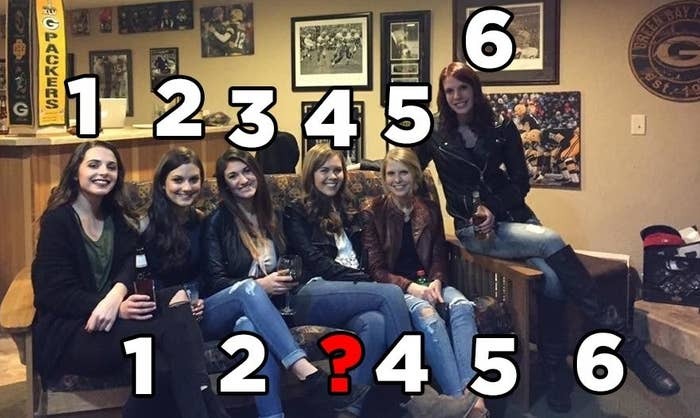
The photograph became popular through online discussions, where users attempted to solve the apparent mystery.
Some theories were straightforward.
Others became increasingly complicated.
That is part of what makes visual puzzles so entertaining online.
A photograph can take only a few seconds to create, yet thousands of people can spend hours debating what they are seeing.
When someone finally provides an explanation, the experience can be strangely satisfying.
You go from confusion to understanding almost instantly.
Why the Answer Feels Obvious Afterwards
One of the defining features of a good optical illusion is that the solution often seems obvious once it has been explained.
Before the explanation, the image looks impossible.
Afterward, you may wonder how you failed to notice the answer immediately.
This happens because your brain has changed its interpretation.
The information in the photograph has not changed.
Your perception of it has.
This phenomenon is common across many visual puzzles.
Once the correct pattern becomes recognizable, it becomes difficult to return completely to your original interpretation.
Optical Illusions Are Not New
Although internet users have made optical illusions incredibly popular, the fascination with visual puzzles is much older than social media.
Artists, psychologists, scientists, and philosophers have studied visual perception for centuries.
People have long been interested in questions such as how we recognize objects, how we perceive depth, and why two people can look at the same image yet interpret it differently.
Modern neuroscience has provided increasingly detailed explanations of these processes.
Researchers now understand that perception involves complex interactions between sensory information and the brain’s expectations.
In other words, seeing is not quite as simple as it feels.
Your Brain Is Constantly Making Predictions
One important idea in modern neuroscience is that the brain does more than receive information.
It also makes predictions.
When you see an object, your brain uses previous experience to help interpret incomplete or ambiguous information.
For example, if you see a familiar object partially hidden behind another object, you can usually identify it immediately.
You don’t need to see every part.
Your brain fills in the missing information.
This ability is incredibly useful.
Without it, everyday visual experiences would be much more difficult.
But optical illusions reveal the limitations of this shortcut.
Why Similar Clothing Makes This Puzzle Effective
The photograph also benefits from a simple visual trick: the clothing does not provide strong enough boundaries between neighboring legs.
If every woman had dramatically different colors and patterns, identifying each leg would probably be easier.
Instead, similar shades and overlapping positions make the limbs appear connected.
The eye has fewer obvious landmarks to use.
This is why small details such as a sock or a seam can suddenly become extremely important.
A tiny visual boundary can completely change how the brain interprets the larger image.
How to Solve the Puzzle Yourself
If you want to understand the illusion without immediately looking at an annotated answer, try this method.
First, count the people.
Then ignore their faces.
Look only at the lower half of the image.
Instead of asking, “Where is the missing pair?” ask, “Which legs clearly belong to each person?”
Start from the outside of the group and work inward.
Follow each leg from the knee toward the foot.
Pay particular attention to clothing boundaries.
Look for socks, shoes, seams, and changes in texture.
Eventually, you can reconstruct the positions of the overlapping legs.
The key is to stop looking at the photograph as one complete picture.
Break it into smaller visual pieces.
The “Missing Legs” Were Never Really Missing
That is ultimately the trick.
The photograph does not require a mysterious explanation.
The apparent discrepancy comes from the way the women’s legs overlap and from how their clothing and positions make those boundaries difficult to recognize.
Once the individual limbs are separated mentally, the puzzle becomes much easier.
The photograph is therefore a wonderful demonstration of a simple principle:
What we see is influenced by how our brains organize what reaches our eyes.
Why People Love Optical Illusions
There is something universally appealing about a visual puzzle.
It gives us a small challenge with an immediate reward.
We look at an image and think we understand it.
Then someone points out something that doesn’t make sense.
Suddenly, we want to solve it.
That curiosity is one reason optical illusions continue to spread across social media.
They are easy to understand, easy to share, and naturally encourage conversation.
One person sees the solution immediately.
Another may stare at the image for several minutes.
And someone else may still insist that the explanation cannot possibly be correct.
That disagreement is part of the fun.
A Simple Picture With a Bigger Lesson
The six-girls photograph may seem like nothing more than an entertaining internet puzzle.
But it also demonstrates something fascinating about human perception.
Our brains are remarkably good at turning incomplete visual information into coherent scenes.
Most of the time, that ability helps us navigate the world efficiently.
Sometimes, however, it produces a surprising result.
A hidden leg becomes invisible.
Two separate objects appear connected.
A perfectly ordinary photograph suddenly looks impossible.
And then, with one small clue, everything makes sense.
Conclusion: Seeing Is More Complicated Than We Think
The mystery of the six girls and five visible pairs of legs is ultimately not about a missing limb.
It is about perception.
The photograph takes advantage of overlapping positions, similar visual patterns, hidden portions of the body, and the brain’s natural tendency to organize information into meaningful groups.
Once you identify the middle legs and follow the visual clues in the clothing, the illusion becomes much easier to understand.
Yet the most interesting part may be what happens before the solution is revealed.
For a few moments, the photograph challenges something we normally take for granted: our confidence in what we see.
That is why optical illusions remain so fascinating.
They remind us that perception is an active process, not simply a perfect recording of reality.
And perhaps that is why a simple photograph of six friends sitting on a couch can keep thousands of people looking, counting, questioning, and laughing.
Sometimes, all it takes to make us curious is one pair of legs that appears to be missing.