Chapter 1: The Disappearing Fence
I came home on a Tuesday afternoon carrying a bag of groceries in one hand and the kind of tired brain that only wants dinner and quiet. The sun was still high over our Central Ohio subdivision, turning every driveway pale and making every lawnmower louder than it needed to be. I remember thinking about grilling burgers. That was how ordinary the day was supposed to be.
Then I opened my back door and saw too much sky.
For a second, my mind refused to understand what my eyes were seeing. My backyard looked unnaturally large, bright, and completely exposed. The six-foot cedar privacy fence that had separated my property from the house next door for nearly fifteen years was gone.
Not broken. Not partly removed. Entirely gone.
The posts had been pulled from the ground, the panels stacked in piles beyond where the boundary should have been, and the entire private side of my house stood wide open to Vanessa Reed’s chaotic construction site.
Vanessa had moved in eight months earlier. She was a successful real estate agent—polished, divorced, and permanently busy. We had never been close friends, but we had always been civil. I waved when she drove past; she waved when she saw me taking the trash bins to the curb. That was the extent of our relationship, and it had been enough.
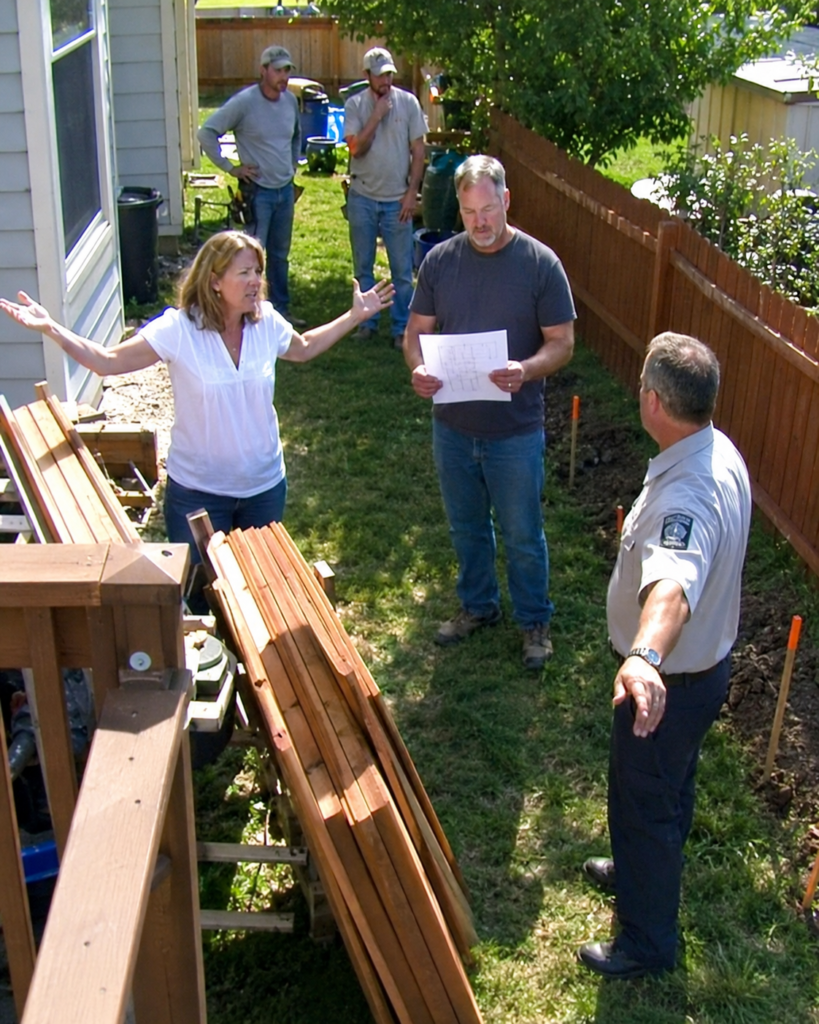
Her yard that afternoon looked like a renovation project that had completely lost control. Half of her old wooden deck was stripped open, patio stones sat in square piles on the grass, and contractors carried heavy lumber back and forth while a radio scratched out music near a toolbox. My cedar fence panels were stacked behind them like salvage from a job site.
I walked across the grass toward the property line. One contractor saw me coming and immediately looked down at his boots. That subtle movement told me everything. People who believe they are doing clean, legal work do not avoid the property owner’s gaze.
Vanessa noticed me and smiled brightly. “Perfect timing, Ethan!” she called out, sounding as cheerful as a marketing brochure. “I was just going to talk to you.”
I looked at the stacked cedar panels. “You were?”
“We’re replacing that old fence,” she said smoothly. “It was falling apart anyway.”
I stood there, waiting for her sentence to correct itself. It didn’t.
“You mean my fence,” I said quietly.
Her smile tightened just enough to reveal irritation rather than confusion. “It was shared.”
“No,” I replied. “It wasn’t.”
She crossed her arms, stepping over a pile of sawdust. “It was right on the property line.”
“Do you have a survey?” I asked.
That single question changed her face. Just a slight shift, but enough to show a crack in her composure. “Not with me,” she said.
“Have you ever seen one?”
She looked toward the framing of her half-built deck, then back at me. “The previous owner told me it was a shared boundary fence.”
There are sentences that tell you a person made an honest mistake. Then there are sentences that tell you a person built an entire expensive plan on top of a baseless assumption. This was the second kind.
Vanessa gestured toward her construction crew as if the beauty of her planned deck should make the lack of permission irrelevant. “We’re putting in a modern horizontal fence,” she explained. “Black metal posts, cedar slats. It’s going to look amazing.”
Amazing. People love to use that word when they want the final result to matter more than the illegal way they achieved it.
“You removed a permanent structure that didn’t belong to you,” I said firmly.
She sighed openly, treating me like a minor scheduling inconvenience. “Ethan, it’s just an old fence.”
I almost answered too quickly. I almost gave her the emotional argument she expected. But instead, I remembered my grandfather’s advice. He used to say that when someone creates a problem for you, the first thing to do is check whether they are standing on solid ground. If they aren’t, you simply let the ground teach them the lesson.
I turned around and walked back into my house.
Chapter 2: Five Inches of Truth
The groceries remained on the kitchen counter. I walked straight into my home office and opened the metal filing cabinet filled with closing documents, property deeds, insurance policies, and repair receipts—the dull paperwork of adulthood that nobody appreciates until a neighbor makes it priceless.
After twenty minutes of searching, I found the official land survey from when I purchased the house fifteen years ago. I spread the thick paper across the desk and followed the boundary line with my index finger.
Then I sat back in my chair.
The fence had not been built on the property line. It had been constructed five inches inside my legal property boundary.
Five inches sounds insignificant when people are speaking casually over a beer. But five inches becomes monumental when concrete posts, building permits, contractors, city inspectors, and property liability gather around it. Every single post hole belonged to me. Every panel belonged to me. The fence was not shared, not straddling the line, and absolutely not hers to demolish.
Early the next morning, I hired a licensed land surveyor. By late afternoon, bright orange wooden stakes marked the exact boundary line from the front yard to the back alley. The freshly dug post holes left by Vanessa’s crew sat clearly and indisputably on my side of the orange string.
Vanessa stepped out onto her patio holding an iced coffee and froze when she saw the bright markers. “That can’t be right,” she said, her voice rising.
“The licensed surveyor says it is,” I told her, standing near the line.
“There has to be some kind of mistake!”
“Maybe,” I replied calmly. “But you will need to hire your own licensed surveyor to legally prove that.”
She stared at the open dirt holes. Then she said something that still makes me shake my head: “Well, it needed replacing anyway.”
That was the moment I realized this was never truly about an old wooden fence. It was about an arrogant mindset—a person who believed her personal design preferences could substitute for my legal permission.
I asked her to immediately halt all construction along that side of the yard until the boundary issue was formally resolved.
She laughed dismissively. “You can’t tell me how to run my home renovation.”
“Maybe not,” I said softly. “We’ll see.”
That evening, I called the city building and zoning department. I didn’t yell, and I didn’t demand punishment. I simply explained that an active deck expansion was currently underway next door, that a boundary structure had been removed without consent, and that a certified survey showed the construction was encroaching onto my property. I asked whether the site needed to be reviewed for setback compliance.
The official on the line grew instantly attentive. She asked for the permit numbers, took detailed notes, and informed me that a senior building inspector would review the site.
Two mornings later, a white city vehicle parked in front of Vanessa’s house. I happened to be working from home that day, and I decided my front flower beds required watering at that exact moment.
The inspector spent nearly two hours reviewing the site next door. He measured the precise distance between my orange stakes and the wooden framing of Vanessa’s new deck. He compared her approved permit drawings to the actual site conditions, took high-resolution photos of the empty post holes, and questioned her project manager.
The project manager’s answers clearly failed to satisfy him. By noon, the entire atmosphere next door had collapsed.
The electric nail guns fell silent. The circular saws stopped humming. The construction workers stood around with hands on their hips, checking their phones and doing the mental math that contractors do when work comes to a sudden, expensive halt.
Vanessa rushed from worker to worker, her voice low and furious. Then, the city inspector attached a bright red document to her permit board.
The city had officially issued a stop-work order.
It wasn’t because of the fence style itself. It was because the verified property boundary revealed that her new deck design violated the city’s mandatory side-yard setback requirements by several inches. The fence she had torn down to speed up her dream project had become the exact obstacle that brought it to a grinding halt.
Chapter 3: The Cost of Convenience
That evening, a sharp knock rattled my front door.
The woman standing on my porch was a far cry from the confident neighbor who had smiled over my stacked cedar panels three days earlier. Her composure had evaporated, replaced by raw frustration.
“You did this,” she said bitterly.
“No,” I replied evenly. “I simply documented the facts.”
She hated that answer because it offered no legal foothold for her anger. “This delay is costing me thousands of dollars,” she snapped. “The contractors are charging daily rescheduling fees, and my building materials are sitting out in the weather!”
“That is very unfortunate,” I said.
Her eyes narrowed into tight slits. “You’re enjoying this, aren’t you?”
I considered her question carefully. The honest answer was nuanced. I took no joy in seeing someone lose money, nor did I want an ongoing feud with a neighbor. But I did feel a quiet sense of relief, because real-world consequences had finally arrived in a language she understood.
“I’m not enjoying it,” I told her. “I’m just not surprised.”
For a long moment, she looked past me toward the bright orange stakes still glowing in the fading light of the side yard. Then, she asked the first practical question of the entire week: “What do you want?”
I invited her to sit on the porch chairs. Cars passed quietly down the street, kids rode their bicycles, and someone a few houses down was mowing their lawn as if nothing were wrong.
I asked her whether she had verified ownership before destroying the fence. She admitted she hadn’t. I asked whether she had bothered to ask my permission. She shook her head. I asked whether her contractor had requested a land survey before breaking ground. She admitted he hadn’t.
“Then here we are,” I said simply.
Vanessa stared out at the street for a long time. “I honestly thought it wasn’t a big deal.”
That was likely the most honest statement she had made all week. Most preventable legal disputes do not begin with malicious intent; they begin with convenience. They start when someone convinces themselves that asking permission will slow down their timeline, assuming the other party won’t mind.
Assuming is a very expensive word around legal property boundaries.
I clearly laid out my non-negotiable terms:
-
The boundary fence would be completely rebuilt on my property, exactly where it had originally stood.
-
It would be a six-foot, high-quality cedar privacy fence matching the original design.
-
The support posts would be set deeply in solid concrete footings.
-
She would cover one hundred percent of the total cost.
-
Going forward, any construction affecting the boundary line would require formal written consent prior to touching a single board.
I braced for an argument, but she remained silent. The mathematical reality had shifted for her. Every single day of delay was costing her hundreds in contractor fees. Rebuilding my fence was no longer an expensive burden—it was her only legal route to getting her building permit reinstated.
“That’s a lot of money,” she murmured.
“So was destroying my private property,” I replied.
A few days later, she signed the agreement. There was no dramatic apology or tearful confession, but I preferred her quiet acceptance of reality over a hollow performance.
Chapter 4: Two Fences, One Lesson
Two weeks later, a professional fencing company arrived at dawn on a Monday morning.
They measured the boundary line meticulously, checking and re-checking their laser levels against my orange stakes. Nobody guessed. Nobody relied on memory. Nobody repeated what a previous homeowner had allegedly claimed.
The new fence was erected over three days—fresh, fragrant cedar panels anchored by heavy-duty posts set in deep concrete footings. By Wednesday evening, I walked out into my backyard and ran my hand along the smooth wood. The sense of security had returned to my yard.
After a secondary inspection confirmed the fence was situated entirely within my boundary line, the city finally lifted the stop-work order. Vanessa’s deck crew returned, the nail guns resumed their rhythmic pounding, and the neighborhood returned to its normal routine.
However, the final detail of the story is what makes the situation truly unforgettable.
Vanessa still wanted her modern horizontal fence with black metal posts and dark-stained cedar slats. But this time, she built it entirely on her own side of the line—exactly three inches away from mine.
Today, two distinct fences run side by side down the length of our backyards. Mine and hers. Parallel, separate, and mathematically impossible to confuse.
When visitors see the setup, they almost always laugh. They ask why two neighbors would ever need two full privacy fences sitting just inches apart. I usually tell them it’s a long story about land surveys.
From a distance, the arrangement looks absurd. Up close, it represents absolute clarity.
No one has to guess anymore. No one has to rely on casual verbal agreements or assumptions. Most importantly, no neighbor gets to decide that my property belongs to them simply because it makes their home renovation easier.
Vanessa and I remain civil. We exchange brief waves when pulling out of our driveways and politely comment on the weather if we are both working in the yard. It isn’t a warm relationship, but it is an orderly one. We are two property owners who learned each other’s boundaries the expensive way.
I have often wondered how different things might have been if she had simply knocked on my door before bringing in the crowbars. I might have agreed to replace the old fence, or perhaps even contributed to the cost of a shared design. But that opportunity vanished the moment she treated my consent as optional.
People often ask if I regret standing my ground over a few inches of dirt. I tell them that wood can be replaced and money can be earned back, but the fence was never just about wood. It was about a fundamental rule of living in a community: you do not take what isn’t yours, and when you cross a boundary, you shouldn’t be surprised when it gets enforced.
Those two fences still stand side by side in the Central Ohio sun—stubborn, quiet, and completely clear. There is my side, there is her side, and between them sits a five-inch lesson neither of us will ever forget.