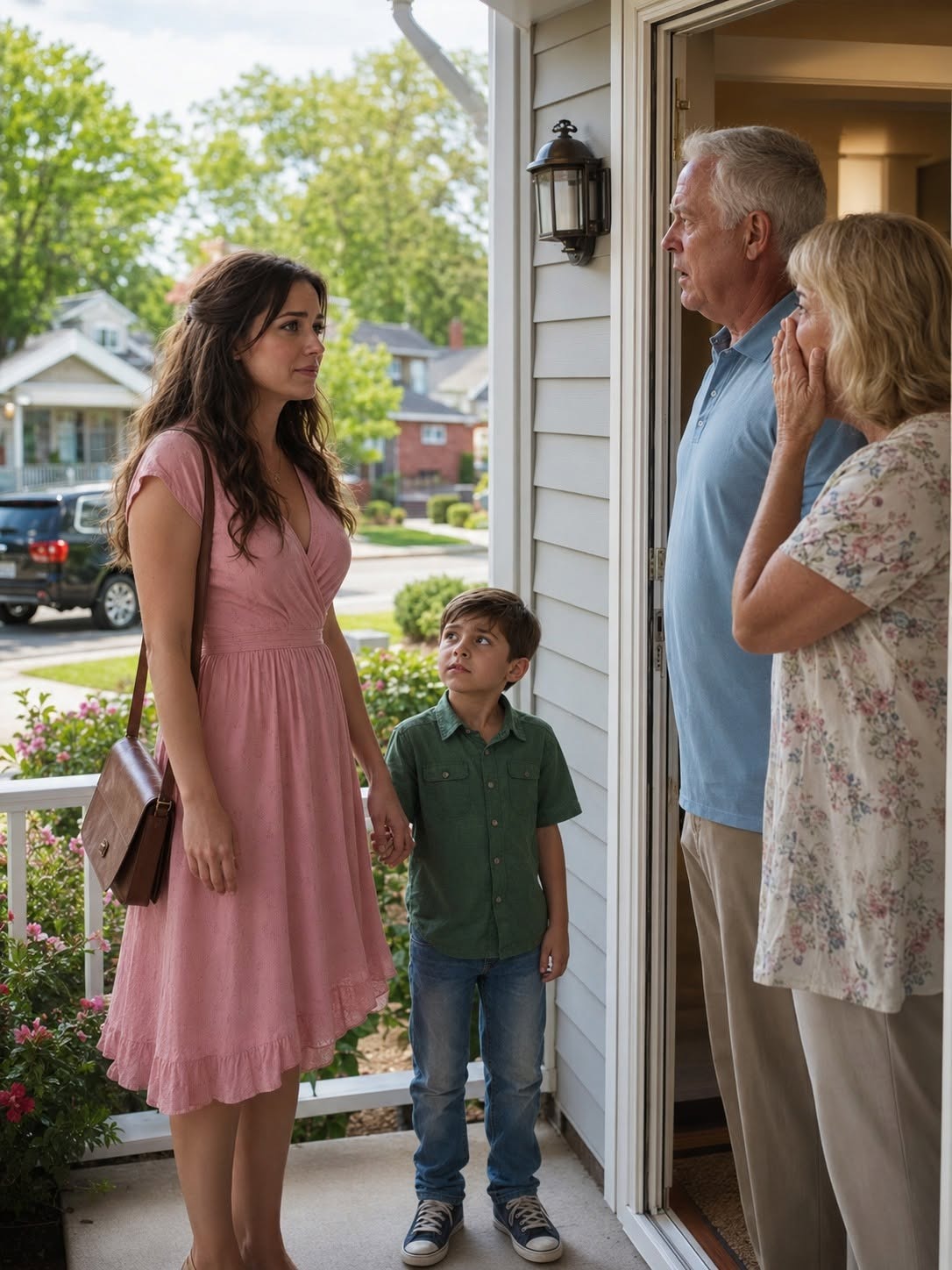
Chapter 1: The Day I Walked Away
People often ask when my life truly began.
Some assume it was the day I became a mother.
Others think it was when I finally built a successful career.
But if I’m honest, my real journey began on the afternoon I walked out of my parents’ house carrying one small duffel bag and more uncertainty than I had ever known.
I was nineteen years old.
Old enough to make decisions.
Young enough to still need my parents.
Looking back, I realize we were all frightened.
We simply showed it in different ways.
It was late September in our small Ohio town.
The maple trees outside our house had just begun turning shades of red and gold, and cool autumn air drifted through the open kitchen window.
Everything looked ordinary.
Inside, nothing felt ordinary at all.
My mother sat quietly at the dining table with both hands wrapped around a mug of tea that had long since gone cold.
My father stood near the window with his arms folded across his chest.
Neither of them spoke while I gathered enough courage to place a small white envelope on the table.
Inside was the result that had changed everything.
My mother opened it first.
She read the paper carefully.
Then she closed her eyes for a brief moment before passing it to my father.
Silence filled the room.
Finally, he looked at me.
“Is this correct?”
“Yes.”
His shoulders rose and fell with a slow breath.
“Have you seen a doctor?”
“Not yet.”
My mother whispered my name.
“Emma…”
I looked toward her.
“Are you sure?”
I nodded.
“I am.”
For several moments, no one said another word.
Outside, a lawn mower hummed somewhere down the street.
A dog barked in the distance.
Life beyond our front door continued exactly as it always had.
Inside, our family stood at a crossroads none of us had expected.
My father carefully folded the paper and placed it back inside the envelope.
Then he asked the question I knew was coming.
“Does the baby’s father know?”
I lowered my eyes.
“No.”
“Will you tell him?”
I hesitated.
“When the time is right.”
My father’s expression tightened.
“Emma, this isn’t something that can wait forever.”
“I know.”
“Then help us understand.”
I searched for words that seemed impossible to find.
“There are circumstances I can’t fully explain right now.”
He frowned.
“What does that mean?”
“It means…”
I paused.
“…that some decisions affect more people than we realize.”
My mother reached across the table.
“We’re your parents.”
“You can tell us.”
Tears filled my eyes.
“I wish I could.”
It wasn’t the answer they wanted.
Perhaps it wasn’t even the answer they deserved.
But it was the only truthful one I could give.
The room grew quiet again.
Eventually my father spoke.
“What are you planning to do?”
“I’m going to have the baby.”
He looked at me for a long time.
“Have you thought about how difficult that will be?”
“Every day.”
“You’ve barely finished your first year of college.”
“I know.”
“You don’t have a full-time job.”
“I know.”
“You’ll need help.”
“I know.”
Every answer sounded the same because none of those facts surprised me.
I had already spent countless sleepless nights thinking about each one.
Nothing about my future looked easy.
But one thing remained certain.
I wanted to become this child’s mother.
My father walked toward the hallway before turning back.
“I don’t understand your decision.”
“I understand that.”
“I hoped your life would follow a different path.”
“So did I.”
That answer seemed to catch him off guard.
For the first time, his voice softened.
“This isn’t what we imagined for you.”
“It isn’t what I imagined either.”
The conversation continued late into the evening.
Sometimes calmly.
Sometimes emotionally.
Each of us tried to explain our fears.
My parents worried about my future.
About education.
Financial security.
The challenges of raising a child while still growing into adulthood myself.
I listened to every concern.
Most of them were reasonable.
Some were difficult to hear.
None changed my decision.
As night settled outside, my father quietly said something I have never forgotten.
“If you choose this path, you’ll have to build your own future.”
The words weren’t shouted.
They weren’t spoken in anger.
They simply reflected how impossible the situation felt to everyone in the room.
I looked around the home where I had grown up.
Family photographs lined the hallway.
My childhood piano still stood in the corner of the living room.
The kitchen smelled faintly of cinnamon from the muffins my mother had baked that morning.
Everything looked familiar.
Yet somehow…
Everything already felt different.
That night I packed one bag.
A few changes of clothes.
My favorite sweater.
A notebook.
Several textbooks.
The photograph of my grandparents that always sat beside my bed.
Before sunrise, I quietly carried the bag downstairs.
My mother was already awake.
She stood beside the kitchen window holding another cup of tea.
Neither of us spoke immediately.
Finally she walked over and hugged me.
Longer than she ever had before.
“I hope someday,” she whispered, “we all understand each other better.”
“So do I.”
She placed a small envelope in my hand.
Inside was a little money she had quietly saved.
“I wish I could give you more.”
“You’ve already given me so much.”
She smiled through tears.
“You’ll always be my daughter.”
A few minutes later, I stepped onto the front porch.
The crisp autumn air felt colder than usual.
Behind me stood the only home I had ever known.
Ahead of me waited a future I couldn’t yet imagine.
I didn’t know where I would live.
I didn’t know how I would finish school.
I didn’t know how I would raise a child.
I only knew one thing.
Some journeys begin not because we’re ready—
but because life quietly asks us to take the very first step anyway.
Chapter 2: Learning to Begin Again
The bus station was quieter than I expected.
Most people hurried from one platform to another without paying much attention to anyone else. Some carried business bags. Others held sleeping children wrapped in blankets. Everyone seemed to be traveling toward somewhere familiar.
I was different.
At nineteen years old, I wasn’t traveling toward a destination.
I was traveling toward an unknown future.
The duffel bag resting beside my feet contained almost everything I owned.
A few changes of clothes.
A notebook filled with college assignments.
Several family photographs.
And the small envelope my mother had slipped into my hand before I left.
I hadn’t opened it until the bus pulled away from my hometown.
Inside were three hundred dollars and a handwritten note.
No matter how far life takes you, never forget that kindness and courage will carry you farther than fear ever can.
There was no signature.
There didn’t need to be.
I folded the note carefully and tucked it into my wallet, where it would remain for years.
Three hours later, I arrived in Columbus.
The city felt enormous compared to the quiet Ohio town where I had grown up.
Tall buildings stretched across the skyline.
Traffic moved steadily through streets I didn’t recognize.
People walked quickly, each following their own schedule.
For the first time in my life, no one knew my name.
The feeling was frightening.
But strangely freeing.
A college friend named Natalie had offered me the spare bedroom in her apartment after hearing only part of what had happened.
She hadn’t asked difficult questions.
She simply said,
“You’ll have somewhere to stay until you figure things out.”
When she opened the apartment door, she smiled warmly.
“You made it.”
“I did.”
She hugged me without another word.
Sometimes kindness arrives quietly.
The apartment wasn’t large.
The second bedroom barely fit a twin bed, a desk, and a narrow dresser.
The heating system rattled every time it started.
The kitchen cabinets had clearly been painted several times over the years.
To me, it felt wonderful.
It was safe.
That first evening, Natalie cooked vegetable soup while I unpacked my bag.
“You don’t have to explain everything,” she said.
“I’m glad you’re here.”
“I don’t even know how long I’ll stay.”
“As long as you need.”
I looked around the little apartment.
“I’ll help with rent.”
“We’ll figure that out later.”
Those three words—
We’ll figure it out.
—became the foundation of my new beginning.
The following weeks passed in a blur.
I found a part-time job at a neighborhood grocery store.
The pay wasn’t impressive, but the manager appreciated reliable employees.
I stocked shelves before sunrise three mornings each week.
Afternoons were spent attending community college classes whenever I could.
Evenings disappeared beneath homework, budgeting, and planning.
Every dollar mattered.
I carried a small notebook everywhere.
One page listed grocery prices.
Another tracked rent.
Another recorded bus schedules.
Life became a collection of careful calculations.
Coffee from home instead of cafés.
Used textbooks instead of new ones.
Walking whenever possible instead of paying for transportation.
None of it felt glamorous.
All of it felt necessary.
As the months passed, my pregnancy became more noticeable.
Customers at the grocery store often smiled kindly.
Older women offered advice.
Parents shopping with young children sometimes shared encouraging stories.
“You’ll do just fine.”
“One day at a time.”
“They grow faster than you think.”
Their words reminded me that hope often comes from unexpected places.
One rainy afternoon, after finishing work, I stopped by a small park before heading home.
Children laughed beneath colorful umbrellas while parents waited nearby.
I sat on a bench watching them.
For the first time in months, fear returned.
Could I really do this?
Would I be enough?
Would my child someday resent growing up without the life I had imagined providing?
The questions arrived faster than the answers.
A little boy chasing bubbles suddenly tripped on the wet sidewalk.
Before anyone else reached him, he stood up by himself, brushed off his jacket, and laughed.
His mother smiled from across the playground.
“You okay?”
“I’m okay!”
Then he started running again.
I smiled despite myself.
Children often reminded adults that moving forward didn’t require perfection.
Only courage.
Near the end of winter, I received a letter from my college advisor.
Inside was information about a scholarship available for students returning after family interruptions.
I almost threw it away.
Then Natalie stopped me.
“Apply.”
“I probably won’t get it.”
“You definitely won’t if you don’t try.”
So I filled out every form.
Wrote every essay.
Gathered every document.
Several weeks later, another envelope arrived.
I had been accepted.
The scholarship covered nearly all of my tuition.
For the first time since leaving home, I allowed myself to believe that my future might still include both education and motherhood.
Not easily.
But possibly.
Spring arrived with warmer mornings and blooming trees.
One afternoon, my phone rang.
The number wasn’t familiar.
When I answered, a gentle voice introduced herself.
“Emma?”
“Yes.”
“This is Mrs. Jenkins from your old neighborhood.”
I immediately remembered my parents’ longtime neighbor.
“I wanted to check on you.”
“I’m doing okay.”
“I’m glad.”
She hesitated.
“Your mother asks about you sometimes.”
My heart tightened.
“She does?”
“She worries.”
I looked out the apartment window for several moments.
“I hope she’s doing well.”
“I’m sure she’d like to hear your voice someday.”
“I hope…”
I paused.
“…maybe when enough time has passed.”
After we ended the call, I sat quietly for a long time.
Distance doesn’t erase love.
Sometimes it simply makes conversation harder.
A few weeks later, on a bright Saturday morning, I went into labor.
Natalie drove me to the hospital with remarkable calm, even though I could tell she was just as nervous as I was.
“You’ve got this.”
“I hope so.”
Several hours later, a nurse carefully placed a tiny baby boy into my arms.
He opened his eyes only briefly before falling asleep again.
His fingers wrapped instinctively around mine.
In that single moment…
Every uncertainty I had carried for months became quieter.
Not because every problem had disappeared.
Because suddenly I understood exactly why I had kept moving forward.
The nurse smiled.
“Have you chosen a name?”
I looked down at the little face resting peacefully against the blanket.
“Yes.”
I smiled through happy tears.
“His name is Leo.”
Across the room, morning sunlight slowly filled the hospital window.
Outside, the world continued exactly as it always had.
Inside…
An entirely new chapter of my life had just begun.
And although I couldn’t yet imagine it, the little boy sleeping peacefully in my arms would one day ask a simple question about grandparents—
a question that would eventually lead us back to the front door I had once believed I would never see again.