Chapter 1: A Mother Knows
Looking back now, I sometimes wonder how many quiet signs a parent can notice before finally deciding that something isn’t right.
For me, it began on an ordinary Tuesday afternoon.
My fifteen-year-old daughter, Maya, walked through the front door after school more slowly than usual. Instead of tossing her backpack onto the hallway bench and telling me about her day, she set it down carefully and leaned against the wall for a moment.
“Long day?” I asked from the kitchen.
She managed a small smile.
“I guess.”
At first, nothing seemed unusual.
High school could be exhausting.
Between homework, soccer practice, exams, and spending time with friends, teenagers often came home tired.
I thought little of it.
But over the following weeks, the small changes began to add up.
One evening she pushed away a plate of pasta after only a few bites.
“I’m just not hungry.”
The next morning she skipped breakfast altogether.
A few days later, she excused herself halfway through dinner because her stomach felt uncomfortable.
“Maybe I ate too fast,” she said.
I believed her.
At least in the beginning.
Then came the mornings when she lingered on the edge of her bed before standing.
The afternoons when she fell asleep on the living room sofa before finishing her homework.
The weekends when she turned down invitations from friends because she said she felt too tired to go out.
This wasn’t the Maya I knew.
She had always been active.
Soccer had been her favorite sport since elementary school.
She loved riding her bike through the neighborhood with friends.
Every Saturday morning she helped me in the garden, insisting tomatoes somehow tasted better when you grew them yourself.
Now the soccer ball sat untouched near the garage.
Her bicycle remained exactly where she’d parked it days earlier.
Even music, something that usually filled her room from morning until bedtime, had grown strangely quiet.
One afternoon I found her sitting by the window with a blanket wrapped around her shoulders.
She wasn’t reading.
She wasn’t looking at her phone.
She simply stared outside.
“You okay?”
She nodded automatically.
“I’m fine.”
But mothers quickly learn that “I’m fine” doesn’t always mean fine.
Sometimes it simply means, “I don’t know how to explain what I’m feeling.”
I walked over and sat beside her.
“Has your stomach been bothering you again?”
She hesitated before answering.
“A little.”
“A little?”
She looked down at her hands.
“Maybe more than a little.”
“How long?”
“I don’t know.”
“You can tell me.”
Her eyes filled with uncertainty.
“I didn’t want everyone to think I was complaining.”
My heart tightened.
“You never have to worry about telling me when something doesn’t feel right.”
She leaned her head against my shoulder.
“It just keeps happening.”
That evening I paid closer attention.
She barely touched dinner.
When she stood to clear her plate, she paused briefly as though waiting for the discomfort to pass before walking to the sink.
It was subtle.
Someone else might not have noticed.
I did.
Later that night I mentioned my concerns to my husband, Robert.
He looked up briefly from his phone before returning to the article he had been reading.
“She’s probably worn out.”
“Maybe.”
“Teenagers go through phases.”
“I know.”
“So let’s not worry too quickly.”
His voice wasn’t unkind.
Simply confident.
He believed there had to be a simple explanation.
Stress.
School.
Lack of sleep.
Changing routines.
All reasonable possibilities.
Part of me wanted to agree.
But another part remained uneasy.
Over the next several days, I quietly kept track of little things.
How often Maya skipped breakfast.
How much she actually ate.
Whether the discomfort seemed worse before or after meals.
She never exaggerated.
In fact, she often minimized what she was feeling.
If I asked whether her stomach hurt, she usually answered,
“It’s manageable.”
Those words concerned me more than if she had complained loudly.
Children who constantly seek attention often describe every discomfort in dramatic detail.
Maya did the opposite.
She tried to hide hers.
One Saturday morning I found her sitting on the staircase halfway between her bedroom and the kitchen.
She had stopped to rest.
“You all right?”
She smiled weakly.
“I stood up too fast.”
I reached for her hand.
It felt cooler than usual.
“Let’s sit for a minute.”
She didn’t argue.
Normally she would have insisted she was fine.
Today she simply nodded.
That afternoon I searched online for information—not to diagnose her, but to understand whether persistent stomach discomfort and fatigue were signs that deserved medical attention.
Every reputable source repeated the same advice.
If symptoms continued or became worse, it was important to consult a healthcare professional.
That evening I mentioned scheduling an appointment.
Robert sighed softly.
“Let’s give it another week.”
“It’s already been several weeks.”
“Maybe she’ll feel better.”
“What if she doesn’t?”
He placed his phone on the coffee table.
“I just don’t want to rush into unnecessary tests.”
Neither did I.
But I also didn’t want to ignore something important.
For the next few days I watched Maya even more carefully.
Monday morning she forgot her lunchbox.
Tuesday she fell asleep while studying.
Wednesday she asked to skip soccer practice.
Her coach later called to check on her because she had never missed practice without a reason before.
By Thursday evening, even our neighbor Mrs. Collins noticed.
“Maya seems quieter lately.”
I smiled politely.
“She’s been feeling a little tired.”
“I hope she feels better soon.”
“So do I.”
That night, after everyone had gone to bed, I stood outside Maya’s room.
Her bedroom door remained slightly open, just as it had since she was little.
Moonlight spilled across the floor.
She was asleep.
At least, I thought she was.
Then I heard her shift uncomfortably beneath the blanket.
A quiet breath escaped her lips.
Not loud enough to wake anyone else.
But enough for a mother to hear.
Enough for a mother to worry.
I realized then that waiting another week no longer felt like the right choice.
The next morning, while making breakfast, I quietly picked up my phone.
Before I could second-guess myself, I searched for the earliest available appointment at our local medical center.
An opening appeared for the following afternoon.
Without hesitating…
I booked it.
Chapter 2: The Appointment
The appointment confirmation arrived in my email only a few seconds after I clicked Confirm.
I stared at the screen longer than I needed to.
Part of me felt relieved.
Another part wondered whether I was overreacting.
Parents walk a difficult line.
No one wants to panic over every headache or every stomachache.
At the same time, no parent wants to ignore a child who has been quietly saying, “Something doesn’t feel right.”
I closed my laptop and slipped my phone into my pocket just as Maya came downstairs.
She looked tired.
Not the kind of tired that disappeared after a good night’s sleep.
The kind that seemed to settle into her shoulders.
“Morning,” she said softly.
“Good morning, sweetheart.”
She poured herself a small glass of orange juice but barely touched it.
Instead, she sat at the kitchen table, absentmindedly tracing circles across the surface with one finger.
“Your stomach again?”
She nodded.
“It’s not as bad as yesterday.”
“But it’s still there.”
“I guess.”
She tried to smile.
“I’ll be okay.”
Those words had become her habit.
She never wanted anyone to worry.
I placed a plate of toast in front of her.
“Eat what you can.”
She managed half a slice before quietly pushing the plate away.
Across the table, Robert folded his newspaper.
“You’ve hardly eaten all week.”
“I know.”
“You need more energy.”
“I’m trying.”
He looked at her thoughtfully.
“You’ve been staying up too late.”
“I haven’t.”
“Exams can be stressful.”
Maya lowered her eyes.
“Maybe.”
The conversation ended there.
No arguments.
No raised voices.
Just two people seeing the same situation differently.
Robert believed time would solve it.
I wasn’t so sure.
After dropping Maya at school, I drove to work, but concentrating proved almost impossible.
Every hour I found myself looking at the clock.
Every free moment I thought about the appointment waiting for us the following afternoon.
During lunch, my coworker Denise noticed I seemed distracted.
“You’ve reorganized that same file three times.”
I laughed quietly.
“Have I?”
“Everything okay?”
I hesitated.
“Maya hasn’t been feeling like herself lately.”
Denise’s expression softened.
“I’m sorry to hear that.”
“We’re taking her to see a doctor tomorrow.”
“That’s probably a good idea.”
“I keep wondering whether I’m worrying too much.”
Denise smiled gently.
“My grandmother used to say that parents notice changes before anyone else.”
Those words stayed with me for the rest of the afternoon.
That evening I found Maya sitting on the back porch watching the sunset.
The spring air carried the scent of freshly cut grass from neighboring yards.
Children rode bicycles along the sidewalk.
Somewhere nearby, someone was grilling dinner.
Everything about the neighborhood felt wonderfully ordinary.
Maya rested both hands around a mug of warm tea.
“I like it out here.”
“I know.”
I sat beside her.
For several minutes we watched the sky slowly change colors.
Finally, I spoke.
“I made an appointment for tomorrow.”
She didn’t seem surprised.
“I thought you might.”
“Are you upset?”
She shook her head.
“No.”
She looked toward the trees lining the edge of our yard.
“I’m actually kind of relieved.”
Those words caught me off guard.
“You are?”
“I’ve been trying to ignore it.”
“What do you mean?”
“The stomach pain.”
She took a slow breath.
“I kept hoping it would just disappear.”
I reached for her hand.
“You should never feel like you have to hide something because you don’t want to worry us.”
“I know.”
“But Dad thinks it’s nothing.”
I chose my words carefully.
“Your dad wants you to be healthy too.”
“I know.”
“He just sees it differently.”
Maya nodded quietly.
“I guess.”
Neither of us said anything else.
Sometimes silence is simply another way families care for each other.
The following afternoon arrived sooner than I expected.
I signed Maya out of school just after lunch.
She climbed into the passenger seat carrying her backpack.
“No math quiz today?”
“It got moved.”
“Good.”
She smiled faintly.
“That might be the best news I’ve had all week.”
The drive to Riverside Medical Center took about twenty minutes.
Traffic moved slowly through downtown.
Neither of us talked much.
The radio played softly in the background.
Occasionally I glanced toward Maya.
She spent most of the drive looking out the window.
Lost in thought.
When we arrived, the reception area felt calm and welcoming.
A volunteer directed us toward the pediatric clinic.
The receptionist greeted us with a warm smile.
“First visit?”
“Yes.”
She handed me several forms.
Medical history.
Insurance information.
Emergency contacts.
As I completed the paperwork, Maya quietly flipped through a magazine without really reading it.
Soon a nurse called her name.
“Hi, Maya.”
The nurse measured her height.
Checked her weight.
Recorded her temperature and blood pressure.
Then she asked several gentle questions.
“When did the discomfort begin?”
“A few weeks ago.”
“Has it been getting better or worse?”
“I think… a little worse.”
“Any changes in your appetite?”
Maya glanced toward me before answering.
“I don’t feel hungry very often.”
The nurse nodded and wrote everything down.
“You’ve done a good job explaining how you’ve been feeling.”
After a few minutes, she smiled reassuringly.
“The doctor will be with you shortly.”
Dr. Emily Lawson introduced herself with an easy smile that immediately put Maya at ease.
She didn’t rush.
She pulled up a chair instead of standing over us.
“I’ve read your notes,” she said.
“But I’d like to hear everything in your own words.”
For nearly twenty minutes, she listened.
Really listened.
She asked about school.
Sports.
Sleep.
Meals.
Energy levels.
Daily routines.
Nothing felt hurried.
When Maya finished describing her symptoms, Dr. Lawson nodded thoughtfully.
“Thank you for explaining everything so clearly.”
She performed a careful physical examination before returning to her chair.
“I’d like to order a few routine tests.”
“What kind of tests?” I asked.
“Some blood work.”
She smiled reassuringly.
“And an abdominal ultrasound.”
Maya looked uncertain.
“Does that hurt?”
“Not at all.”
“It’s simply a way for us to take a closer look so we understand what’s causing your discomfort.”
The explanation seemed to relax her.
“Okay.”
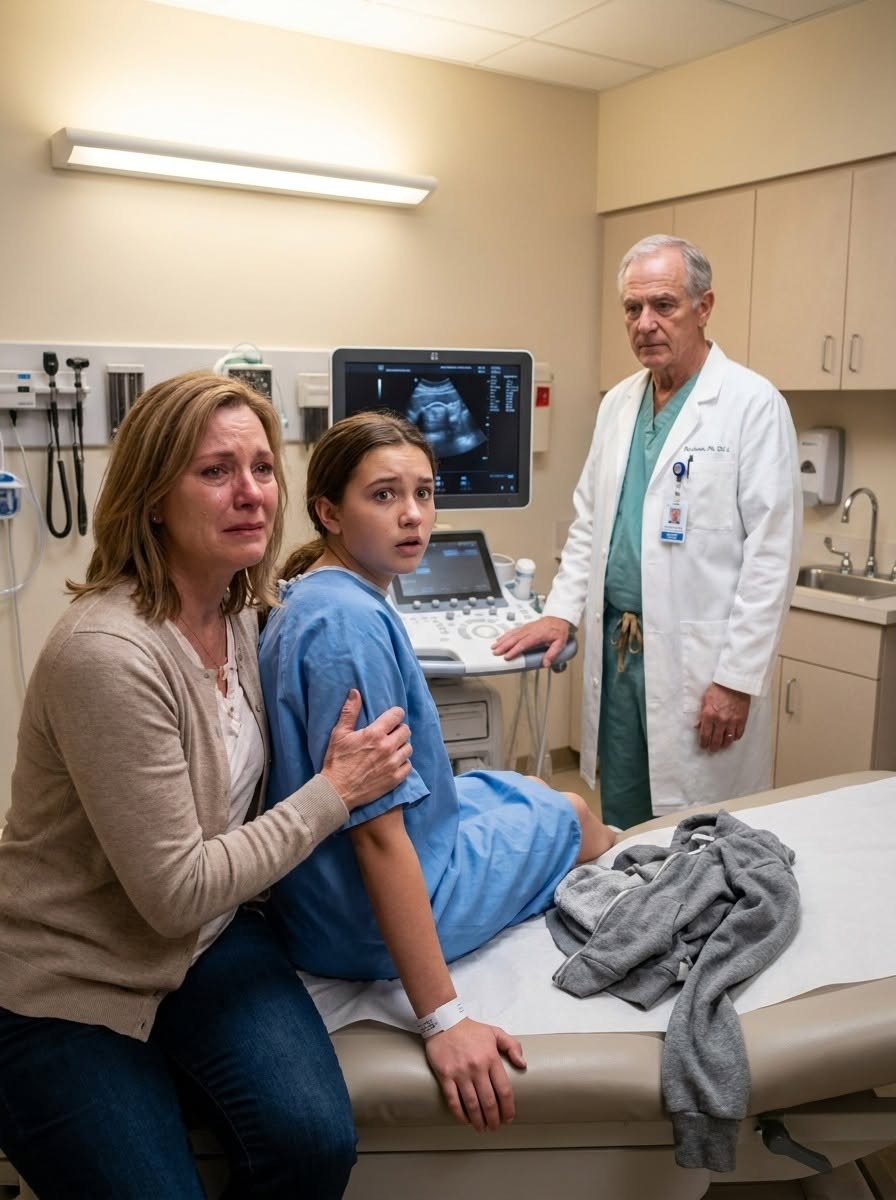
Within the hour, we were guided to the imaging department.
The ultrasound room was quiet.
Soft lighting filled the space.
The technician greeted Maya warmly before helping her onto the examination table.
“You’ll feel some cool gel.”
She smiled.
“Most people say that’s the worst part.”
Maya laughed quietly.
“That’s not too bad.”
The examination began.
For the first several minutes, the technician remained pleasantly conversational.
She asked Maya about school.
Favorite hobbies.
Whether she liked science or history better.
Then…
The room gradually became quieter.
The technician focused more carefully on the monitor.
She adjusted the angle of the probe.
Captured several images.
Paused.
Recorded another set.
She remained calm and professional, but her concentration noticeably deepened.
After saving the final image, she smiled politely.
“Thank you, Maya.”
She covered her with a blanket.
“The doctor will review everything and come speak with you shortly.”
When she stepped outside, the room fell silent again.
Maya looked at me.
“Do you think they found anything?”
I squeezed her hand gently.
“I think they’re being thorough.”
A few minutes later, there was a gentle knock at the door.
Dr. Lawson entered carrying Maya’s chart.
She smiled reassuringly before taking a seat beside us.
“I’ve had a chance to review the images.”
She paused briefly, choosing her words with care.
“I can already tell you one important thing.”
I held my breath.
“There are several reassuring signs.”
Relief washed over me.
Then she continued.
“However…”
She turned the monitor slightly so we could see it.
“…there is one area I’d like us to examine more closely so we can understand exactly what’s causing Maya’s symptoms.”
The room became very quiet.
Not because anyone was frightened—
but because we all knew the next conversation would help determine the best path forward for Maya’s health.