A Small Detail Most People Never Question
Public restrooms are full of design features that most of us rarely stop to consider. We use them every day in airports, shopping centers, restaurants, schools, and office buildings, often without giving much thought to why they look the way they do.
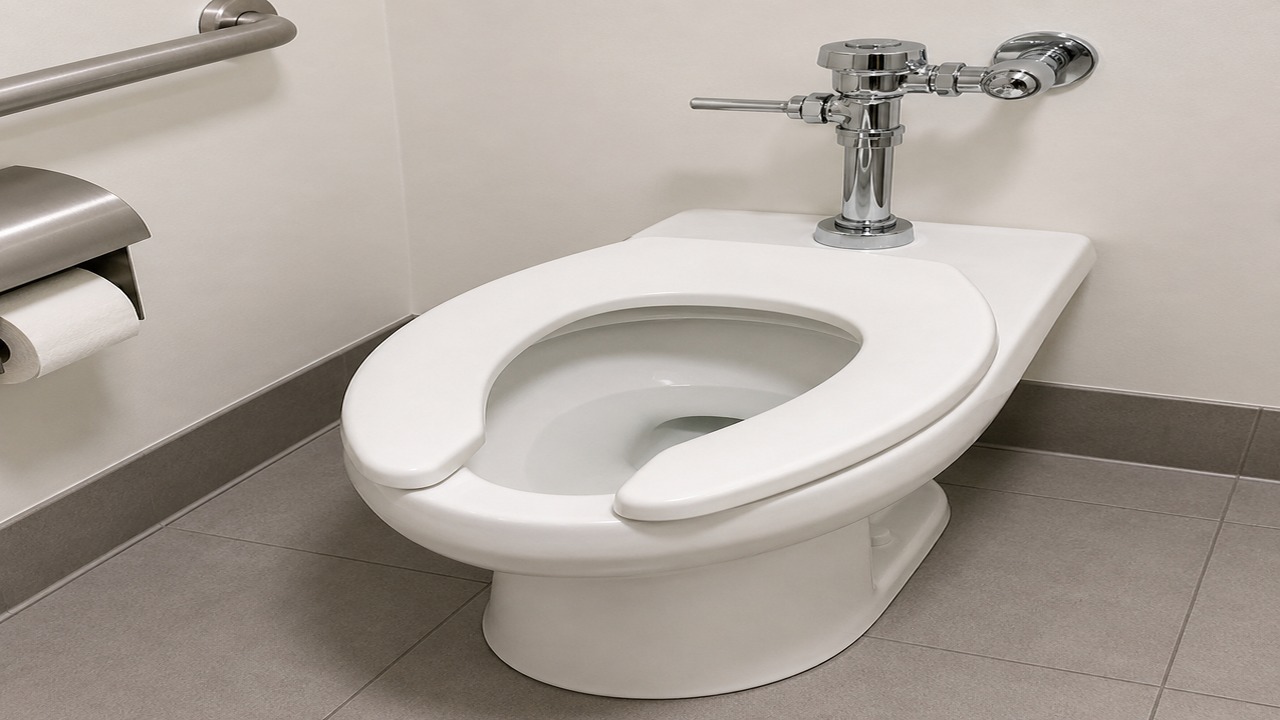
One feature that frequently goes unnoticed is the U-shaped toilet seat, also known as an open-front toilet seat.
At first glance, some people assume it’s simply a way to reduce manufacturing costs or an unusual design choice. Others may wonder why public restrooms don’t use the same fully enclosed toilet seats commonly found in homes.
In reality, the open-front toilet seat was designed with several practical goals in mind, including hygiene, ease of cleaning, accessibility, and maintenance. Its widespread use reflects decades of public health recommendations and building standards intended to make shared restrooms more practical for everyone.

What Is an Open-Front Toilet Seat?
An open-front toilet seat is a toilet seat with a gap at the front rather than a continuous oval shape.
While closed-front seats are common in residential bathrooms, open-front seats are frequently installed in commercial and public facilities, including:
- Airports
- Schools
- Office buildings
- Shopping centers
- Restaurants
- Hospitals
- Government buildings
The design has become a familiar feature in many countries because it serves the unique needs of high-traffic public restrooms.
Hygiene Is One Important Consideration
One of the primary reasons open-front seats became popular is hygiene.
Public restrooms serve many people throughout the day, making cleanliness a top priority.
The front opening helps reduce unnecessary contact with the front portion of the seat during use. Public health experts and plumbing standards have long recognized this design as one way to support cleaner restroom environments.
While no toilet seat design alone can eliminate the spread of germs, minimizing contact points may contribute to improved hygiene when combined with regular cleaning and proper handwashing.
Easier Cleaning and Maintenance
Another practical advantage is easier cleaning.
Because the seat does not have a closed front section, custodial staff can access more of the surface quickly during routine cleaning.
This simplifies the removal of dust, dirt, and other residue while reducing areas where grime may accumulate.
In facilities that serve hundreds or even thousands of visitors each day, even small improvements in cleaning efficiency can make a meaningful difference.
The design also allows maintenance personnel to inspect the seat more easily for wear or damage.
Built for High-Traffic Environments
Public restroom fixtures experience significantly more use than those found in private homes.
As a result, commercial restroom equipment is often designed with durability in mind.
Open-front seats typically use slightly less material than fully enclosed models, which can reduce manufacturing costs and simplify replacement when necessary.
Although material savings are not the primary reason for the design, they can contribute to lower long-term maintenance expenses for large facilities managing multiple restrooms.
Their straightforward construction also makes them well suited to environments where fixtures are used frequently throughout the day.
Supporting Accessibility
Accessibility is another important consideration in restroom design.
For some individuals with mobility limitations, as well as caregivers providing assistance, the open-front design may offer additional convenience during use.
Accessible restroom design involves many features working together, including:
- Adequate floor space
- Grab bars
- Appropriate seat height
- Accessible sinks
- Easy-to-operate fixtures
While the toilet seat itself is only one component, its design can contribute to overall usability for a wide range of people.
Why Homes Usually Use Closed-Front Seats
Residential bathrooms have different priorities than public facilities.
Homeowners often choose closed-front seats because they may find them more comfortable or prefer their appearance.
Since family bathrooms generally experience much lower traffic, cleaning demands are different from those of public restrooms.
Interior design preferences also play a greater role in residential settings, where personal comfort and aesthetics are important considerations.
As a result, both open-front and closed-front seats continue to serve different purposes depending on where they are installed.
Building Standards and Public Facilities
Many commercial buildings follow plumbing codes or design standards that specify the type of toilet seat appropriate for public restrooms.
In the United States, for example, plumbing standards commonly reference open-front seats for many public toilet installations.
These recommendations are intended to promote consistency, hygiene, and practicality in shared facilities.
Specific requirements may vary depending on the jurisdiction, building type, and applicable plumbing codes.
Everyday Design Often Solves Practical Problems
The open-front toilet seat is one example of how ordinary objects are often shaped by practical needs rather than appearance alone.
Many familiar features found in public spaces—from automatic faucets to touch-free soap dispensers and hand dryers—were developed to improve hygiene, efficiency, and user experience.
Although people rarely think about these design choices, they often reflect years of engineering, public health research, and real-world experience.
The U-shaped toilet seat belongs to this broader tradition of functional design.
Small Details Can Have a Big Impact
Good design is often subtle.
When something works well, people may hardly notice it.
The open-front toilet seat demonstrates how a small modification can support cleanliness, simplify maintenance, improve accessibility, and help public facilities operate more efficiently.
While opinions about comfort and appearance may differ, the design continues to serve practical purposes in busy shared environments around the world.
Conclusion
The U-shaped toilet seat found in many public restrooms is far more than an unusual design choice. Its open-front shape was developed to support hygiene, simplify cleaning, improve accessibility, and meet the practical demands of high-traffic public facilities.
Although many people prefer traditional closed-front seats at home, public restrooms require solutions that balance cleanliness, durability, and ease of maintenance for countless daily users. The open-front design helps meet those needs while reflecting decades of thoughtful engineering and public health considerations.
Human curiosity often begins with simple questions about the everyday objects around us. Looking more closely at familiar designs reminds us that even the smallest details can have practical purposes, quietly making shared spaces cleaner, safer, and more efficient for everyone.
Sources
- International Association of Plumbing and Mechanical Officials (IAPMO). Uniform Plumbing Code. https://iapmo.org
- International Code Council (ICC). International Plumbing Code. https://www.iccsafe.org
- Centers for Disease Control and Prevention (CDC). Healthy Hygiene Practices. https://www.cdc.gov/hygiene
- American Society of Plumbing Engineers (ASPE). Plumbing Design Standards. https://www.aspe.org
- U.S. Access Board. ADA Accessibility Standards. https://www.access-board.gov