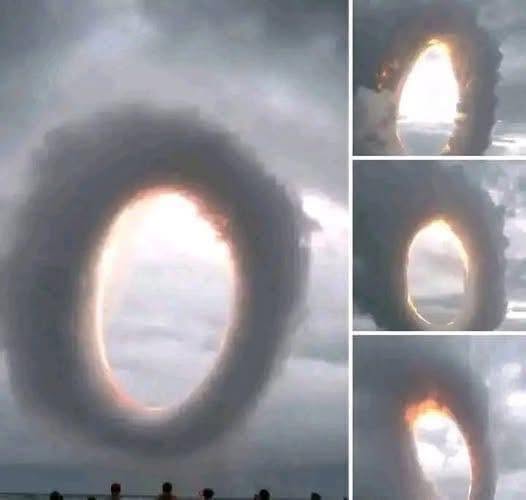
Imagine looking up on an ordinary afternoon and spotting what appears to be a giant glowing doorway suspended among the clouds. The circular opening seems almost perfectly shaped, allowing brilliant sunlight to pour through as though the sky itself has opened.
It’s no surprise that images like these quickly spread across social media. Some viewers describe them as “portals in the sky,” while others wonder whether they represent an extremely rare weather event. The dramatic appearance naturally sparks curiosity, inspiring countless discussions and imaginative theories.
Yet, as extraordinary as these formations appear, meteorologists have a fascinating scientific explanation. Rather than being mysterious, they are one of the atmosphere’s most remarkable natural displays.
What Is a Fallstreak Hole?
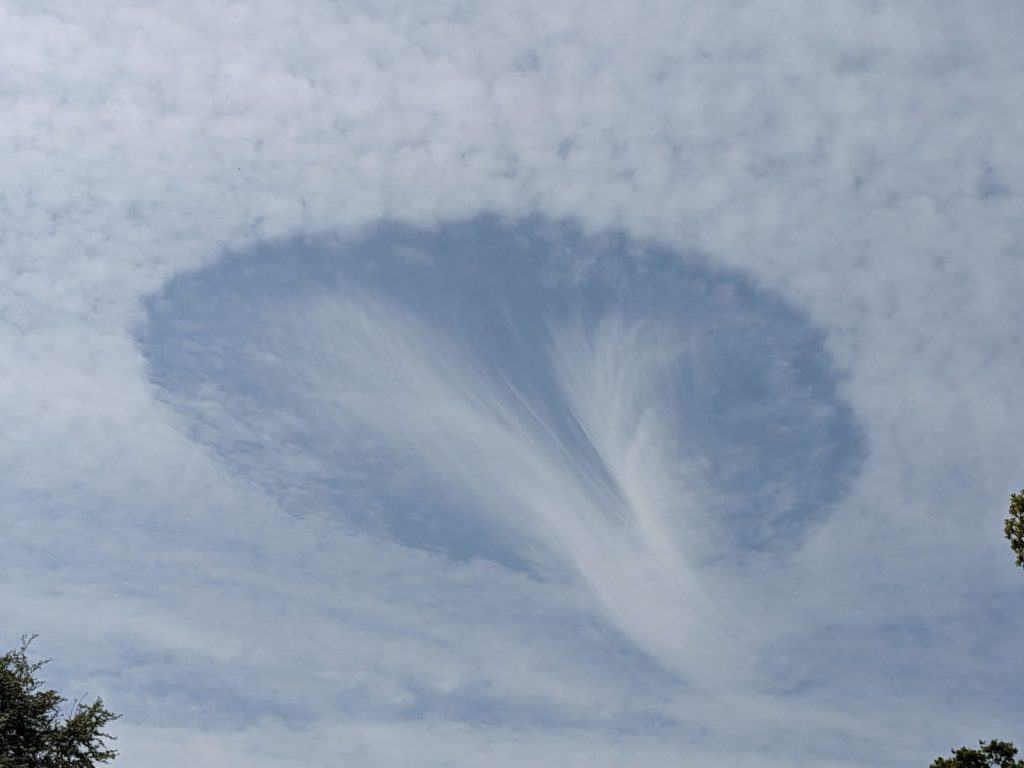
The unusual opening seen in the clouds is most likely a fallstreak hole, sometimes called a hole-punch cloud.
A fallstreak hole is a naturally occurring gap that forms within a layer of clouds under very specific atmospheric conditions. Although relatively uncommon, these formations have been documented around the world and are well understood by weather scientists.
Their nearly circular appearance often gives the impression that something has “punched” a hole through the cloud layer, creating a dramatic window that allows sunlight to shine through.
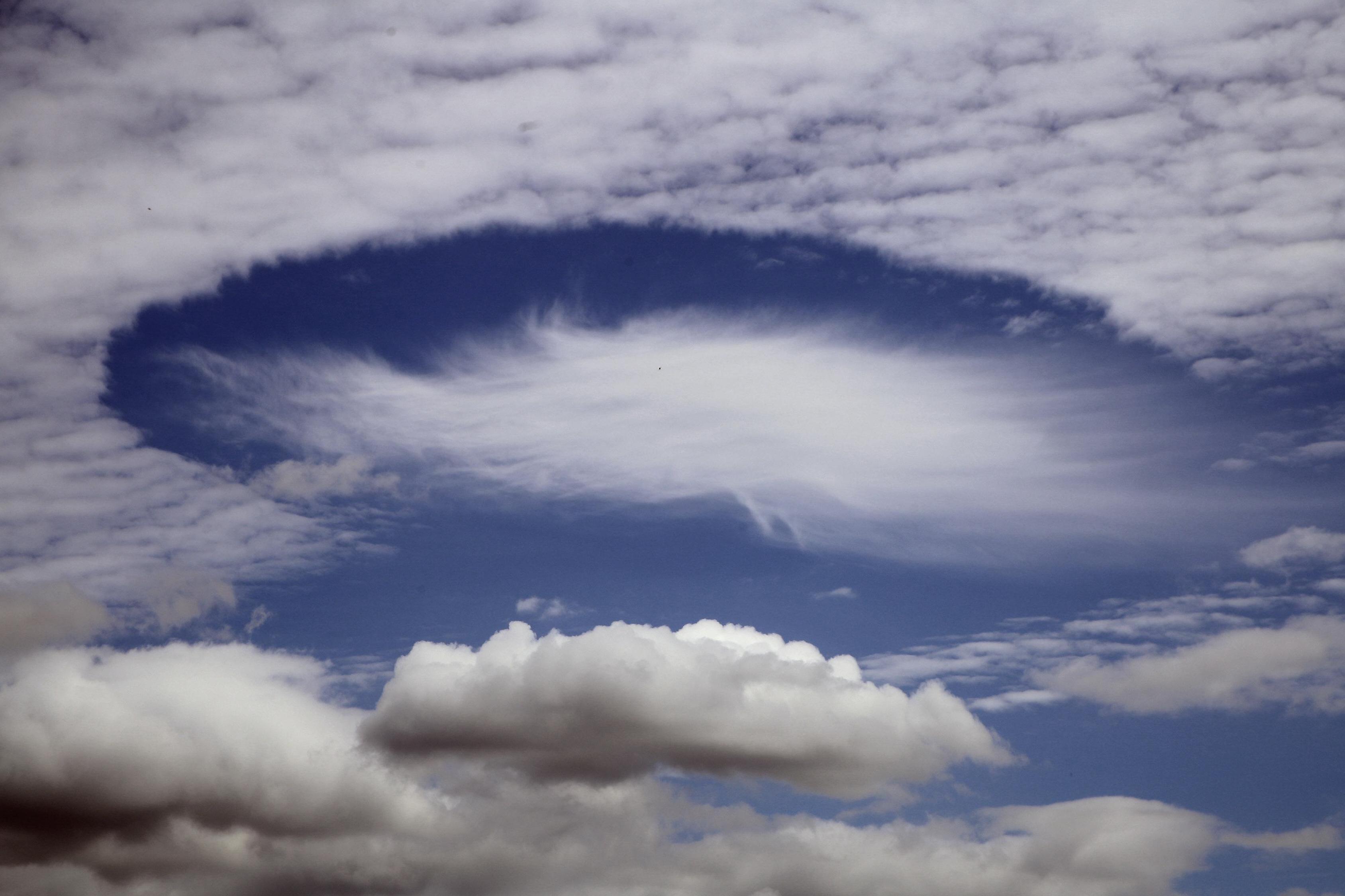
Because the surrounding cloud remains largely intact, the contrast between the opening and the cloud deck makes the phenomenon especially striking.
How Do These Cloud Formations Develop?
The process begins inside a particular type of cloud composed of supercooled water droplets.
These droplets remain in liquid form even though the surrounding air temperature is below the normal freezing point of water. Under the right conditions, they remain stable until something triggers a rapid freezing process.
Once freezing begins, the newly formed ice crystals grow quickly by drawing moisture away from the nearby liquid droplets.
As this happens:
- The surrounding water droplets evaporate.
- Ice crystals continue to grow.
- A circular or oval-shaped gap gradually expands.
- Thin streaks of ice crystals often fall beneath the opening, giving the phenomenon its name—fallstreak.
The result is an impressive opening that can appear almost perfectly symmetrical.
Why Does It Glow So Brightly?
One reason fallstreak holes attract so much attention is the beautiful way sunlight interacts with them.
When the sun shines through the newly formed opening, the contrast between the bright blue sky and the surrounding cloud layer creates the illusion of a glowing portal.
Depending on the position of the sun, observers may notice:
- Brilliant rays of sunlight
- Soft golden illumination
- Bright white cloud edges
- A dramatic circular “window” in the sky
The visual effect is entirely natural but undeniably breathtaking.
The Surprising Role of Airplanes
One of the most interesting discoveries made by atmospheric scientists is that aircraft can sometimes trigger the formation of fallstreak holes.
As an airplane passes through a cloud layer containing supercooled water droplets, changes in air pressure around the wings or propellers can cause localized cooling.
This rapid temperature change may encourage the droplets to freeze into ice crystals.
Once freezing starts, the process spreads outward naturally, gradually enlarging the opening over several minutes.
Importantly, the aircraft does not create the hole by physically pushing clouds aside. Instead, it provides the conditions that allow the natural freezing process to begin.
Where Are Fallstreak Holes Most Common?
These formations can occur in many parts of the world whenever atmospheric conditions are favorable.
Meteorologists most often observe them in:
- Temperate regions
- Autumn and winter months
- Areas with extensive mid-level cloud layers
- Locations experiencing stable atmospheric conditions
Because several environmental factors must align simultaneously, fallstreak holes remain relatively uncommon.
Even experienced weather observers may only witness a few during their lifetime.
Why Do They Sometimes Look So Perfectly Circular?
One aspect that fascinates many people is the remarkable symmetry of these cloud openings.
Scientists explain that the freezing process often expands outward from a relatively small starting point.
As nearby droplets evaporate evenly in all directions, the opening naturally develops a rounded shape.
Wind conditions, humidity, and atmospheric stability influence whether the final formation appears:
- Nearly circular
- Oval-shaped
- Slightly irregular
- Surrounded by wispy ice crystal streaks
Each fallstreak hole is unique, making every observation a little different.
Separating Science From Speculation
Whenever unusual sky phenomena appear online, they often inspire imaginative interpretations.
Throughout history, people have associated remarkable cloud formations with folklore, cultural stories, or symbolic meanings. Today, social media allows these ideas to spread rapidly, adding to the excitement whenever dramatic images emerge.
While such interpretations can be interesting from a cultural perspective, meteorologists emphasize that fallstreak holes are a well-documented atmospheric phenomenon supported by decades of scientific observation and research.
Understanding the science behind these formations does not diminish their beauty. Instead, it highlights just how extraordinary Earth’s atmosphere can be.
Why Weather Phenomena Continue to Fascinate Us
Clouds are constantly changing, shaped by invisible interactions involving temperature, moisture, pressure, and wind.
Because these processes happen high above us, many weather events appear mysterious until scientists study them more closely.
Phenomena such as:
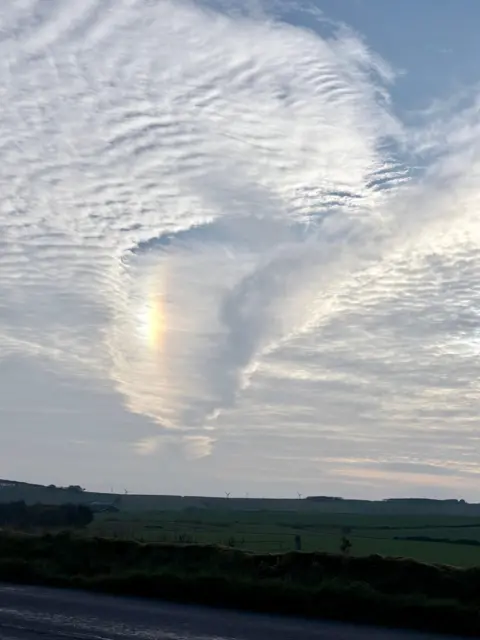
- Haloes around the Sun
- Lenticular clouds
- Mammatus clouds
- Sundogs
- Fallstreak holes
all demonstrate how ordinary atmospheric physics can produce extraordinary visual displays.
Each reminds us that nature is capable of creating scenes that seem almost artistic.
What If You See One?
If you’re fortunate enough to spot a fallstreak hole, consider taking a photograph.
Weather enthusiasts often enjoy documenting these rare formations and sharing them with local meteorological organizations or citizen science communities.
Observing details such as:
- The cloud type
- Time of day
- Sun position
- Weather conditions
- Nearby aircraft activity
can help scientists better understand when and where these events occur.
Of course, simply taking a moment to appreciate the view can be rewarding as well.
Conclusion
A giant opening in the clouds may initially seem mysterious, but the science behind a fallstreak hole is every bit as remarkable as its appearance. Formed through the interaction of supercooled water droplets, ice crystals, and specific atmospheric conditions—sometimes with the assistance of passing aircraft—these rare cloud formations showcase the incredible complexity of Earth’s weather systems.
While they may resemble glowing portals or windows in the sky, fallstreak holes remind us that nature often produces its most spectacular displays through ordinary physical processes working together in extraordinary ways.
Human curiosity has always drawn us to the skies, inspiring both scientific discovery and cultural imagination. By exploring the fascinating explanations behind these beautiful cloud formations, we gain not only a deeper appreciation for the atmosphere above us but also a renewed sense of wonder about the natural world.
Sources
- National Oceanic and Atmospheric Administration (NOAA) – Cloud Formation and Weather: https://www.noaa.gov
- NASA Earth Observatory – Clouds and Atmospheric Science: https://earthobservatory.nasa.gov
- Royal Meteorological Society – Cloud Types and Atmospheric Phenomena: https://www.rmets.org
- Met Office (UK) – Clouds and Weather Explained: https://www.metoffice.gov.uk
- World Meteorological Organization (WMO) – Understanding Weather and Climate: https://wmo.int