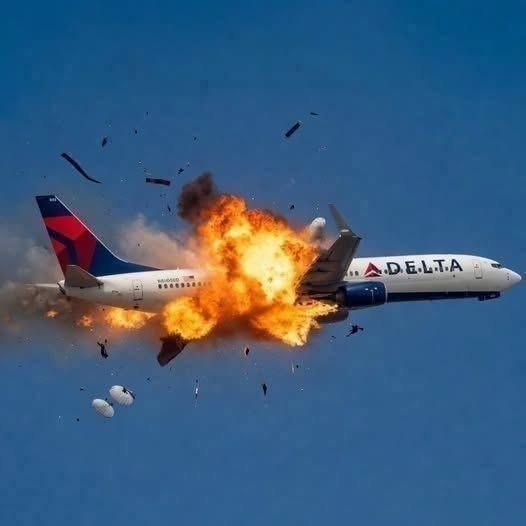
It starts with a notification on your phone.
A dramatic headline appears across social media:
“Plane with more than 244 onboard just crashed.”
Within minutes, thousands of people begin sharing the post. Comments flood in with messages of concern, speculation, and unanswered questions. Friends tag one another asking whether the news is real, while others search desperately for more information.
Moments like these demonstrate just how quickly information can travel in today’s digital world. A single headline can reach millions of readers before professional journalists or official agencies have had time to verify the facts.
In one recent example, a widely circulated online article claimed that a passenger aircraft carrying more than 244 people had crashed. However, the article itself acknowledged that no major news organization or official aviation authority had confirmed such an event at the time of publication.
This situation serves as an important reminder that not every viral headline reflects verified reality. Understanding how aviation news is reported, how misinformation spreads, and how readers can verify breaking stories helps create a more informed online community.
Why Aviation Headlines Spread So Quickly
Commercial aviation is one of the safest forms of transportation, yet it remains a topic that naturally attracts public attention.
When an airplane is mentioned in a breaking headline, people instinctively want answers. Air travel connects families, businesses, and countries across the globe, so any suggestion of an emergency quickly becomes international news.
Social media platforms accelerate this process. A headline that triggers curiosity or concern often receives thousands of shares before anyone checks whether the information has been confirmed.
Researchers studying online behavior have found that emotionally engaging stories frequently spread faster than factual corrections. This doesn’t necessarily mean people intend to mislead others. More often, they simply want to alert friends and family about something they believe could be important.

The Case of the Viral “244 Onboard” Story
The widely shared headline about a passenger aircraft carrying more than 244 people generated significant attention online.
Interestingly, the article itself explained that searches across major news organizations and official aviation updates had found no confirmation matching the claim at that time.
Instead, it encouraged readers to:
Check reputable news organizations.
Wait for official statements.
Compare multiple independent sources.
Avoid assuming viral posts are automatically accurate.
This illustrates an important lesson in digital literacy. Sometimes the headline creates urgency, while the article encourages caution.
Rather than focusing on speculation, readers benefit from understanding how verified aviation reporting actually works.
How Breaking Aviation News Is Confirmed
When a significant aviation event occurs, information typically follows a well-established process.
Official authorities gather preliminary facts before making public announcements.
Airlines communicate with passengers, families, and the media.
National transportation safety agencies begin investigations when appropriate.
Major news organizations verify information through multiple independent sources before publishing detailed reports.
Because of this careful process, verified information may take time to emerge.
Early reports often contain only limited details, while later updates provide greater clarity as investigators collect additional evidence.
Patience is essential during rapidly developing situations.
Trusted Sources for Aviation Information
When evaluating aviation news, reliable sources matter.
Some of the most trusted organizations include:
The Federal Aviation Administration (FAA)
The National Transportation Safety Board (NTSB)
The International Civil Aviation Organization (ICAO)
National civil aviation authorities
Official airline newsrooms
Established international news agencies
These organizations prioritize accuracy over speed, which is why their updates may arrive later than social media posts.
Although waiting can feel frustrating, verified information helps prevent unnecessary confusion.

Why False or Unverified Stories Gain Attention
Psychologists have long studied why surprising stories attract more engagement than ordinary news.
Several factors contribute.
Emotional Response
Unexpected headlines immediately capture attention because humans naturally focus on events that appear unusual or important.
Information Gaps
When readers don’t know whether something is true, curiosity encourages them to continue searching for answers.
Social Sharing
People often share stories because they believe they are helping others stay informed.
Algorithmic Visibility
Popular posts receive greater visibility on many digital platforms, allowing them to spread rapidly regardless of accuracy.
Understanding these patterns can help readers pause before reacting.
Aviation Safety Has Improved Dramatically
Although aviation incidents receive widespread media coverage, commercial flying has become remarkably safe over the past several decades.
Advances in aircraft engineering, pilot training, maintenance procedures, navigation technology, and international safety standards have all contributed to this progress.
Modern aircraft undergo rigorous inspections.
Flight crews receive extensive training.
Air traffic control systems continue evolving through technological improvements.
These combined efforts help make commercial aviation one of the most carefully regulated transportation industries in the world.
The Cultural Fascination with Flight
Long before airplanes existed, humans dreamed of flying.
Ancient myths from many civilizations describe people attempting to reach the skies.
In Greek mythology, the story of Icarus reflects humanity’s fascination with flight and the importance of wisdom alongside ambition.
Chinese legends describe early experiments with kites.
Medieval inventors imagined mechanical flying machines centuries before powered aircraft became reality.
These stories symbolize more than transportation.
They represent exploration, discovery, courage, and curiosity.
Today, aviation continues that tradition by connecting continents and cultures in ways previous generations could scarcely imagine.

Separating Myth from Modern Reality
Throughout history, extraordinary stories have often circulated during times of uncertainty.
In earlier centuries, rumors spread through travelers and handwritten letters.
Today, they spread through smartphones and social media.
While technology has transformed communication, one thing remains unchanged: people are naturally drawn to remarkable stories.
Scientific thinking encourages us to distinguish between possibilities and verified facts.
Rather than accepting every dramatic claim immediately, critical thinking asks simple questions:
Who reported this?
Can multiple reliable sources confirm it?
Has an official organization commented?
What evidence supports the claim?
These habits help readers navigate today’s information landscape with greater confidence.
Practical Tips for Verifying Viral News
If you encounter an alarming aviation headline online, consider taking the following steps before sharing it.
Read Beyond the Headline
Headlines are designed to capture attention.
The full article often provides important context that changes the overall message.
Check Multiple Sources
If a major aviation event has truly occurred, multiple reputable news organizations will usually report it independently.
Look for Official Statements
Government aviation authorities and airlines often publish verified updates through their official websites or social media channels.
Pay Attention to Timing
Early reports frequently change as additional information becomes available.
Avoid drawing conclusions based on incomplete details.
Avoid Spreading Speculation
If facts remain uncertain, waiting for confirmation is often the most responsible choice.
How Social Media Can Support Accurate Information
Social media is not inherently unreliable.
In many cases, it provides valuable real-time updates during developing events.
The challenge lies in distinguishing firsthand verified information from speculation.
Users can contribute positively by:
Sharing information from trusted organizations.
Correcting misinformation respectfully.
Avoiding sensational language.
Encouraging others to verify before reposting.
Small actions by individual users collectively improve the quality of information shared online.
Digital Literacy Is More Important Than Ever
Modern readers consume more information in a single day than previous generations often encountered in weeks.
Developing digital literacy means learning how information is created, distributed, and verified.
This includes understanding:
Source credibility
Editorial standards
Fact-checking processes
Confirmation bias
The influence of algorithms
These skills extend far beyond aviation stories and benefit readers in every area of daily life.
Why Responsible Journalism Matters
Professional journalism follows standards designed to improve accuracy.
Editors verify claims.
Reporters consult multiple sources.
Corrections are published when necessary.
Although mistakes occasionally happen, reputable news organizations prioritize transparency and accountability.
Responsible reporting becomes especially important during rapidly developing events when incomplete information can easily lead to misunderstanding.

Conclusion
The viral headline claiming that a passenger aircraft carrying more than 244 people had crashed reminds us of an important lesson about today’s digital world.
Extraordinary headlines can spread within minutes, but verified information often takes longer to emerge. Rather than reacting immediately, readers benefit from checking trusted sources, waiting for official confirmation, and approaching dramatic claims with thoughtful curiosity.
Throughout history, humanity has been fascinated by stories of exploration, technology, and the skies above us. That curiosity has inspired remarkable achievements, from ancient dreams of flight to modern commercial aviation connecting millions of people every day.
In the digital age, our curiosity remains just as powerful. The difference is that we now have the tools to pair curiosity with critical thinking. By verifying information before sharing it, we contribute to a more informed and responsible online community where facts can travel just as far as headlines.
Sources
- Federal Aviation Administration (FAA) — https://www.faa.gov
- National Transportation Safety Board (NTSB) — https://www.ntsb.gov
- International Civil Aviation Organization (ICAO) — https://www.icao.int
- International Air Transport Association (IATA) — https://www.iata.org
- Reuters – Aviation News — https://www.reuters.com/world/aviation
- Associated Press News — https://apnews.com
- BBC News – Aviation — https://www.bbc.com/news/topics/cyx5krnw38vt/aviation