
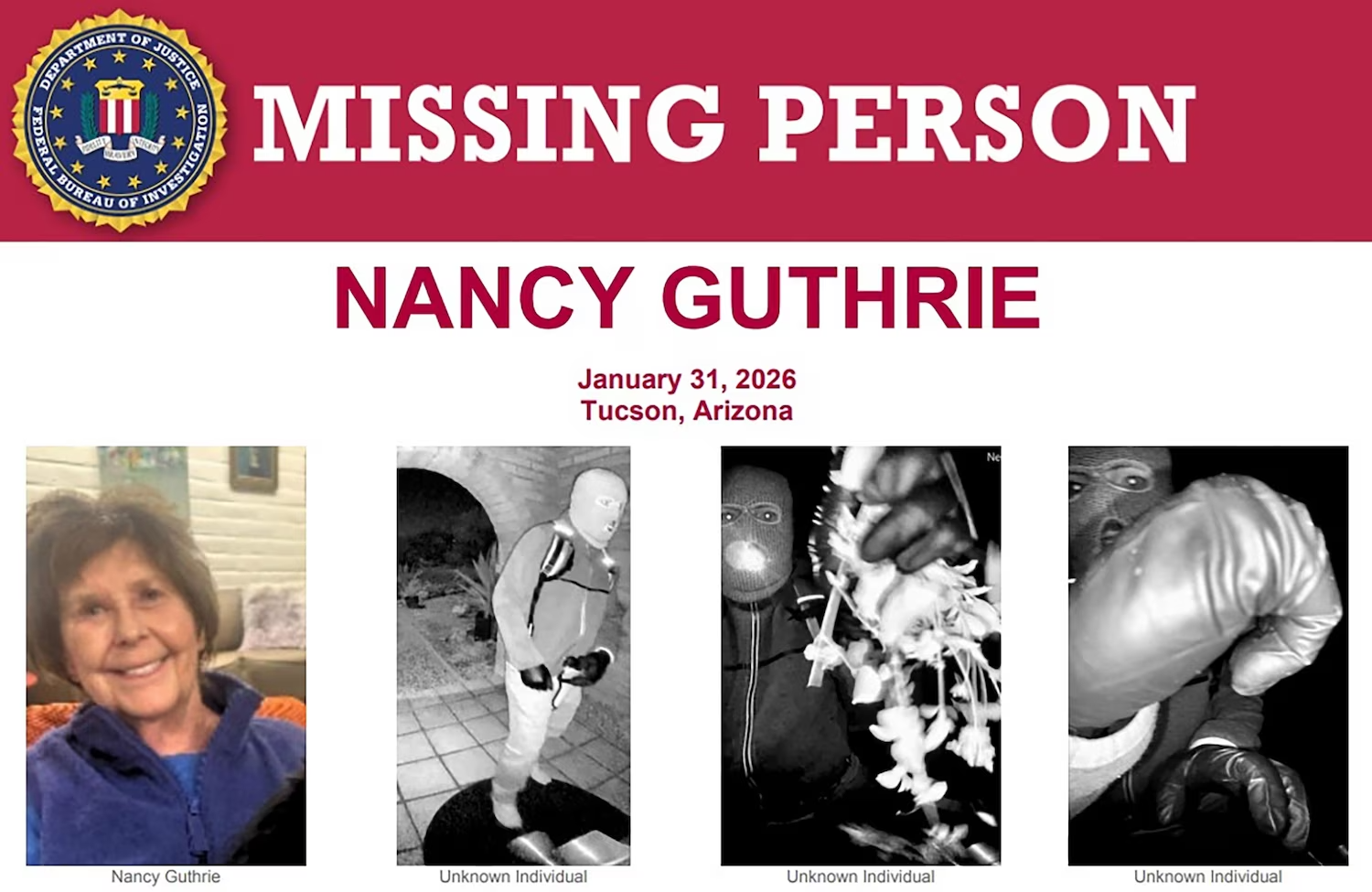
The disappearance of Nancy Guthrie, an 84-year-old woman reported missing from her home in Arizona in early February, has drawn national attention as investigators continue to review evidence and gather information. Law enforcement authorities and independent experts have examined various aspects of the case, including sleep science, forensic evidence, and the medical factors that may influence how a person responds when awakened suddenly during the night.
While the investigation remains ongoing and many details have not been publicly confirmed, specialists in sleep medicine and forensic pathology have discussed general scientific principles that may help explain how individuals react when abruptly awakened from deep sleep. Officials emphasize that these expert observations are not conclusions about the case itself but rather explanations of possible physiological responses.
This article provides a verified overview of the case based on publicly reported information, expert commentary about sleep physiology, and the investigative process typically used in missing-person cases.
Overview of the Missing Person Case

According to reports from authorities and media coverage, Nancy Guthrie was reported missing from her residence in Arizona on February 1. Investigators believe the incident occurred during the early-morning hours.
Law enforcement officials responded to the report and began an investigation that included examining the residence, interviewing potential witnesses, and collecting physical evidence. As is standard practice in missing-person investigations, authorities have encouraged the public to provide any information that may assist the case.
At the time of the most recent public updates, investigators had not released definitive conclusions regarding what occurred.
Because missing-person investigations often involve sensitive details, law enforcement agencies typically limit the release of information while evidence is being reviewed.
Early Evidence Reviewed by Investigators
Reports indicate that investigators discovered small traces of blood on the front entry area of the residence. Authorities confirmed that the blood belonged to Guthrie. However, officials have not publicly confirmed how the blood was produced or whether it is connected to the circumstances of her disappearance.
Physical evidence such as blood traces can help investigators reconstruct events surrounding a disappearance. Forensic specialists often analyze such evidence to determine factors including:
-
The source of the blood
-
The direction and pattern of the droplets
-
Whether the blood may indicate movement or injury
These analyses are typically conducted in specialized forensic laboratories and may require time before conclusions can be reached.
Sleep Science and Sudden Awakening
Sleep specialists have discussed how abrupt awakenings during the night can affect the human brain, particularly among older adults.
Dr. Pat Byrne, a sleep specialist who commented on the topic during a podcast discussion, explained that the brain does not immediately transition from sleep to full awareness. Instead, it passes through a temporary phase known as sleep inertia.
What Is Sleep Inertia?
Sleep inertia is a physiological state that occurs when a person wakes suddenly from sleep. During this period, the brain may remain partially in a sleep state while the body begins to awaken.
Research published in sleep medicine journals indicates that sleep inertia can cause several temporary effects, including:
-
Confusion or disorientation
-
Slowed reaction times
-
Difficulty making decisions
-
Reduced awareness of surroundings
These effects are typically short-lived, often lasting several minutes, although the duration can vary depending on the sleep stage from which the person awakens.
Sleep Stages and Brain Activity
Human sleep occurs in several distinct stages that repeat throughout the night.
The two major categories of sleep are non-rapid eye movement (non-REM) sleep and rapid eye movement (REM) sleep.
Deep Sleep (Slow-Wave Sleep)
Deep sleep, also known as slow-wave sleep, is one of the most restorative phases of the sleep cycle. During this stage:
-
Brain activity slows significantly
-
The body performs important recovery processes
-
External awareness is greatly reduced
When someone is awakened during deep sleep, they may experience stronger symptoms of sleep inertia because the brain requires time to transition to full alertness.
REM Sleep
REM sleep is the stage most associated with dreaming. Brain activity during REM sleep is more active than in deep sleep, but the body remains relaxed.
If someone wakes from REM sleep, they may feel temporarily confused or disoriented while their brain transitions to wakefulness.
Sleep researchers note that the specific stage of sleep at the time of awakening can influence how quickly someone becomes fully alert.
How Sudden Awakening Can Affect Older Adults

Sleep specialists also emphasize that abrupt awakenings may affect older adults differently than younger individuals.
Several factors can influence this response, including:
-
Age-related changes in sleep patterns
-
Underlying medical conditions
-
Medication use
-
Cardiovascular health
Research published by organizations such as the National Institutes of Health (NIH) and other medical institutions indicates that older adults often experience lighter sleep patterns and more frequent nighttime awakenings.
However, sudden disruptions during deep sleep can still produce temporary confusion or slower responses in some individuals.
Experts stress that these physiological responses vary widely and cannot be used to determine what happened in a specific case without confirmed evidence.
Medical Considerations in Sleep Disruption
Reports about the case indicated that Guthrie had a pacemaker, which is a medical device used to regulate heart rhythm in individuals with certain cardiovascular conditions.
Cardiologists explain that pacemakers help maintain stable heart function by sending electrical impulses to the heart when necessary. Many people with pacemakers live active lives for many years.
Sleep specialists note that individuals with cardiovascular conditions may require careful medical monitoring, but it is not possible to determine whether such conditions played any role in a specific event without clinical evaluation.
Medical experts caution against drawing conclusions about health risks in individual cases without verified medical evidence.
Forensic Analysis of Blood Evidence
Forensic pathologists sometimes analyze blood droplet patterns to understand how an injury or event may have occurred.
Dr. Michael Baden, a forensic pathologist who discussed the case publicly, explained that certain blood droplet patterns may indicate whether blood originated from areas such as the nose, mouth, or hands.
However, forensic specialists also emphasize that blood pattern interpretation requires careful laboratory examination and scene reconstruction.
Several factors influence blood patterns, including:
-
Movement of the person involved
-
Surface conditions
-
Environmental factors
-
The height from which blood droplets fall
Because of these variables, forensic conclusions typically rely on detailed analysis rather than visual observation alone.
How Missing-Person Investigations Proceed

Missing-person investigations follow structured procedures used by law enforcement agencies across the United States.
These investigations typically involve several stages.
Evidence Collection
Investigators examine the location where the person was last seen and gather any physical evidence that may help reconstruct events.
Witness Interviews
Law enforcement officers speak with neighbors, family members, and potential witnesses to establish a timeline.
Digital and Surveillance Analysis
Authorities may review surveillance cameras, phone records, or digital activity to identify movements or communications prior to the disappearance.
Coordination With Other Agencies
In some cases, federal agencies or specialized units assist local authorities, particularly when investigations extend across jurisdictions.
Because each investigation is unique, the timeline for updates can vary depending on the complexity of the case.
Public Assistance in Missing-Person Cases
Law enforcement agencies often rely on public assistance when investigating disappearances.
Members of the public may help by reporting:
-
Sightings or information about the missing individual
-
Surveillance footage that may be relevant
-
Unusual activity observed near the time of disappearance
Authorities usually provide contact information for tip lines so that potential leads can be reported.
Public cooperation has played an important role in resolving many missing-person investigations.
Responsible Reporting During Active Investigations
When investigations are ongoing, officials often encourage the public to rely on verified updates from credible sources.
Early reports in high-profile cases may contain incomplete or evolving information. As investigators review evidence, previously reported details may change.
Responsible reporting helps ensure that accurate information reaches the public while protecting the integrity of the investigation.
Experts emphasize that speculation can sometimes interfere with investigations or cause unnecessary distress to families.
Community Impact of Missing-Person Cases
Cases involving missing older adults often generate significant concern within local communities. Neighbors, volunteers, and community organizations frequently assist search efforts or provide support to families.
Many communities organize search teams, distribute flyers, or share verified information through local networks.
These efforts highlight the importance of community cooperation when individuals go missing.
Looking Ahead in the Investigation
As authorities continue their investigation into Nancy Guthrie’s disappearance, officials are expected to release additional information if new evidence becomes available.
Investigators will continue examining physical evidence, interviewing witnesses, and reviewing available data to better understand the events surrounding the case.
Because investigations must prioritize accuracy and evidence, updates may take time.
Law enforcement agencies typically release information only when it has been verified and when doing so will not interfere with investigative efforts.
Conclusion
The disappearance of Nancy Guthrie remains an active investigation as authorities work to determine what occurred during the early-morning hours when she was last seen. While experts have discussed general scientific topics such as sleep inertia and forensic evidence patterns, these discussions are intended to explain possible physiological responses rather than provide definitive answers about the case.
Missing-person investigations often require careful analysis of evidence, witness testimony, and forensic data. As officials continue their work, verified information from law enforcement and credible sources remains essential for understanding the situation accurately.
For families, communities, and investigators alike, the priority remains finding answers and ensuring that any new information is carefully examined through the investigative process.