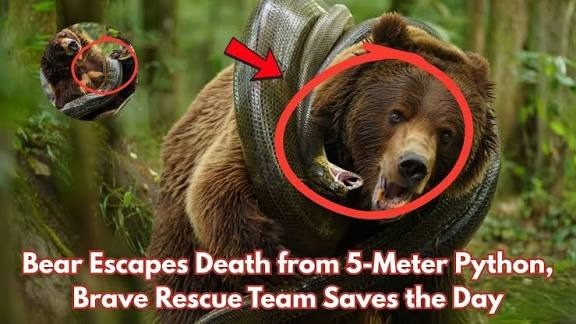
Bear vs. Python: What Happens When Two Powerful Wild Animals Meet?
In the wild, survival often depends on strength, timing, and the ability to react to the unexpected. A bear can rely on its powerful limbs, sharp claws, and strong jaws, while a large python uses a very different strategy, depending on stealth, muscular strength, and its ability to constrict prey.
But what would happen if these two remarkable animals crossed paths?
The idea of a bear fighting a python captures the imagination because the animals represent two very different forms of natural power. One is a large mammal capable of moving quickly over land, climbing in some cases, and defending itself with powerful physical tools. The other is a muscular snake that can remain hidden for long periods and strike when an opportunity appears.
Although dramatic encounters between wild animals often attract attention online, the outcome of a confrontation between a bear and a python would depend on several factors, including the species involved, their sizes, the environment, and whether either animal felt threatened.
Understanding their natural abilities offers a fascinating look at how wildlife survives—and why a meeting between these animals would be unpredictable.

The Bear: A Powerful Animal Built for Survival
Bears are among the most recognizable large mammals in the world. Depending on the species, they inhabit forests, mountains, grasslands, Arctic regions, and other environments.
Brown bears, black bears, and polar bears differ considerably in size, habitat, and behavior. However, many bears share physical characteristics that make them formidable animals in their natural environments.
Their strong limbs help them move heavy objects, climb in certain circumstances, and travel across challenging terrain. Their claws can be used for digging, climbing, obtaining food, and defense. Powerful jaws and a keen sense of smell also help them find food and respond to changes in their surroundings.
Despite their reputation, bears do not spend their lives looking for fights. Many are opportunistic omnivores, eating a varied diet that can include plants, berries, insects, fish, and other food sources depending on the species and season.
Avoiding unnecessary conflict is often beneficial because injuries can make it harder for an animal to find food or protect itself.
If a bear encountered a large snake, its response would depend on the circumstances. It might investigate, retreat, or react defensively if it perceived an immediate threat. There is no single behavior that can be predicted for every bear.

The Python: A Patient and Powerful Constrictor
Pythons are nonvenomous snakes found across parts of Africa, Asia, and Australia. Some species are relatively small, while others can grow to impressive lengths and develop substantial muscular strength.
Unlike venomous snakes, pythons subdue their prey primarily through constriction. After capturing an animal, a python may wrap its body around the prey and tighten its coils. Constriction interferes with normal blood circulation, helping the snake subdue its victim.
Pythons generally rely on camouflage, patience, and ambush rather than pursuing animals over long distances. Their patterned scales can help them blend into vegetation, leaf litter, and forest surroundings.
Their hunting strategies are suited to particular prey and habitats. Depending on the species and its size, a python may feed on mammals, birds, and other animals it can capture and swallow.
However, being a powerful constrictor does not mean a python can overpower every large animal it encounters. The size of its potential prey, the snake’s own dimensions, and the circumstances of an encounter all matter.
A very large python may pose a serious threat to some animals, especially when it can launch an effective ambush. A large bear, meanwhile, presents a different and potentially dangerous challenge.
What Might Happen if a Bear Met a Python?
A hypothetical encounter between a bear and a python would not necessarily begin with a fight.
In nature, animals often try to avoid unnecessary risks. A bear might pass through an area where a snake is resting without noticing it. A python might remain hidden rather than confront an animal too large or dangerous to capture.
The situation could change if one animal surprised the other at close range.
A python’s advantage would be greatest if it could approach suitable prey without being detected and establish a secure hold. Its body is designed to grip and constrict, but successfully subduing a large, powerful mammal would be a very different challenge from capturing the animals that typically make up its diet.
A bear’s size, mobility, and strong limbs could help it resist an attack. Its claws and jaws also provide defensive capabilities. Yet these advantages would not make the bear invulnerable: a bite, an entanglement, or an unexpected encounter could still cause injury.
The surrounding environment would also matter. Dense vegetation might provide a snake with places to hide, while open ground could give a bear more room to move. Water, uneven terrain, and the animals’ relative sizes could further influence their behavior.
For these reasons, it would be misleading to declare one animal the guaranteed winner without knowing the details.
Could a Python Actually Kill a Bear?
The answer requires distinguishing biological possibility from a documented event.
Large pythons are capable of killing and consuming certain mammals, and some species can reach substantial sizes. Nevertheless, bears are large, powerful mammals with physical characteristics that make them very different from the typical prey of a python.
A python attempting to subdue a bear would face a significant challenge, particularly if the bear were a healthy adult. The bear’s size and ability to struggle could make it difficult for the snake to establish and maintain an effective hold.
At the same time, wildlife encounters do not always follow simple rules. Relative body size, surprise, health, and the exact circumstances can change the risks involved.
There is an important difference between saying that a particular encounter is biologically conceivable and claiming that it has actually happened. Videos and social media posts sometimes use dramatic titles to describe animal confrontations, but footage may be miscaptioned, staged, edited, or generated with artificial intelligence.
Without reliable documentation, a specific story about a bear fighting or being killed by a python should not be presented as an established wildlife event.
Why Size Is Not the Only Factor in a Wild Animal Encounter
People often compare wild animals by asking which one is stronger. In reality, physical strength is only one part of survival.
A predator’s success depends on whether its hunting strategy suits the animal it encounters. Pythons use stealth and constriction, while bears have a different combination of movement, senses, strength, and defensive behavior.
The difference between hunting and self-defense is also important. An animal that can successfully capture one kind of prey may be poorly equipped to handle a much larger opponent. Similarly, an animal that is powerful in a direct confrontation may still be vulnerable to surprise or injury.
Age and health matter, too. A young or injured animal may respond differently from a healthy adult. Environmental conditions can influence movement, visibility, and the ability to escape.
Most encounters between wildlife are not dramatic battles to the finish. Animals generally seek food, shelter, mates, and safety. Fighting can consume valuable energy and lead to injuries that threaten future survival.
A bear and a python meeting in the same habitat would therefore not automatically mean that a battle would occur.
The Role of Habitat in Bear and Python Encounters
Bears and pythons do not all live in the same places. Bears inhabit several regions across North America, Europe, and Asia, while pythons are native to parts of Africa, Asia, and Australia.
Their ranges can overlap in some parts of Asia, depending on the bear and python species. For example, Asian black bears and certain pythons inhabit some of the same broad regions. However, sharing a region does not mean that these animals regularly encounter one another or that confrontations are common.
Habitat is a major influence on wildlife behavior. Forests offer cover and abundant hiding places, while rivers and wetlands attract animals looking for water or food. Seasonal changes can also affect where animals travel and what resources they seek.
When two species occupy overlapping habitats, they may coexist without direct conflict because they use different areas, feed on different resources, or are active at different times.
This is one reason wildlife research focuses not only on the physical abilities of animals but also on their behavior, distribution, and ecological relationships.
What Viral Animal Videos Can Teach Us
A video showing a bear and a large snake in a tense encounter would naturally attract attention. Viewers might wonder which animal has the advantage, whether the footage is authentic, and what happened before or after the recorded moment.
However, a short clip rarely provides enough information to explain an entire encounter.
The location may be unclear, the species may be misidentified, or the footage may show only a small part of a longer event. In some cases, an apparently realistic video may have been created or altered using digital tools.
Responsible wildlife reporting should identify the original source whenever possible, verify the location and species, and distinguish observed behavior from speculation.
This approach does not make wildlife stories less interesting. On the contrary, understanding the real abilities and limitations of animals often makes their behavior even more fascinating.
Rather than assuming that every dramatic video depicts a genuine battle, viewers can use it as an opportunity to learn more about the animals involved.
A Powerful Reminder of Nature’s Complexity
A bear and a python represent two very different approaches to survival. The bear relies on its size, strength, mobility, and adaptable feeding habits. The python depends on stealth, muscular control, and a specialized method of capturing prey.
If these animals encountered one another, the outcome would depend on their species, relative sizes, health, surroundings, and the circumstances of the meeting. Neither animal could be declared the certain winner in every possible scenario.
Most importantly, an encounter would not necessarily become a fight. Avoiding injury is often a better survival strategy than engaging in a dangerous confrontation.
The natural world is full of remarkable adaptations, but it rarely follows the simple rules of a competition. Every animal occupies a particular ecological role, and its abilities have developed in response to the challenges it faces.
A hypothetical meeting between a bear and a python is compelling precisely because it raises so many questions. By looking beyond dramatic headlines and examining the biology of both animals, we gain a more accurate understanding of how wildlife survives in a complex and unpredictable world.
The real lesson is not simply which animal might win. It is how differently two remarkable creatures have evolved to survive.