A ceremonial first pitch is usually a lighthearted part of a baseball game. A famous guest walks onto the field, raises a hand to the crowd, throws the ball toward the catcher, and returns to the sidelines. Sometimes the throw is accurate. Sometimes it is not.
For former U.S. President George W. Bush, however, a first pitch has carried unusual cultural significance for decades.
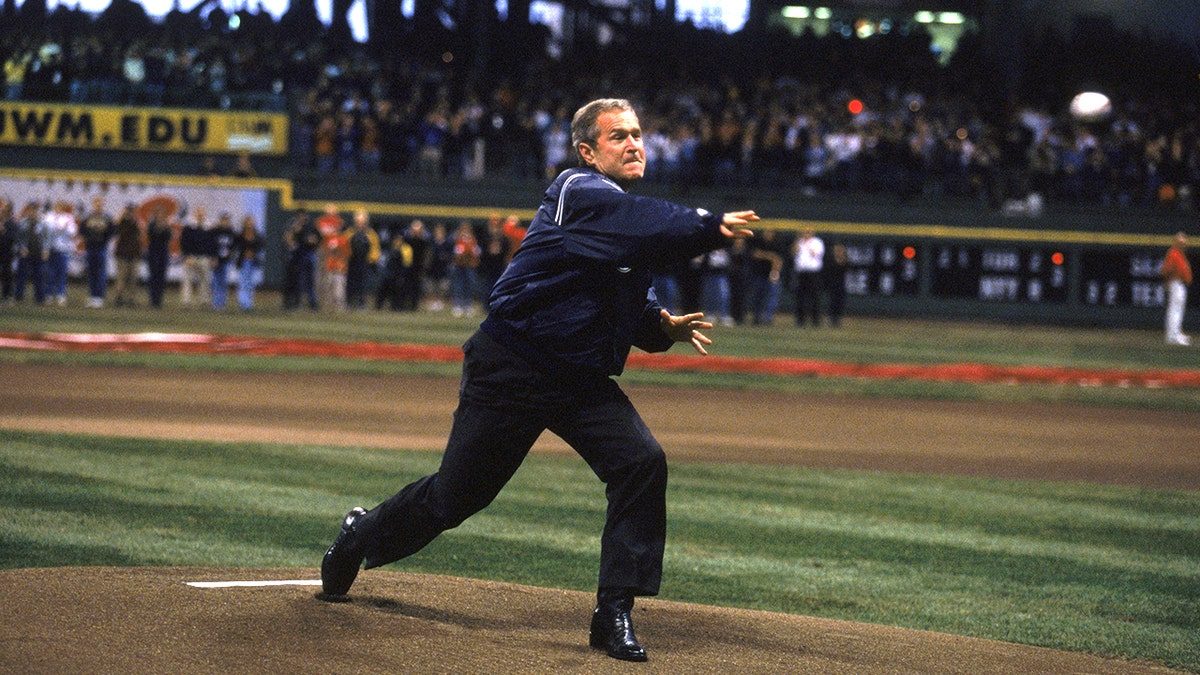
In October 2023, Bush returned to the mound before Game 1 of the World Series between the Texas Rangers and Arizona Diamondbacks in Arlington, Texas. The pitch bounced before reaching Hall of Fame catcher Iván Rodríguez, creating an amusing contrast with one of Bush’s most remembered baseball moments: his precise ceremonial pitch at Yankee Stadium in 2001.
That difference has occasionally encouraged online speculation about whether a single imperfect throw might reveal something more significant about a person’s physical condition. But a careful look at baseball, human movement, aging, and the available evidence tells a much more ordinary story.
Why George W. Bush’s First Pitch Became So Famous
George W. Bush has a particularly strong connection with baseball.
Before becoming president, Bush was part-owner of the Texas Rangers, and baseball remained an important part of his public identity. The George W. Bush Presidential Library describes baseball as one of his favorite White House interests and documents his participation in numerous ceremonial events involving the sport.
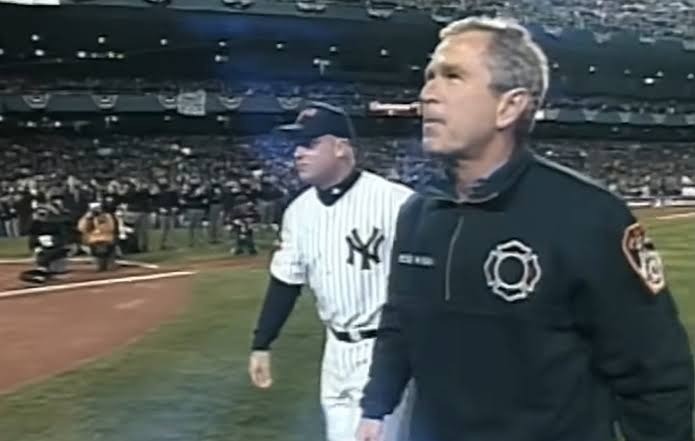
His most famous first pitch came on October 30, 2001, when he took the mound at Yankee Stadium before Game 3 of the World Series between the New York Yankees and Arizona Diamondbacks.
The moment occurred only weeks after the September 2001 attacks, when public attention and emotions across the United States were unusually intense. Bush wore an FDNY sweatshirt and threw the ball from the pitcher’s mound to Yankees catcher Todd Greene. The pitch reached the catcher cleanly and became one of the most recognizable ceremonial pitches in American sports history.
The symbolism of that moment has been discussed extensively over the years. It became associated not simply with baseball, but with a particular period in American history and the role that sporting events can sometimes play in public life.
A 2026 retrospective by USA Today Sports revisited the event nearly 25 years later, illustrating how frequently the footage continues to be remembered.
The 2023 Pitch Was Very Different
More than two decades later, Bush returned to the World Series stage.
On October 27, 2023, he threw the ceremonial first pitch before Game 1 between the Texas Rangers and Arizona Diamondbacks at Globe Life Field. Unlike the famous 2001 pitch, the ball traveled low and bounced shortly before reaching Iván Rodríguez.
The difference was immediately noticeable because the two moments are so easy to compare.
In 2001, Bush was 55 years old.
In 2023, he was 77.
Age naturally affects physical performance in many people. Balance, coordination, reaction time, flexibility, muscle strength, and the ability to generate force can all change gradually with age. That does not mean that an imperfect athletic movement automatically indicates a medical condition.
A ceremonial pitch is also an unusually poor test of health.
It lasts only a few seconds, involves a specific throwing motion, and takes place in front of thousands of spectators and cameras. Even experienced athletes and public figures occasionally throw inaccurate ceremonial pitches
 .
.
Can One Unusual Throw Reveal a Health Problem?
This is where scientific perspective becomes particularly important.
Human movement is influenced by many variables. A person may release a ball at a slightly different angle, shift their weight differently, misjudge the distance, or simply fail to generate the intended amount of force.
Even professional athletes are not perfectly consistent.
The Washington Post has previously examined the unpredictable nature of ceremonial first pitches, noting that numerous well-known athletes and public figures have produced inaccurate throws. The article emphasizes how easily nerves, expectations, and the unusual circumstances surrounding a ceremonial pitch can affect the result.
That makes it difficult to use one throw as meaningful evidence of someone’s overall physical condition.
From a scientific standpoint, medical assessment generally depends on a person’s broader history, repeated observations, physical examination, and, when appropriate, diagnostic testing. A short sports clip cannot substitute for that process.
Therefore, claims suggesting that Bush’s 2023 pitch proves a particular health condition go beyond what the available evidence can establish.
Why People Look for Hidden Meaning in Physical Moments
The fascination with Bush’s first pitch also connects to a broader human tendency.
People naturally look for patterns.
When viewers see an older public figure perform a familiar action differently from the way they did decades earlier, the contrast can feel meaningful. The brain naturally compares the two images and searches for an explanation.
This phenomenon is not unique to presidents.
A singer may perform a familiar song differently years later. An actor may move differently in an older interview. An athlete may appear less energetic than during their peak career.
In each case, viewers can be tempted to interpret a small observation as evidence of a much larger story.
Sometimes that interpretation may eventually be supported by additional information. But sometimes the simplest explanation is simply that people change as they age.
The Cultural Meaning of the First Pitch
The first pitch itself has a long place in American baseball culture.
Presidential involvement in baseball is particularly well established. U.S. presidents have participated in ceremonial first pitches for generations, making the tradition a visible intersection between sports, public life, and American culture.
George W. Bush’s connection with baseball makes his appearances especially notable.
The George W. Bush Presidential Library records his longstanding relationship with the sport, including his ownership connection to the Texas Rangers and numerous baseball-related events during his presidency.
His 2001 World Series appearance subsequently became part of this larger tradition.
In cultural terms, the significance of that pitch is therefore larger than its technical accuracy. It became an image people remembered because of the historical moment surrounding it.

Why the 2001 Pitch Still Matters
The 2001 pitch is sometimes remembered primarily because it was accurate.
But the historical context explains much of its lasting importance.
MLB’s retrospective describes Bush taking the mound at Yankee Stadium on October 30, 2001, wearing an FDNY pullover and receiving a powerful response from the crowd. The pitch was caught by Todd Greene.
More recent retrospectives have returned to the moment because it represented an unusual intersection of baseball and American public life.
The New York Times’ 2026 retrospective of the Yankees’ post-2001 World Series period also revisited the preparations behind the ceremonial pitch, including Bush’s interaction with Derek Jeter before he stepped onto the field.
The event therefore has a cultural life independent of the physical mechanics of throwing a baseball.
Aging, Athletic Performance, and Normal Physical Change
Aging is another important part of the discussion.
The human body does not remain physically identical throughout adulthood. Strength, flexibility, balance, cardiovascular capacity, and coordination can change over time. The pace of those changes varies considerably between individuals.
Physical activity can remain an important part of healthy aging, but maintaining activity does not mean that someone will perform every movement exactly as they did decades earlier.
A 77-year-old former president does not need to reproduce the physical performance of his 55-year-old self to demonstrate that he is functioning normally.
This distinction is important because online discussions can sometimes treat photographs or short videos as though they were medical examinations.
They are not.
What About Claims of a “Terrifying Health Crisis”?
Extraordinary claims require stronger evidence than a single unusual moment.
The phrase “health crisis” creates a very specific impression, but an inaccurate ceremonial pitch alone does not establish such a crisis.
Publicly available material reviewed for this article does not provide evidence that the 2023 World Series pitch itself demonstrated a sudden medical problem. Contemporary reporting described the pitch as bouncing before reaching Rodríguez, while coverage of Bush’s baseball history provides extensive context for his repeated participation in ceremonial first pitches.
It is possible for people online to speculate about what a physical moment might mean. Speculation, however, should remain clearly separated from documented information.
Without medical records or a reliable statement from Bush or his representatives addressing a specific condition, viewers should be cautious about treating internet interpretations as established fact.
A More Interesting Way to Look at the Moment
Perhaps the most interesting aspect of the story is not whether a baseball landed perfectly.
It is the passage of time.
The 2001 and 2023 pitches provide two snapshots separated by 22 years. One became famous because of its historical setting and accuracy. The other became memorable partly because viewers already knew the earlier story.
Seen together, they illustrate something familiar about human experience: people change, circumstances change, and familiar moments can look very different when repeated years later.
The comparison also demonstrates why context matters.
A single frame can create a question. A reliable answer requires considerably more information.
Final Reflection: Why We Remain Curious
Human beings have always been fascinated by unusual moments involving famous people.
A brief gesture, an unexpected expression, or an imperfect performance can become the starting point for a much larger story. Sometimes that curiosity helps us discover meaningful history. At other times, it encourages speculation that goes beyond the available evidence.
George W. Bush’s World Series pitches offer a useful reminder of that distinction.
The 2001 pitch remains an important cultural image connected with a remarkable period in American history. The 2023 pitch was simply a very different athletic moment, one that naturally attracted attention because of the contrast.
Neither moment needs an extraordinary explanation to be interesting.
Perhaps that is the most valuable lesson. Curiosity encourages us to ask questions, but careful thinking reminds us to distinguish what we can observe from what we merely imagine. In an age when a few seconds of video can reach millions of people, that distinction matters more than ever.