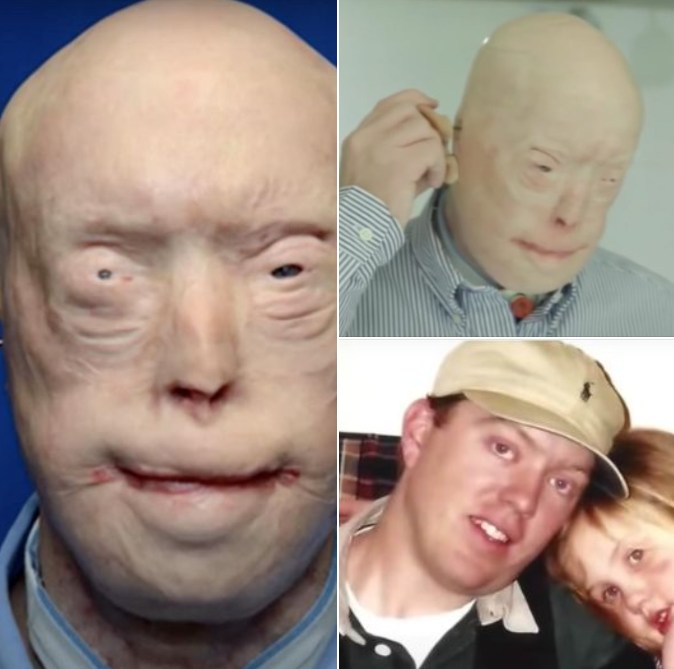
On an ordinary day, most people never imagine how quickly life can change. For Patrick Hardison, a volunteer firefighter and devoted father from Mississippi, one emergency call transformed his future in ways he could never have predicted.
Like countless first responders across the world, Patrick rushed toward danger when others were moving away from it. His mission was simple: help someone who might be trapped inside a burning home. What followed was a life-altering event that would test his resilience, challenge the limits of modern medicine, and ultimately inspire millions.
Years later, Patrick would become known around the world for undergoing one of the most complex face transplant procedures ever performed. His story is not only about medical achievement. It is also about determination, family support, organ donation, and the extraordinary possibilities of scientific advancement.
Who Is Patrick Hardison?
Patrick Hardison was a volunteer firefighter, husband, and father who lived a relatively ordinary life before a devastating house fire changed everything.
In 2001, he responded to an emergency involving a residential fire. While attempting to help during the rescue effort, part of the structure collapsed, causing severe injuries to his face, scalp, neck, and upper body.
The injuries dramatically altered his appearance and created numerous physical challenges. Everyday activities that most people take for granted became difficult and often painful.
Despite undergoing dozens of reconstructive procedures over many years, Patrick continued to face significant obstacles affecting his quality of life.

Life After the Accident
Recovery from major injuries is rarely straightforward. Beyond the physical challenges, many individuals must also navigate emotional and social adjustments.
For Patrick, public outings often became difficult experiences. He spoke openly about attracting attention from strangers and feeling self-conscious in social situations.
Simple tasks such as eating, speaking comfortably, and protecting his eyesight required ongoing medical care and adaptation.
Yet throughout these challenges, Patrick remained committed to his family and determined to keep moving forward.
His experience highlights an important reality faced by many people living with visible differences: resilience often develops not because challenges disappear, but because individuals learn to face them day after day.
The Evolution of Face Transplant Surgery
Face transplantation is one of the most remarkable developments in modern reconstructive medicine.
The concept may sound like science fiction, but it has become a real surgical option for carefully selected patients with severe facial injuries or conditions.
The world’s first partial face transplant was performed in 2005 on French patient Isabelle Dinoire. The procedure marked a turning point in medical history and opened the door to future advancements.
Face transplantation involves replacing damaged facial tissues with donor tissues, including skin, muscles, nerves, blood vessels, and sometimes bone structures.
These procedures are highly complex and require extensive planning, specialized surgical teams, and long-term medical monitoring.
A Search for Hope
As surgical techniques continued to improve, Patrick learned that face transplantation might offer a possibility for a better future.
One of the key figures in his journey was Eduardo D. Rodriguez, a reconstructive surgeon recognized for pioneering work in facial transplantation.
Finding a suitable donor, however, proved to be a lengthy and uncertain process.
Transplant compatibility involves numerous medical factors, including tissue matching, blood type considerations, and other biological requirements. Suitable donor opportunities are extremely rare.
For a long time, it seemed uncertain whether Patrick would ever receive the chance to undergo the procedure.

The Gift That Made History Possible
The turning point came when a donor was identified.
The donor was David Rodebaugh, a young man whose family chose organ and tissue donation following a tragic accident.
Organ donation often creates opportunities for life-changing medical procedures. In this case, the decision by David’s family made it possible for surgeons to perform a groundbreaking operation that would benefit Patrick and advance medical science.
Stories like this frequently highlight the profound impact donor families can have on the lives of others.
While transplantation technology receives much of the attention, none of these procedures would be possible without individuals and families willing to make generous decisions during difficult moments.
One of the Most Complex Surgeries Ever Performed
In 2015, Patrick underwent a face transplant procedure that required extraordinary coordination.
More than 100 medical professionals participated in the operation, including surgeons, anesthesiologists, nurses, technicians, and support staff.
The surgery lasted approximately 26 hours.
The transplant included extensive facial structures, such as the scalp, ears, eyelids, portions of bone, and other facial tissues.
Medical experts considered the procedure one of the most comprehensive face transplants ever attempted at that time.
Because of the complexity involved, the operation carried significant risks. Extensive planning and preparation were required before the surgical team moved forward.
Recovery and Rehabilitation
A successful surgery marks only the beginning of a transplant journey.
Recovery involves months and often years of rehabilitation, medical monitoring, and adjustment.
For Patrick, rehabilitation required learning how to perform many familiar functions in new ways. Activities involving facial movement, speech, and swallowing demanded patience and persistence.
Doctors also closely monitored the transplanted tissues to ensure his body accepted them properly.
Like many transplant recipients, Patrick must continue taking medications that help prevent rejection of donor tissues.
These lifelong commitments are an important part of successful transplant outcomes.
The Science Behind Face Transplants
Face transplantation represents a fascinating intersection of several medical disciplines.
Plastic and reconstructive surgery provide the structural foundation for the procedure.
Microsurgery allows surgeons to connect tiny blood vessels and nerves with remarkable precision.
Immunology helps physicians understand how to reduce the body’s rejection response.
Rehabilitation specialists assist patients in regaining function after surgery.
Advances in imaging technology, surgical planning, and transplant medicine have collectively made procedures possible that would have seemed unimaginable only a few decades ago.
Researchers continue studying ways to improve outcomes, reduce complications, and expand treatment options for future patients.

Public Fascination and Cultural Significance
Stories involving face transplants often capture public imagination because the human face plays such a central role in identity, communication, and social interaction.
Throughout history, cultures around the world have viewed the face as a symbol of individuality and personal expression.
Modern medicine’s ability to restore facial function and appearance naturally inspires curiosity.
At the same time, medical experts emphasize that face transplantation is not a cosmetic procedure. Its primary purpose is restoring function, improving quality of life, and helping patients regain essential abilities such as blinking, breathing, eating, and communicating.
Understanding this distinction helps place these remarkable surgeries within the broader context of healthcare and patient well-being.
Life After Transplantation
Years after his surgery, Patrick continued to share his experience publicly.
His story became a source of encouragement for individuals facing serious medical challenges and long recovery journeys.
By speaking openly about his experiences, he helped raise awareness about organ donation, reconstructive medicine, and the importance of hope during difficult circumstances.
His journey also demonstrated that recovery is rarely defined by a single event. Instead, it is a process involving perseverance, support systems, medical care, and personal determination.
For many people, that message resonates far beyond the medical details of his procedure.
What Patrick Hardison’s Story Teaches Us
Several important lessons emerge from Patrick’s journey.
First, advances in medicine continue to expand possibilities for patients facing complex health challenges.
Second, organ and tissue donation can profoundly transform lives.
Third, recovery often depends on both medical expertise and human resilience.
Finally, stories like Patrick’s remind us that behind every medical breakthrough is a person striving for a better future.
Technology may make extraordinary procedures possible, but courage, compassion, and perseverance remain at the heart of every recovery story.
A Reflection on Human Curiosity
Human beings have always been fascinated by stories of survival, innovation, and transformation. From ancient healing traditions to today’s advanced surgical techniques, our curiosity drives us to explore what is possible and to push the boundaries of knowledge. Patrick Hardison’s journey reflects that enduring spirit of discovery. His story reminds us that scientific progress is not simply about technology—it is about improving lives, creating opportunities for healing, and inspiring hope. As medicine continues to evolve, stories like his encourage us to appreciate both the power of human ingenuity and the resilience of the human spirit.

Sources
NYU Langone Health
Time Magazine
Fox News Interviews with Patrick Hardison
People Magazine
American Society of Plastic Surgeons
National Institutes of Health (NIH)
Mayo Clinic – Organ and Tissue Transplantation Resources