Chapter 2: More Than a Shirt
The courtroom remained silent after Mr. Carroway finished speaking.
His words hung in the air as though the faded shirt alone could summarize my entire life as a mother.
I glanced at Nolan.
His fingers gently touched the tiny embroidered moon above his pocket.
He wasn’t embarrassed by the shirt.
He was confused.
Children don’t naturally judge clothing the way adults sometimes do.
To Nolan, it was simply his favorite shirt.
Judge Harlan looked toward me.
“Mrs. Bellamy, would you like to respond?”
I stood slowly, carrying only my worn folder.
“I would, Your Honor.”
My voice wasn’t loud.
It didn’t need to be.
“I understand why the photograph was shown.”
I looked briefly toward Grant.
“But I hope today we remember that a single photograph rarely tells the whole story.”
The judge nodded.
“You may continue.”
I opened my binder.
Inside were neatly organized documents separated by handwritten tabs.
School.
Medical.
Housing.
Work.
Activities.
Each page represented countless ordinary days.
Not dramatic moments.
Just the quiet work of raising a child.
I handed the first set of papers to the court clerk.
“Nolan has missed only two days of school this year.”
The clerk passed the records to the judge.
“Both absences were due to a seasonal illness confirmed by his pediatrician.”
I turned another page.
“These are his report cards.”
Judge Harlan adjusted his glasses.
Every subject showed steady progress.
Beside nearly every grade sat the same teacher’s comment.
Kind. Respectful. Always prepared.
I smiled.
“Nolan loves science.”
The judge looked toward the little boy.
“Is that true?”
Nolan nodded enthusiastically.
“My favorite is astronomy.”
“I can see that.”
The judge smiled gently.
“I like your little moon.”
Nolan instinctively looked down at the embroidered pocket.
“Mom found it.”
His smile returned.
“It was on sale.”
The courtroom grew quiet again.
Grant’s attorney stood.
“No one disputes that Mrs. Bellamy loves her son.”
He paused.
“The concern is whether affection can replace financial stability.”
Grant folded his hands confidently.
The attorney continued.
“My client owns a four-bedroom home.”
He displayed several photographs.
A spacious backyard.
A bright bedroom decorated with new furniture.
A large playroom.
“He can provide opportunities unavailable in Mrs. Bellamy’s current circumstances.”
I listened without interruption.
The house looked beautiful.
No one questioned that.
Then Judge Harlan asked the question neither attorney seemed to expect.
“How often has Mr. Bellamy exercised his current parenting time?”
The attorney hesitated.
“My client maintains regular communication.”
The judge looked down at another document.
“I’m asking about time.”
Silence.
Finally Grant answered himself.
“My work schedule has been demanding.”
Judge Harlan nodded thoughtfully.
“I understand.”
He turned another page.
“The records before me indicate that during the past twelve months, Mr. Bellamy requested to reschedule or cancel fourteen weekend visits.”
Grant shifted slightly in his chair.
“Business travel.”
The judge made another note.
When it became my turn again, I quietly removed another folder.
“This contains Nolan’s school attendance at family events.”
Science fair.
Reading day.
Music performance.
Field trip volunteers.
Every event listed the attending parent.
Each time, my signature appeared.
Judge Harlan studied the pages carefully.
“You attended all of these?”
“Yes, Your Honor.”
“Despite working multiple jobs?”
“Yes.”
Grant looked down at the table.
Then the judge surprised everyone.
“I’d like to hear from Nolan.”
My heart skipped.
Children were never asked to choose between parents.
This wasn’t that kind of question.
Judge Harlan smiled warmly.
“Nolan.”
“Yes, sir.”
“I have something very important to ask.”
Nolan sat up a little straighter.
“When you think about home…”
“…what comes to mind?”
The courtroom waited quietly.
Nolan thought for several seconds.
Then he answered honestly.
“The smell of cinnamon.”
A few people looked puzzled.
The judge smiled.
“Tell me more.”
“Our apartment is above a bakery.”
“Every morning it smells like warm bread.”
He smiled.
“And Grandma sings while making pancakes.”
Several people quietly smiled.
The judge nodded.
“What else?”
“My mom leaves little notes in my lunch.”
He looked toward me.
“Sometimes she draws funny rockets.”
I laughed softly.
“They’re not very good rockets.”
“They are to me.”
Even the court reporter smiled.
Grant’s attorney cleared his throat.
“Nolan…”
He walked closer.
“Do you like visiting your father’s house?”
“Yes.”
“It’s big.”
“And you have your own room there?”
“Yes.”
“Wouldn’t you like to live somewhere with more space?”
Nolan frowned.
“I already have enough space.”
The attorney looked surprised.
“But your father’s house is much larger.”
Nolan considered the question carefully.
Then he gave the kind of answer only an eight-year-old could.
“My room isn’t where I feel the most at home.”
The courtroom became completely still.
“And where is that?”
Nolan smiled.
“Where Mom reads before bed.”
No one spoke.
Because sometimes…
Children explain love more clearly than adults ever can.
The attorney glanced once more toward the photograph.
“Let’s return to the clothing issue.”
He reached for the enlarged picture again.
“This shirt has clearly been worn many times.”
Nolan looked down at it.
Then back toward the attorney.
“It’s my favorite.”
“I understand.”
“But why this one?”
Nolan’s face brightened.
“Because of the moon.”
He gently touched the tiny embroidery again.
“My mom says even little lights can help people find their way.”
The words caught me by surprise.
I had almost forgotten saying them months earlier during a neighborhood blackout.
Grant looked at the shirt differently now.
Not as evidence.
As a memory.
Judge Harlan closed the folder in front of him.
“I appreciate everyone’s testimony today.”
He paused.
“But custody decisions are not made solely by comparing homes, clothing, or income.”
The courtroom remained silent.
“They require a full understanding of a child’s daily life.”
Just as he prepared to move to the next witness…
Nolan quietly raised his hand.
“Your Honor?”
The judge looked pleasantly surprised.
“Yes, Nolan?”
The little boy stood slowly.
He looked down at the faded navy-blue shirt everyone had spent the morning discussing.
Then he carefully began unfastening the top button.
I immediately realized what he was doing.
My heart skipped.
Because hidden inside that shirt—
where no one in the courtroom had thought to look—
was something Nolan had quietly created weeks earlier.
Something written in blue marker…
That he had never intended for strangers to see.
And within moments…
The little silver moon shirt everyone believed proved a mother’s failure…
was about to tell a very different story.
Chapter 3: The Words No One Expected
The courtroom fell silent.
Even the attorney who had spent the morning pointing to Nolan’s faded shirt stopped speaking.
Nolan looked toward me.
Not because he was asking for permission.
Because he wanted to be sure I wasn’t upset.
I smiled gently and gave him a small nod.
“It’s okay,” I whispered.
He smiled back.
Then, with careful little fingers, he unbuttoned the rest of the shirt.
Several people leaned forward, unsure of what they were about to see.
Judge Harlan watched quietly.
“Take your time, Nolan.”
“Yes, sir.”
Nolan slipped the shirt off carefully, leaving on the white T-shirt he wore underneath.
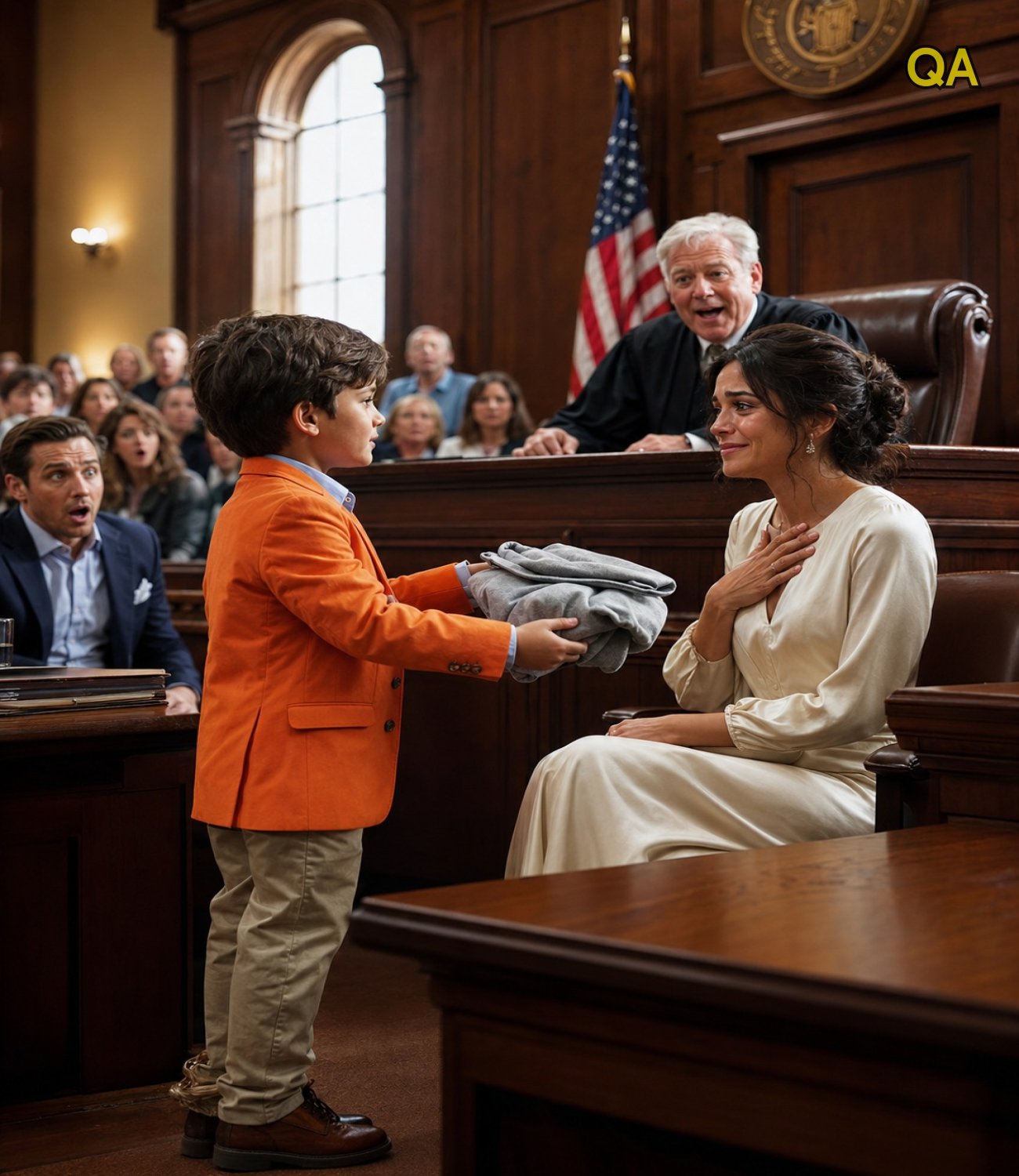
Then he turned the navy shirt inside out.
Near the bottom hem, written in neat blue marker between two seams, was a message.
Not large.
Not professionally written.
Just the careful handwriting of an eight-year-old boy.
The bailiff accepted the shirt and handed it to the judge.
Judge Harlan adjusted his glasses before reading the words aloud.
“Mom says the moon still shines even when you can’t always see it. I want to be like that and help people feel safe.”
The room became completely still.
No one had expected those words.
The faded mark that had been described as proof of neglect wasn’t dirt hiding poor care.
It partially covered a message Nolan himself had written months earlier after asking whether he could “make the shirt even more special.”
I remembered that evening immediately.
It had happened after one particularly difficult week.
The heating system had stopped working.
My car refused to start.
I had picked up extra shifts at the diner.
Nolan found me folding laundry late at night.
“Mom?”
“Yes?”
“Can I write something inside my moon shirt?”
I laughed.
“Inside?”
“So nobody can see it.”
“What would you write?”
He thought for a long moment.
“A reminder.”
“A reminder of what?”
“That good things are still there.”
I had handed him a washable fabric marker.
“Just don’t write on the outside.”
He smiled proudly.
“I won’t.”
Neither of us imagined that little message would one day be read inside a courtroom.
Grant stared at the shirt.
His confident expression had disappeared.
The attorney beside him quietly cleared his throat.
“Your Honor…”
But the judge gently raised one hand.
“I’d like to hear from Nolan.”
He looked toward my son.
“Can you tell us why you wrote that?”
Nolan nodded.
“One night our lights went out.”
He looked around the courtroom.
“I got scared.”
“So Mom took me outside.”
I smiled as the memory returned.
The neighborhood had been dark after a storm.
Without streetlights, the sky looked brighter than I had ever seen.
Nolan continued.
“She pointed at the moon.”
“And what did she say?”
He smiled.
“She said sometimes you can’t see all the light…”
“…but it never stops being there.”
The judge remained silent.
“So I wanted to remember.”
Grant’s attorney tried once more.
“Your Honor, while this is certainly touching…”
The judge looked directly at him.
“This hearing concerns the child’s well-being.”
“It does.”
“I believe the child’s own words are relevant.”
The attorney nodded respectfully and sat down.
Judge Harlan returned the shirt carefully.
“Nolan.”
“Yes, sir?”
“I understand why this shirt is important to you.”
“It reminds me of home.”
Those four words settled quietly over the courtroom.
Not because they were dramatic.
Because they were sincere.
I noticed several people in the gallery discreetly wiping away tears.
One of the court clerks smiled softly before returning to her notes.
Even the bailiff’s expression had softened.
Sometimes ordinary honesty reached people more deeply than carefully prepared arguments.
Then Judge Harlan looked toward Grant.
“Mr. Bellamy.”
Grant stood.
“You’ve presented evidence of financial stability.”
“Yes, Your Honor.”
“You’ve shown photographs of your home.”
“Yes.”
“You’ve explained the opportunities you can provide.”
“I have.”
The judge nodded.
“Those are all valuable things.”
Grant seemed hopeful.
Then the judge continued.
“But today I’ve also heard about school conferences attended.”
“Bedtime routines.”
“Packed lunches.”
“Handwritten notes.”
“Science projects.”
“Conversations during power outages.”
He gently folded his hands.
“These are not things measured on bank statements.”
Grant lowered his eyes.
For the first time that day, Grant looked directly at Nolan instead of the judge.
“I didn’t know about the shirt.”
Nolan answered honestly.
“You never asked.”
The words weren’t angry.
They were simply true.
Grant seemed unable to reply.
A long silence followed.
Finally, Judge Harlan spoke.
“This court will take a brief recess before concluding today’s hearing.”
Everyone slowly began standing.
Attorneys gathered papers.
The bailiff announced the recess.
I reached for Nolan’s shirt.
Before I could help him put it back on, Grant quietly walked toward us.
He stopped several feet away.
Not close enough to make Nolan uncomfortable.
His voice was softer than I had heard in years.
“Nolan…”
My son looked up.
“I’ve missed a lot, haven’t I?”
Nolan thought carefully before answering.
Then he gave the kind of response only a child could.
“You missed my second-grade play.”
“My science fair.”
“My birthday picnic.”
He counted silently on his fingers.
“And when I learned to ride my bike.”
Grant closed his eyes briefly.
Each memory sounded heavier than the one before it.
There was no accusation in Nolan’s voice.
Only facts.
Sometimes facts carried more weight than anger ever could.
As the bailiff announced that court would resume in five minutes, Judge Harlan remained standing near the bench, quietly watching the exchange.
He wasn’t looking at expensive suits.
Or photographs.
Or financial records anymore.
He was watching something much harder to measure—
whether a father was finally beginning to understand that raising a child wasn’t about providing the biggest house…
but about showing up for all the ordinary moments that quietly become a childhood.