DNA Testing, Paternity Questions, and the Rare Science of Chimerism
DNA testing is widely regarded as one of the most reliable tools in modern medicine and family law. Paternity tests, ancestry services, and clinical genetic analyses can provide highly accurate information when samples are collected, processed, and interpreted correctly. Yet genetics is a complex field, and rare biological circumstances can sometimes make an apparently straightforward result more difficult to understand.
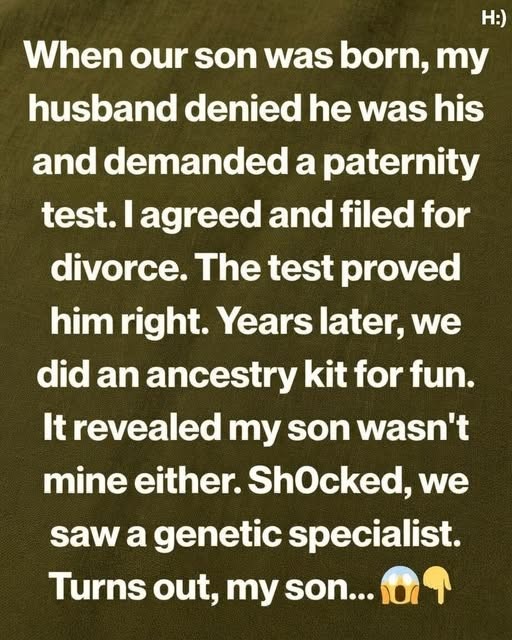
A widely shared personal account describes a mother whose husband questioned whether their newborn son was biologically related to him. After requesting a paternity test, the husband received a result indicating that he was not the child’s biological father. The situation reportedly led to the end of the marriage. Years later, an ancestry DNA test raised another unexpected question when it appeared that the mother herself was not genetically related to her son.
The account attributes the unusual findings to chimerism, a rare genetic condition in which one person has two or more genetically distinct groups of cells. Although individual stories circulating online cannot always be independently verified, the underlying scientific issue is real. Medical literature documents rare cases in which chimerism, sample limitations, transplantation, and other factors have complicated DNA-based relationship testing.
Understanding these exceptions does not diminish the value of DNA testing. Instead, it highlights why unexpected results should be reviewed carefully, confirmed through accredited laboratories, and interpreted with support from qualified genetics professionals.
How Paternity DNA Tests Usually Work
A paternity test compares specific genetic markers from a child with markers from an alleged father. A child inherits approximately half of their DNA from each biological parent. Modern relationship tests commonly examine multiple short tandem repeat, or STR, markers. When the alleged father’s markers are incompatible with those inherited by the child, the laboratory may exclude him as the biological father.
When performed by an accredited laboratory using properly identified samples, paternity testing can be extremely accurate. A result supporting paternity may reach a probability of 99.9% or higher, depending on the testing method and the family members available for comparison. An exclusion may also be highly persuasive when enough genetic markers do not match.
However, “highly accurate” does not mean that every result should be interpreted without context. Laboratories must account for sample identity, sample quality, close biological relatives, mutations, and rare genetic variation. In legal or high-stakes family matters, experts generally recommend chain-of-custody collection, where trained staff verify identities and document how samples are handled.
At-home DNA kits can be useful for personal ancestry exploration, but they are not automatically equivalent to legal relationship tests. Their results may require confirmation through a laboratory that specializes in parentage analysis, especially if a finding could affect family relationships, inheritance, custody, immigration, or financial obligations.
Why an Unexpected DNA Result Can Be So Difficult
DNA findings often carry emotional weight because they can challenge long-held assumptions about family, identity, and trust. A paternity result may affect more than two adults. It can influence a child’s sense of belonging, access to medical history, relationships with relatives, and practical decisions involving care or support.
For that reason, a surprising result should not be treated as proof of wrongdoing without careful follow-up. Health professionals and genetic counselors stress the importance of repeat testing and clear communication. An unexpected result can arise from several causes, including administrative errors, sample mix-ups, laboratory limitations, a mutation in a tested marker, or uncommon biological conditions.
In particularly complex cases, testing additional relatives may help clarify the genetic picture. A laboratory may compare samples from the child, mother, alleged father, grandparents, or siblings. It may also use a different type of genetic marker or collect DNA from more than one tissue type, such as blood and cheek cells, when medically appropriate.
What Is Genetic Chimerism?
Chimerism is a condition in which one person has two or more populations of cells with different genetic material. The term comes from Greek mythology, but in biology it describes a real and unusual phenomenon. A chimera can develop when two early embryos merge during pregnancy, resulting in one individual whose cells do not all share exactly the same DNA profile.
Another form of chimerism may occur after a person receives a bone marrow or stem cell transplant. Because the donor’s blood-forming cells can establish themselves in the recipient’s body, blood samples may contain DNA that differs from DNA found in other tissues. This is especially important in forensic, medical, and parentage testing contexts.
Microchimerism is related but distinct. It refers to the presence of a small number of cells from another individual, such as fetal cells that remain in a mother’s body after pregnancy or maternal cells that persist in a child. Microchimerism is generally present at low levels and does not usually create the same kind of broad testing discrepancy associated with tetragametic chimerism.
Tetragametic chimerism, which can occur after the fusion of two fertilized eggs, is especially relevant to rare parentage-testing discussions. In such a case, one genetic cell line may be more represented in blood, while another may be present in reproductive tissues or other parts of the body. If a DNA test relies on a sample containing one cell line, it may not fully reflect the genetics associated with conception.
Can Chimerism Affect Parentage Testing?
Yes, but it is important to emphasize that this is rare. Medical journals have reported exceptional cases in which a parent’s routine DNA sample did not appear to match their biological child as expected. In some cases, additional testing of other tissues, relatives, or reproductive material helped explain the discrepancy.
One well-known category of cases involves mothers whose blood or cheek-swab DNA did not initially show the expected biological relationship to their children. Further investigation identified different DNA profiles in different tissues, consistent with chimerism. These cases demonstrate that a single DNA sample may not always represent every cell line in an individual’s body.
Such examples are scientifically significant precisely because they are unusual. Most parentage tests do not encounter chimerism, and the overwhelming majority of well-conducted tests provide reliable answers. Still, the existence of documented exceptions supports an important principle: when results conflict sharply with known medical history or other credible evidence, repeat testing and specialist evaluation are appropriate.
Other Factors That May Complicate DNA Analysis
Chimerism is not the only reason a DNA result may need further review. A person who has undergone a bone marrow transplant may show donor DNA in blood samples. In that circumstance, a laboratory may need to use a non-blood sample, such as a cheek swab, hair follicle with tissue, or another clinically suitable source. The correct approach depends on the individual’s medical history and the laboratory’s protocols.
Rare mutations can also affect one or more genetic markers used in relationship testing. Accredited laboratories are trained to recognize when a mutation may be a possibility and may expand testing rather than treating a single inconsistency as conclusive. Testing close relatives may offer additional evidence in these circumstances.
Administrative problems are another consideration. Any testing process can be affected by incorrect labeling, accidental contamination, or a mix-up in sample handling. These events are not common in reputable laboratories, which use quality-control systems to reduce risk, but they are one reason why legal cases rely on documented collection procedures and independent review.
Consumer ancestry testing creates an additional distinction. These services generally use selected genetic variants to estimate ancestral origins and identify potential relatives. They are valuable tools for genealogy, but their results are not designed to replace clinical genetic consultation or court-admissible paternity testing.
What Families Should Do After a Surprising DNA Result
People who receive an unexpected paternity, maternity, or ancestry finding should avoid making immediate decisions based solely on one report. The first step is to contact the testing company or laboratory and ask what type of test was performed, which samples were used, and whether confirmatory analysis is available.
When a result could have legal, medical, or major personal consequences, a second test through an accredited relationship-testing laboratory is advisable. The follow-up test should use verified identity procedures and may involve testing multiple family members. If the results remain inconsistent, a clinical geneticist or genetic counselor can help determine whether more specialized testing is warranted.
A genetic counselor can explain what a result does and does not establish, discuss potential biological explanations, and help families consider the emotional implications. Counselors do not make personal decisions for families, but they can provide accurate information in a setting designed to be supportive and confidential.
Parents and caregivers should also consider the wellbeing of any child involved. Conversations about DNA and family identity can be sensitive at every age. Experts often recommend approaching such discussions with honesty, patience, and age-appropriate language, while avoiding blame or assumptions that have not been supported by reliable evidence.
Trust, Science, and the Importance of Careful Interpretation
The reported story of a family affected by an unusual DNA finding reflects a broader lesson about genetic information. DNA testing is powerful, but it is not separate from human judgment. A laboratory result must be understood in light of the testing method, the sample source, medical history, and the possibility—however rare—of biological complexity.
Scientific progress has made family relationship testing more precise than ever. At the same time, genetics continues to reveal that human biology does not always fit simple assumptions. Chimerism, transplantation-related DNA changes, and rare mutations are reminders that an unexpected result may call for investigation rather than immediate conclusions.
For families facing a difficult DNA result, the most responsible path is usually verification, professional guidance, and compassion. Accurate testing matters, but so do the relationships and wellbeing of the people whose lives may be affected by its interpretation.
Sources
Disclaimer: This content is intended for entertainment purposes only and is not based on real events.