Chapter 1: The Whispers at Midnight
“She has no idea. By the time she signs, it’ll be too late to change anything.”
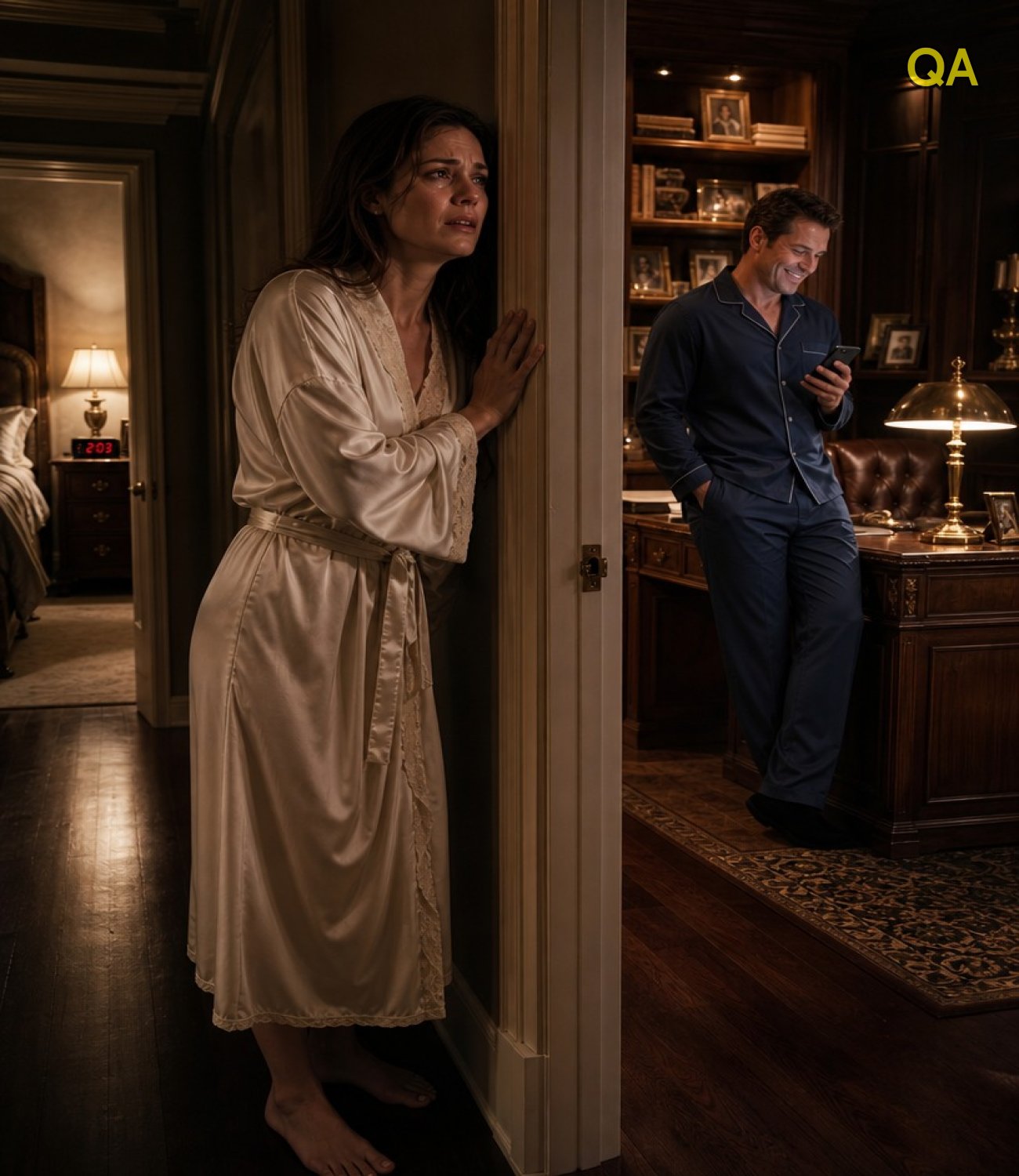
At 2:07 a.m., Marcela woke with a sharp jolt. For a brief moment, she assumed she was lingering in a lingering nightmare. But her husband’s voice continued drifting down the dark hallway from the study. It was smooth, confident, and punctuated with an amused chuckle. Arturo only adopted that tone when he was certain he held every winning card.
Marcela reached across the bed. The sheets beside her were cold. More than his words, that coldness chilled her to the core.
Slipping into a light robe, she moved silently down the hallway toward the half-open door of the study. Warm yellow light spilled onto the hardwood floor.
“And what if she actually reads the documents this time?” a second voice asked over a speakerphone.
Arturo laughed softly. “Marcela trusts me completely. She never bothers reading the fine print. She leaves the business to me so she can focus on her writing.”
Those words pierced through thirty-one years of shared history. In an instant, decades of absolute trust dissolved into a single, sharp emotion: profound doubt.
The next morning, the house was deceptive in its normalcy. Sunbeams illuminated the kitchen counter as Arturo calmly sipped his espresso. He reminded her casually that on Friday afternoon they would meet to sign administrative routine paperwork regarding the management of their shared estate.
“Just standard updates,” he said with a warm smile, kissing her cheek before leaving for his firm.
Once the front door closed, Marcela stepped into his study alone for the very first time.
She searched through the drawers of the heavy mahogany desk. Hidden beneath a stack of leather stationery, her fingers brushed against a small brass key. It opened the lower compartment of a side filing cabinet. Inside lay a archive of records she had never seen before—bank accounts, property transfers, and commercial licensing deals for her best-selling novels.
At the very back of the drawer rested a single red folder. Inside was a draft of a revised will alongside several notarized transfer documents.
One page immediately caught her attention. It was covered with red ink annotations. In the original draft, her name appeared as the primary beneficiary of the estate and sole owner of her literary rights.
In the revised version, her name had been completely crossed out.
Marcela stood in the quiet room, holding the paper in her hands. She didn’t weep or raise her voice. Instead, a strange, crystalline calm settled over her. For thirty-one years, she had been a devoted partner. Now, she realized she was an obstacle waiting to be quietly removed.
Chapter 2: Assembling the Evidence
Marcela did not let emotion cloud her next steps. Retreating to her private dressing room, she retrieved an old address book from the bottom of her jewelry chest. She found the personal number of Renata Méndez, a former university classmate who had become one of the city’s premier legal minds in asset protection.
She dialed the number immediately.
“Marcela?” Renata answered, her tone warm. “It’s been far too long.”
“Renata, I need to see you today,” Marcela said, keeping her voice entirely steady. “I’ve discovered something, and I need absolute discretion.”
“Come to my office at two o’clock,” Renata replied without missing a beat. “Bring every scrap of paper you can safely carry.”
Renata’s office occupied the top floor of a high-rise overlooking the central boulevard. Marcela arrived carrying a discreet leather briefcase filled with original documents, carefully executed photocopies, and handwritten financial trails.
Renata spent nearly two hours examining the materials, her expression growing increasingly solemn.
“There are profound irregularities here, Marcela,” Renata said finally, setting down her fountain pen. “It appears your corporate signatures have been systematically duplicated on secondary agreements, transferring your royalties into accounts you don’t control.”
“What are our next steps?” Marcela asked.
“We act quietly, swiftly, and thoroughly,” Renata replied.
Within twenty-four hours, Renata assembled a specialized core team: a senior forensic accountant, a certified handwriting analyst, and a financial investigator. Working in shifts, they cross-referenced thirty years of royalty earnings against secondary holding companies Arturo had quietly established across multiple jurisdictions.
With every report generated, the full scope of the deception became undeniably clear: Arturo had been preparing to strip her of her legal rights, her wealth, and her creative legacy.
That evening, Marcela returned to the estate. Arturo was in the kitchen pouring wine, behaving as though nothing in the world were amiss. She engaged in casual conversation, but for the first time in three decades, she observed him not as a loving husband, but as a subject of forensic interest.
Chapter 3: The Moment of Truth
A few days later, Arturo escorted Marcela to an exclusive private club downtown. He had arranged a private conference room to sign what he called the “final estate restructuring papers.”
A notary sat at the head of the polished oak table, flanked by stacks of official documents.
“It’s just a formality, darling,” Arturo said smoothly, handing her a luxury pen. “Sign at the tabs, and we can celebrate over lunch.”
Marcela sat down slowly. Instead of flipping to the signature pages as she had always done, she opened the first document and began reading every single line out loud.
Arturo’s smile faltered slightly. “Marcela, there’s really no need to read every clause. The notary is on a tight schedule.”
“I have plenty of time,” she said softly. She turned to page twelve, pointing her finger at a specific notarized line. “That’s curious… this signature bears my name, dated October 14th of last year. But on that exact date, I was in another city on a three-week promotional book tour.”
Silence descended upon the room.
Arturo’s posture stiffened. “You’re misremembering dates, Marcela. Let’s not make a scene in front of—”
Before he could finish his sentence, the double doors of the private suite swung open.
Renata Méndez walked into the room with quiet, absolute authority. She was accompanied by two legal representatives, a court-appointed special auditor, and an official carrying a sealed judicial envelope.
The atmosphere in the room instantly shifted from a casual signing to a formal confrontation.
Renata stepped forward, placing a thick legal brief directly over the documents Arturo had prepared.
“Good afternoon, gentlemen,” Renata announced calmly. “We have served an emergency court injunction temporarily suspending all asset transfers, power of attorney privileges, and corporate restructuring related to Marcela Rivas.”
Arturo stood up abruptly, his chair scraping loudly against the floor. “This is preposterous! My wife is confused. This is a private family matter!”
Marcela looked up from the table, meeting his gaze with unyielding clarity.
“No, Arturo,” she said softly. “You simply assumed I would never open my eyes.”
Chapter 4: The Unraveling
Renata opened the court folder and began laying out verified exhibits: forensic signature analyses, bank transfers detailing diverted royalty funds, and certified copies of the hidden revised will.
“We have identified systematic irregularities across multiple corporate accounts,” Renata stated to the notary. “Furthermore, we have filed formal petitions to audit every entity connected to these transactions.”
The notary closed his official ledger immediately. “Under these circumstances, I am legally bound to halt all proceedings. No signatures will be executed today.”
Arturo’s face paled as he realized the magnitude of the trap he had walked into. He turned toward Marcela, his voice softening in a desperate attempt at control. “Marcela, please. We can walk home and discuss this quietly like reasonable adults.”
She slowly shook her head. “We have nothing left to discuss in private. Everything from this day forward will be conducted in the light.”
Over the following months, the legal machinery moved with relentless precision. Forensic auditors examined every transaction, tracking millions in diverted literary income and undisclosed property holdings.
With every audit report, Arturo’s web of deceit unraveled further. Deprived of access to Marcela’s fortune and facing severe corporate oversight, his standing within the financial community evaporated rapidly.
At the final judicial hearing, Marcela took the stand. She presented her testimony with composure, relying strictly on verified facts, bank records, and forensic evidence.
The judge ruled decisively in her favor:
-
All power of attorney rights granted to Arturo were formally revoked.
-
Full ownership of her intellectual property, past royalties, and future copyrights was restored exclusively to her.
-
A mandatory financial division of the estate was ordered to compensate for unauthorized transfers.
The sprawling, quiet house where she had spent thirty-one years was eventually sold off. Arturo was forced to move into a modest rental apartment while dealing with ongoing legal restitution.
Marcela chose a bright, airy apartment in the city center—a space filled with green plants, open windows, and sunlight.
Chapter 5: Rewriting the Future
In her new home, Marcela rediscovered a quiet sense of peace she had forgotten existed.
She sat at her desk overlooking the city canopy and began to write once more. At first, the words came slowly, weighed down by the past. But soon, paragraph by paragraph, a new story began to take shape.
A year later, her new novel was published. It quickly reached the top of national best-seller lists—not because of the personal drama that had preceded it, but because of its powerful exploration of resilience, self-discovery, and the quiet dignity of reclaiming one’s life.
During a crowded book-signing event at a renowned downtown bookstore, a young aspiring writer stepped up to the table.
“Marcela,” the young woman asked, holding a fresh copy of the book, “how did you find the courage to walk away and start over when everything seemed set in stone?”
Marcela paused for a moment, looking down at the pages of her book, then looked up with a warm, genuine smile.
“I realized that there is never a perfect moment to demand the truth,” she replied gently. “You simply decide that you will no longer let someone else write your story, and you pick up the pen yourself.”
The audience broke into applause.
Marcela signed her name across the title page in clear, elegant script—not as a formality on a hidden contract, but as an author fully in control of her own destiny.
Her name was finally back where it belonged.