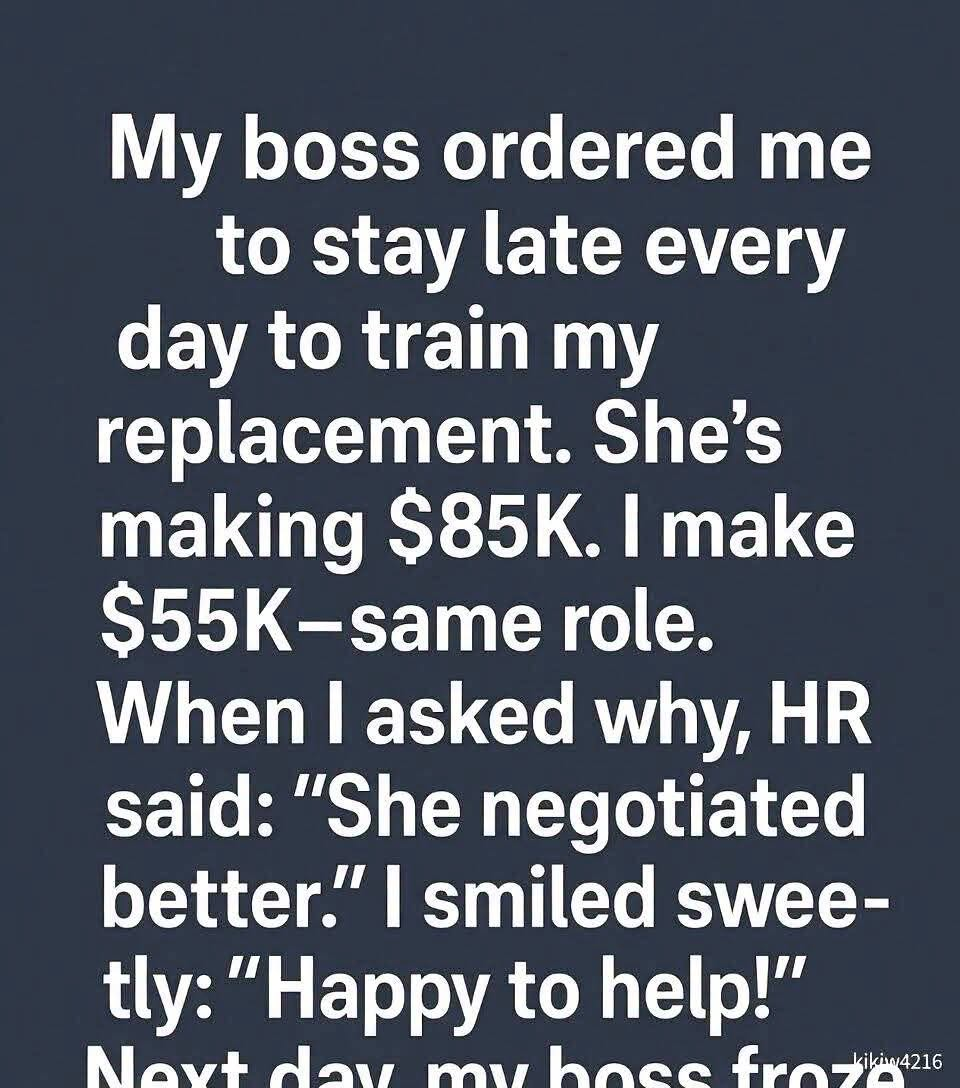
I Was Asked to Train My Higher-Paid Replacement, So I Finally Stood Up for Myself
For years, I had been the person my company relied on whenever something went wrong. I answered questions no one else could answer, solved problems that never appeared in my job description, and stayed late because I knew certain tasks would fall apart if I walked away.
My reward for that dedication was a familiar promise: the company appreciated me, and things would get better eventually.
Then one afternoon, my boss called me into his office and delivered news that changed everything.
The company had hired someone new to take over my position. Her salary was higher than mine, and I was expected to train her before leaving my role.
I was supposed to smile, cooperate, and transfer years of knowledge to the person who would replace me.
For a moment, I considered doing exactly what I had always done: making the situation easier for everyone else, even if it came at my own expense.
Instead, I decided to do something different.
I would fulfill my responsibilities professionally, document the work I had actually been assigned, and stop treating every unrecognized extra task as an obligation.
I would not shout or create a scene. I would simply make the invisible work visible.
The Employee Everyone Relied On
I had spent years building a reputation as the dependable employee.
When a project fell behind schedule, I found a way to get it moving again. When a client raised a difficult question, colleagues came to my desk. When an important deadline approached, I often stayed late to make sure nothing was overlooked.
At first, I was proud of being trusted.
I believed that consistent effort would eventually lead to better opportunities, a meaningful raise, or at least recognition that my responsibilities had grown beyond my original position.
But the rewards never quite arrived.
Each time I took on an additional task, it gradually became part of what everyone expected from me. A temporary favor became a routine responsibility. An occasional late evening became another example of my supposed flexibility.
My manager rarely needed to ask twice because I had trained the entire office to believe I would always find a solution.
The problem was not that I was capable of doing the work. The problem was that my willingness to help had become a substitute for proper staffing, clear responsibilities, and fair compensation.
I had become indispensable to the daily operation without gaining the authority or salary that should have accompanied that level of responsibility.
The Meeting That Changed My Perspective
When my boss explained that a replacement had been hired, I tried to remain composed.
He described the decision as a practical business move. The new employee had experience that the company wanted, and management believed she would be a good fit for the position.
Then came the part that was hardest to ignore.
I was expected to train her.
I would explain the systems, introduce her to the processes, answer her questions, and help her understand the work I had spent years learning. Meanwhile, she would be earning more money for the position I had been performing.
My boss spoke as though the arrangement were entirely reasonable.
Perhaps he expected me to protest. Perhaps he assumed I would feel too uncomfortable to question the decision. Either way, he seemed confident that I would continue cooperating as I always had.
I did not argue about the new employee’s salary. She had not created the company’s compensation decisions, and she was entitled to negotiate for herself.
My concern was with management’s expectations.
If the company had decided that my role needed to change, then the transition needed to be managed properly. My existing duties, training responsibilities, and additional work could not simply be combined into an unlimited list of obligations.
For the first time, I began to separate what I was responsible for from what I had merely allowed myself to become responsible for.
Making the Invisible Work Visible
The following morning, I arrived with a clear plan.
I organized my outstanding responsibilities into two groups.
The first contained my assigned duties: the work I was expected to complete, the deadlines I had agreed to meet, and the procedures that needed to be documented.
The second contained the additional responsibilities I had gradually absorbed over the years. These included informal troubleshooting, repeated requests from other departments, unplanned administrative tasks, and problems that had never officially belonged to my position.
I placed the documents on my boss’s desk.
There was no dramatic speech. I simply explained what each list represented and asked management to clarify which responsibilities should take priority during the transition.
I also requested a written training plan, including the time available for training, the tasks that needed to be completed, and the person responsible for decisions that fell outside my authority.
My boss looked surprised.
He had grown accustomed to receiving solutions without having to consider how much time or effort they required. Now, he had to examine the actual workload rather than rely on my willingness to absorb it.
The two lists did not create a new problem. They revealed one that had existed for years.
When the New Employee Saw the Reality of the Job
My replacement began learning the role soon afterward.
She was intelligent, professional, and understandably eager to succeed. I made a point of treating her fairly because she was not responsible for the company’s decision to hire her at a higher salary.
I explained the documented procedures, showed her where essential information was stored, and answered questions related to my responsibilities.
But I no longer pretended that every informal task was a normal part of the position.
When she asked about an issue that required a management decision, I explained the situation and directed the question to the appropriate person. When a request came from another department without clear ownership, I asked for clarification rather than automatically taking it on.
The difference became apparent quickly.
Tasks that had once been completed quietly behind the scenes now required someone to decide who was responsible for them. Requests that had previously landed on my desk without discussion needed to be assigned properly.
My replacement began to understand that the position involved more than the written job description suggested.
I did not want her to fail. In fact, I wanted her to have a fair chance to succeed without inheriting an unreasonable workload disguised as a normal expectation.
A responsible handover should prepare a new employee for the role, not transfer years of undocumented work and unclear boundaries to another person.
The Consequences of My Boss’s Assumptions
As the days passed, management began receiving more questions.
Some problems required decisions that I had previously made informally. Other tasks had no clearly assigned owner. A few projects slowed because the company had never documented the processes on which it depended.
My boss appeared increasingly frustrated.
He wanted the same level of output, but the system he had relied on was no longer operating through one employee’s unlimited availability.
I continued completing my assigned duties carefully. I kept records of the work completed, communicated about deadlines, and raised potential problems before they became emergencies.
What I stopped doing was silently accepting every additional responsibility simply because I knew how to handle it.
There is a difference between being a dedicated employee and becoming the automatic solution to every organizational problem.
By making that distinction clear, I forced management to confront questions it should have addressed much earlier.
Who was responsible for the unresolved tasks? Which requests were genuinely urgent? How much time did training require? And why had so many essential processes depended on knowledge that existed largely in one person’s head?
Those were management questions, and management needed to answer them.
Why Setting Boundaries Was Not the Same as Refusing to Work
I knew some people might interpret my behavior as uncooperative.
For years, I had been the person who said yes. The moment I began asking for priorities and clarification, the change was noticeable.
But I was not refusing to perform my job.
I was completing my assigned work, sharing relevant knowledge, and participating in the transition. I was simply asking the company to define the limits of those responsibilities instead of treating every request as automatically mine.
That distinction matters in any workplace.
Employees can be helpful without agreeing to unlimited workloads. They can support colleagues without becoming permanently responsible for other people’s unfinished tasks. They can care about the success of a company while still expecting reasonable expectations and fair compensation.
Boundaries also make work more sustainable. When responsibilities are clearly documented and priorities are agreed upon, teams can plan more effectively and identify staffing problems before they become crises.
The goal is not to make work difficult for others. It is to prevent an unhealthy arrangement from continuing simply because one person has been willing to carry it.
The Opportunity That Helped Me Move Forward
While the transition continued, I began looking more seriously at opportunities outside the company.
Previously, I had convinced myself that leaving would be too risky. I knew the systems, understood the people, and could handle the daily challenges with little supervision.
Familiarity had made the job comfortable in some ways, even as the workload became increasingly frustrating.
But I began reviewing my experience differently.
I listed the projects I had managed, the processes I had improved, the problems I had solved, and the knowledge I had accumulated. I realized that many of the skills I had treated as ordinary were valuable professional assets.
I updated my résumé, contacted potential employers, and began interviewing.
Eventually, I received an offer from another company with better compensation and clearer expectations.
The offer mattered because it demonstrated that my experience could be valued elsewhere. I did not need to remain in a workplace where years of extra effort had become so routine that they were barely noticed.
Accepting the position was not about punishing my former employer. It was about choosing an environment that better matched my professional goals.
Walking Away on My Own Terms
When my departure became official, I completed the remaining work assigned to me and organized the documentation needed for a smooth handover.
I answered appropriate questions, clarified outstanding tasks, and ensured that management had a record of the responsibilities that remained.
I left without a dramatic confrontation.
My boss may have expected an argument, an emotional resignation, or one final attempt to convince him that I deserved more. Instead, I made my decision and followed through.
The most important change had happened before I walked out of the building.
I no longer believed that being valuable meant being endlessly available.
I no longer treated exhaustion as proof of dedication or assumed that recognition would eventually arrive if I simply worked harder.
And I no longer confused loyalty to an employer with an obligation to ignore my own interests.
My new job offered better pay, but the deeper benefit was the clarity I had gained about what I wanted from my working life.
The Lesson I Wish I Had Learned Earlier
Looking back, I do not believe every extra task I accepted was a mistake. Helping colleagues, learning new skills, and taking initiative can all be valuable parts of professional growth.
The problem was allowing temporary exceptions to become permanent expectations without discussing how my role, compensation, or workload should change.
I had assumed that my employer would eventually recognize the imbalance and correct it.
Instead, the arrangement continued because it was convenient.
That realization taught me several important lessons.
First, keep track of your responsibilities and achievements. Documentation makes it easier to explain your contribution and negotiate changes to your role.
Second, discuss workload and priorities before frustration becomes overwhelming. Asking which task should come first is often more constructive than silently accepting conflicting deadlines.
Third, distinguish between helping during an occasional emergency and consistently performing work that belongs to another role.
Finally, remember that professional loyalty should not require abandoning your own long-term goals.
Not every workplace will respond positively when an employee establishes boundaries. In those situations, exploring other opportunities may be a practical step toward a healthier professional future.
Knowing Your Worth Changes How You Work
My experience did not teach me that every employer is exploitative or that every difficult workplace should be abandoned immediately.
It taught me that good work needs clear expectations, reasonable boundaries, and a fair understanding of the value being provided.
My replacement was not my enemy. My boss’s decisions were not hers to answer for. The real issue was a system that had relied too heavily on one employee’s willingness to do more than anyone had formally acknowledged.
Once I stopped treating that arrangement as inevitable, I could make better decisions about my responsibilities and my future.
I completed the work I had agreed to do. I documented what needed to be transferred. I pursued a better opportunity and left professionally.
I did not need to create a scene to make my point.
I needed to recognize that my time, experience, and skills had value—and then make decisions that reflected that understanding.
Sometimes, the most important career lesson is not learning how to work harder. It is learning when to ask for clearer expectations, when to negotiate, and when to move toward an opportunity that recognizes what you bring to the table.