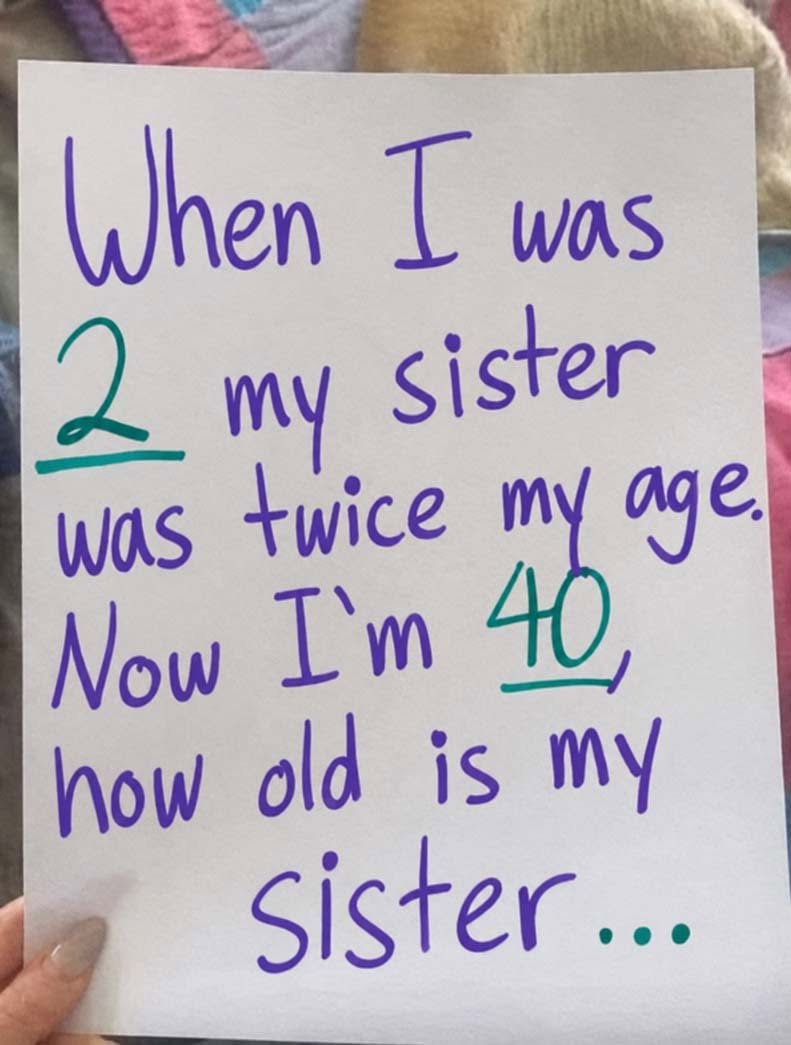
Have you ever come across a question that looked so simple you answered it almost instantly, only to realize moments later that you had overlooked an important detail?
That is exactly what happens with the famous “How Old Is My Sister?” riddle. It has been shared across social media, puzzle websites, and discussion forums because it appears to require complicated math, yet the solution depends on something much simpler: logical thinking.
Many people rush to solve it, convinced that the answer must involve multiplication or a hidden mathematical trick. Others spend several minutes trying different calculations before realizing the puzzle is testing something else entirely.
This type of brain teaser reminds us that mathematics is not only about numbers. It is also about understanding relationships, recognizing patterns, and applying basic principles correctly. While the riddle itself is straightforward, the way our minds approach it reveals fascinating insights into human psychology, reasoning, and even the long history of logic puzzles across different cultures.
The Viral Sister Age Riddle
The challenge reads:
“When I was 2, my sister was twice my age. Now that I’m 40, how old is my sister?”
At first glance, many readers immediately begin multiplying or searching for a hidden formula.
Some even assume that because the sister was once twice as old, she must somehow continue to be twice as old later in life.
That assumption leads many people away from the correct answer.
Instead, the puzzle is asking whether you understand one of the most basic concepts in mathematics: an age difference remains constant over time.

Solving the Puzzle Step by Step
Let’s examine the information carefully.
When the speaker was 2 years old, the sister was twice that age.
Twice two equals four.
At that moment:
Speaker: 2 years old
Sister: 4 years old
The difference between them is:
4 − 2 = 2 years
That age gap never changes.
Fast forward to today.
The speaker is now 40 years old.
Since the sister has always been 2 years older, we simply add the same difference.
40 + 2 = 42
Final Answer
The sister is 42 years old.
The solution is surprisingly simple once the relationship between the two ages is understood.
Why So Many People Get the Wrong Answer
This puzzle illustrates several common thinking mistakes.
The first is focusing on the phrase “twice my age.”
Many people assume that because the sister was twice as old at one point, that ratio should continue forever.
However, age ratios change over time.
For example:
When one sibling is 2 and the other is 4, the older sibling is exactly twice as old.
Years later, if one is 20 and the other is 22, the ratio is no longer two to one.
Eventually, when one sibling is 40 and the other is 42, the ages are very close relative to each other.
The important value is not the ratio.
It is the constant difference between their ages.
The Mathematics Behind Age Problems
Age puzzles have been part of recreational mathematics for centuries because they encourage logical reasoning instead of complicated calculations.
Most age problems involve one of three concepts:
Constant Age Difference
No matter how old people become, the difference between their ages never changes.
If two siblings are two years apart today, they will still be two years apart fifty years from now.
Changing Age Ratios
Ratios gradually become smaller over time.
For example:
Age 2 and 4
Ratio: 2:1
Age 10 and 12
Ratio: 1.2:1
Age 40 and 42
Ratio: 1.05:1
Although the difference remains two years, the ratio continually changes.
Understanding Context
Many riddles intentionally include information that sounds more important than it actually is.
The phrase “twice my age” attracts attention, while the true clue is hidden in the age difference.
Why Our Brains Love Simple Riddles
Scientists who study cognition have found that people naturally rely on mental shortcuts when solving everyday problems.
These shortcuts, often called heuristics, allow us to make quick decisions without analyzing every detail.
Most of the time, this strategy works well.
However, puzzles are specifically designed to exploit these shortcuts.
Instead of encouraging slow reasoning, they tempt readers into answering immediately.
Once people recognize the hidden assumption, the solution suddenly appears obvious.
This moment is often called an “aha” experience.
Psychologists have long studied these moments because they provide valuable insight into how humans solve problems.
The History of Logic Puzzles
Age riddles belong to a tradition that stretches back thousands of years.
Ancient civilizations used mathematical puzzles not only for entertainment but also for education.
Historical records show that mathematical challenges appeared in ancient Egypt, Greece, China, India, and the Islamic Golden Age.
Teachers often used puzzles to strengthen reasoning skills rather than simply teaching arithmetic.
Many famous mathematicians also enjoyed creating problems that required logical thinking instead of lengthy calculations.
Today, these puzzles continue to appear in classrooms because they encourage students to understand concepts rather than memorize formulas.
The Cultural Appeal of Brain Teasers
Almost every culture has its own tradition of riddles.
Some are based on language.
Others involve numbers.
Some rely on observation or creative thinking.
These puzzles often served several purposes:
They entertained families during gatherings.
They helped children develop reasoning skills.
They encouraged discussion and cooperation.
They challenged listeners to think beyond obvious answers.
Modern social media has simply given these traditional brain teasers a much larger audience.
Instead of being shared around a dinner table, they now reach millions of people within hours.
Why We Often Overcomplicate Simple Questions
One interesting aspect of this riddle is that many people assume there must be a hidden trick because it appears online.
When readers expect deception, they sometimes ignore the simplest explanation.
Psychologists refer to this as overthinking.
Instead of applying basic logic, the brain begins searching for unnecessary complexity.
Ironically, the correct answer is usually the one based on straightforward reasoning.
This demonstrates an important lesson that extends far beyond mathematics.
Sometimes the simplest explanation is also the correct one.
Educational Benefits of Solving Riddles
Teachers frequently use puzzles because they build several important skills.
Logical Reasoning
Students learn to separate useful information from distractions.
Mathematical Thinking
Rather than memorizing equations, learners understand relationships between numbers.
Patience
Many riddles reward careful observation instead of quick guessing.
Confidence
Successfully solving puzzles encourages learners to trust their reasoning abilities.
These skills remain valuable throughout life in education, work, and everyday decision-making.
Common Mistakes People Make
Several incorrect answers appear repeatedly whenever this riddle is shared online.
One common mistake is answering 80, assuming the sister remains twice as old forever.
Another is answering 44, often because of a simple calculation error.
Some people even suggest there is not enough information.
In reality, the puzzle provides exactly what is needed.
Once the original age difference is identified, the answer becomes fixed.
The Psychology of the “Aha” Moment
One reason puzzles remain so popular is the satisfaction people experience after solving them.
Researchers studying insight have found that solving a challenging problem often produces a rewarding emotional response.
This feeling encourages curiosity and motivates people to tackle more complex challenges in the future.
That positive reinforcement may explain why brain teasers continue to attract readers of all ages.
The enjoyment comes not only from finding the answer but from understanding why the answer is correct.
Could the Puzzle Be Written Differently?
Absolutely.
Changing just one sentence can produce a completely different problem.
For example:
“When I was 5, my sister was three years older than me.”
“When I was 8, my brother was half my age.”
Each version requires slightly different reasoning, even though the underlying mathematical principle remains the same.
This flexibility is one reason educators enjoy creating age-based riddles.
They can introduce different concepts while keeping the problems accessible.
Lessons Beyond Mathematics
Although this puzzle is about age, its broader lesson applies to many situations.
Carefully examining information before reaching a conclusion often leads to better decisions.
Whether reading news, evaluating claims, solving workplace challenges, or making everyday choices, slowing down to identify the key facts usually produces more reliable results.
The sister age riddle reminds us that accurate thinking often depends less on advanced knowledge and more on careful observation.
Final Thoughts
The viral “How Old Is My Sister?” riddle has remained popular because it transforms a simple arithmetic question into an engaging exercise in logical reasoning. While many people initially focus on the phrase “twice my age,” the real key lies in recognizing that the age difference between siblings never changes.
The correct answer is 42 years old, but the puzzle offers something more valuable than a number. It encourages us to slow down, examine the information carefully, and resist the temptation to jump to conclusions.
Throughout history, riddles have entertained, educated, and challenged people across cultures. Whether shared in classrooms, family gatherings, or online communities, they continue to spark curiosity and remind us that learning often begins with asking thoughtful questions.
Perhaps that enduring curiosity is the greatest reward of all. Every puzzle, no matter how simple it appears, offers an opportunity to sharpen our minds, appreciate logical thinking, and enjoy the timeless satisfaction of discovering an elegant solution.
Sources
- National Council of Teachers of Mathematics (NCTM). Developing Mathematical Reasoning Through Problem Solving. https://www.nctm.org/
- American Psychological Association (APA). Research on reasoning, cognition, and problem-solving. https://www.apa.org/
- Encyclopaedia Britannica. Logic. https://www.britannica.com/topic/logic
- Stanford Encyclopedia of Philosophy. Logic and Informal Reasoning. https://plato.stanford.edu/
- Khan Academy. Ratios, proportions, and mathematical reasoning. https://www.khanacademy.org/