This Bizarre Chicken Illusion May Trick Your Eyes: How Many Chickens Can You See?
Introduction: The Viral Chicken Puzzle and Its Mysteries
Visual puzzles have long entertained and fascinated people across generations, from classic optical illusions to mind-bending artwork. Among the latest viral sensations is an unusual chicken illusion, prompting viewers everywhere to ask: how many chickens can you spot in the picture? At first glance, most observers quickly tally the large rooster heads, coming up with what feels like a confident answer—often 7 or 8. Yet, as with many optical tricks, a closer inspection reveals a far more complicated reality.
This article takes a deep dive into the chicken illusion, examining its structure, the psychology behind why our eyes can be deceived, and the broader role of visual puzzles in education, entertainment, and even neuroscientific research. Join us as we unravel not only how many chickens are really hidden in the image, but why puzzles like this captivate so many people worldwide.
The Optical Illusion: First Impressions and Deeper Insights
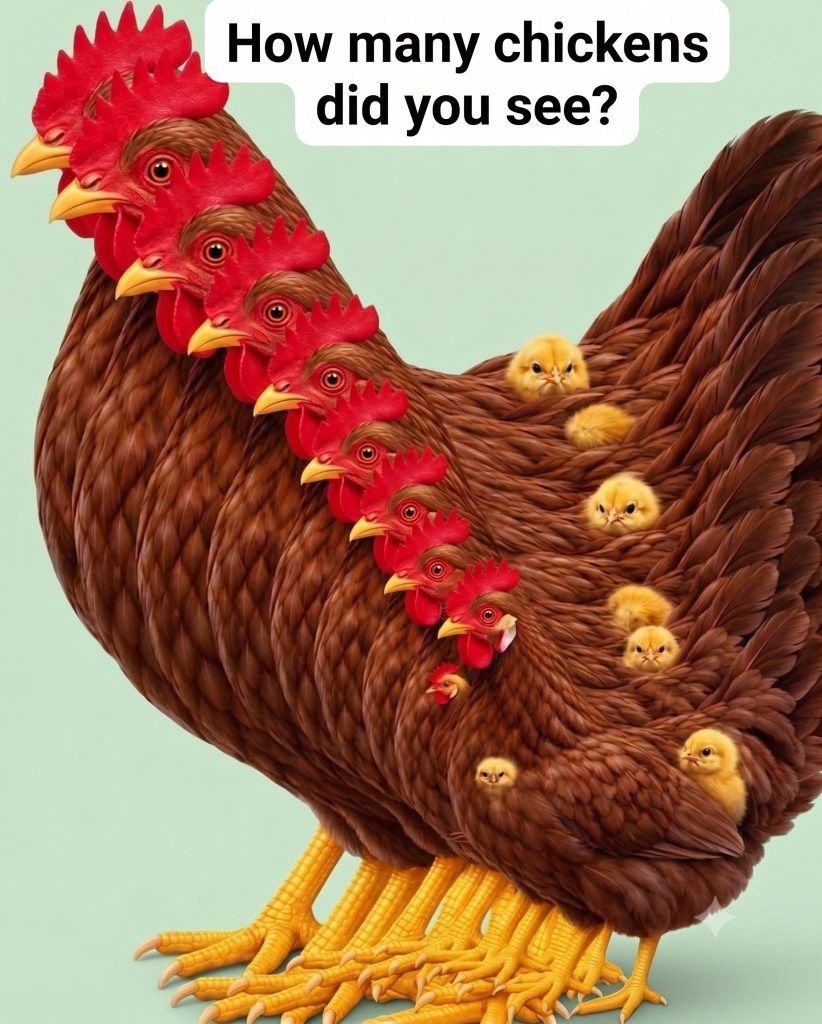
The chicken illusion challenges the viewer with a composite image where rooster heads overlap and intertwine, and tiny chicks are artfully disguised among the feathers. Most people instinctively scan the image from left to right and focus on the biggest objects—the nine prominent rooster heads that dominate the upper and central parts of the image. These rooster heads, with their bold colors and clear outlines, immediately draw our attention, often leading to an undercount as several shapes blend into each other or are obscured behind feathered details.
Hidden in plain sight, the puzzle also features eight small, subtly colored baby chicks. They nestle amid brown feathers and carefully shaded contours, making them easy to overlook during a quick scan. By focusing solely on the bold adult features, many participants miss these yellow chicks entirely until a more methodical visual sweep is performed.
With a careful count—nine adult rooster heads and eight hidden chicks—the astounding answer is that a total of 17 chickens are present in the image. This count far exceeds the initial guesses of most viewers, demonstrating the effectiveness of this visual puzzle in obscuring detail through clever design.
The Science of Visual Perception and Illusions
To understand why the chicken illusion deceives us, it helps to explore how human vision and the brain cooperate. Visual perception is an active process in which our eyes collect information, but it is our brain that interprets and organizes the scene. Often, especially in complex images, the brain relies on shortcuts—known as gestalt principles—to quickly make sense of a visual environment.
These principles include:
- Figure-ground organization: Our brains distinguish primary objects (figures) from their backgrounds. In the illusion, rooster heads stand out as figures, while smaller chicks merge into the background plumage.
- Proximity and similarity: We tend to group objects that are close together or look alike. Overlapping shapes, such as the rooster heads, are likely to be counted as single features unless examined closely.
- Closure: The brain fills in gaps, often neglecting finer details if the main structure seems complete at a glance.
These processing shortcuts enable rapid interpretation of everyday scenes but can lead us astray when encountering deliberate illusions or puzzles.
Why Do Optical Puzzles Capture Our Attention?
Optical puzzles like the chicken illusion are more than just entertainment; they offer valuable insights into cognitive psychology and even practical benefits. Researchers have long used visual puzzles to study perception, attention, and memory. Such illusions reveal how the brain combines signals from the eyes, applies prior knowledge, and sometimes overrides raw information, all in pursuit of a coherent picture.
Besides scientific applications, visual puzzles are beloved for their playful challenge. They encourage critical thinking, attention to detail, and perseverance. Social media platforms have amplified the popularity of such illusions, sparking friendly competition as users compare answers and share strategies for finding hidden details.
Strategies for Solving Visual Illusions and Puzzles
If you’re eager to improve your performance with visual puzzles like the chicken illusion, consider these science-based tips:
- Sweep the image systematically: Instead of scanning randomly, move methodically from left to right and top to bottom. This reduces the chance of missing hidden features.
- Change your focus: After identifying large, obvious shapes, shift attention to less dominant regions. The brain may need to adjust its initial “figure vs. background” assessment.
- Look for color and texture cues: Subtle changes in color or fine detail often mark hidden objects, such as the yellowish tint of baby chicks among brown feathers.
- Take short breaks and revisit: Sometimes, stepping away and returning later can help you see missed elements as the brain resets its focus.
These strategies can not only boost your prowess with optical puzzles, but may also refine general observation skills useful in daily life.
The Educational Value of Visual Illusions
Visual illusions like the chicken puzzle play an important role in educational settings. Teachers use illusions to demonstrate how perception works and to provoke discussion about sensory input versus cognitive interpretation. Students get to experience first-hand how intuition can sometimes lead to error and how deliberate analysis can reveal hidden answers.
Cognitive scientists, too, incorporate optical puzzles in experiments aimed at mapping brain function and understanding neural pathways involved in sight. For individuals of all ages, puzzles foster patience, attention, and confidence in problem-solving skills.
International and Societal Reactions to the Viral Illusion
As digital communication grows, so too does the global reach of viral images like the chicken illusion. Social media challenges prompt people from diverse backgrounds to solve the same puzzle, share their findings, and even debate different answers. These viral trends help bridge cultural and linguistic divides through a shared cognitive experience.
In classrooms, offices, and homes, people embrace such illusions as tools for group interaction, icebreakers, and cognitive “warm-ups.” The rapid dissemination of puzzles through WhatsApp, Facebook, and TikTok demonstrates their universal appeal and their capacity for sparking conversation beyond borders.
Expert Perspectives: What Neuroscientists and Psychologists Say
Leading experts in vision science, psychology, and neuroscience have long studied the phenomenon of visual illusion. According to research from institutions such as the Nature Publishing Group and journals like Scientific American, the brain’s interpretation of complex scenes depends on both innate wiring and learned experience. Optical illusions illustrate gaps between sensation and perception, revealing the flexible, sometimes fallible nature of the mind’s eye.
Dr. Susana Martinez-Conde, a leading researcher at the State University of New York, has published extensively on how visual illusions can help us understand consciousness itself. Optical illusions, Dr. Martinez-Conde notes, “allow scientists to study the brain’s construction of reality, helping us appreciate the strengths and limits of human perception.”
Such studies reinforce the significance of playful illusions in illuminating serious scientific questions.
Puzzles, Play, and Brain Health
Beyond curiosity and education, puzzles like the chicken illusion can also promote brain health. According to the Mayo Clinic, regular engagement with brain teasers and visual puzzles may help maintain cognitive sharpness across the lifespan. Participation in such activities is associated with improved attention, memory, and problem-solving, and is recommended as part of a balanced lifestyle for aging populations.
Conclusion: The Joy in Seeing Beyond the Obvious
The viral chicken illusion serves as a vivid reminder not only of the power—and limits—of human vision but also of the joy in discovery. While most people spot only a handful of chickens at first, patient scrutiny reveals the hidden flock, challenging our assumptions about what is obvious and what can be overlooked.
Next time you encounter a visual puzzle, resist the urge to rush. Enjoy the process of peeling back layers of perception, and maybe even share the challenge with friends and family. Whether for entertainment, education, or insight into the marvels of the mind, optical illusions like this offer something valuable for everyone.
Sources
Disclaimer: This content is intended for entertainment purposes only and is not based on real events.