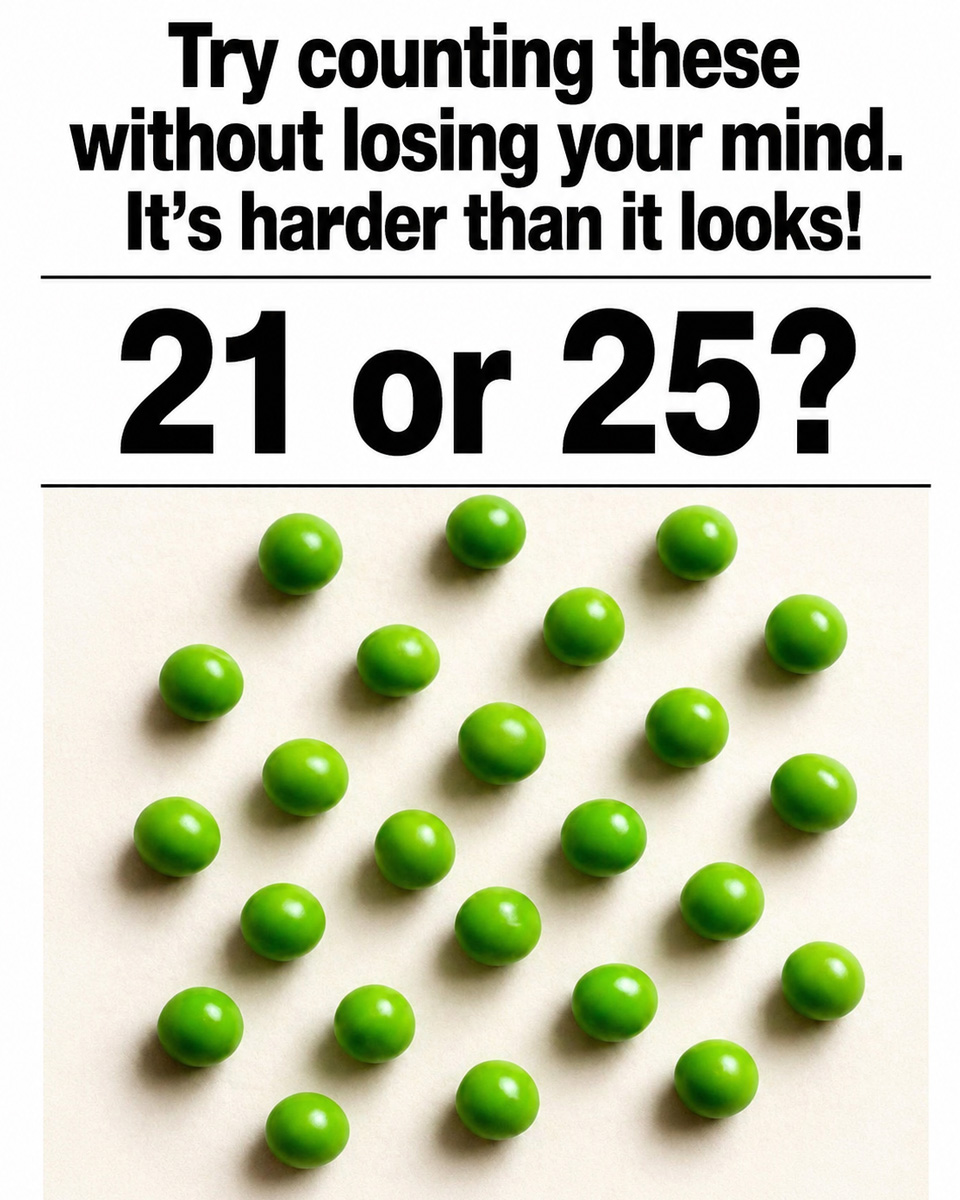
Can You Count the Green Peas? This Viral Puzzle Is Trickier Than It Looks
Visual puzzles continue to captivate people because they challenge the brain in unexpected ways. What appears to be a simple counting exercise can quickly become a test of concentration, attention to detail, and perception. One popular puzzle asks a seemingly easy question: Are there 21 or 25 green peas in the picture? Surprisingly, many people disagree on the answer.
Before reading further, take a close look at the image and count the peas yourself. You may be surprised by the result.

Why This Puzzle Is So Confusing
At first glance, the peas appear to be randomly scattered across the image. However, they are actually arranged in a staggered pattern rather than in straight rows and columns.
Because each row is slightly offset from the next, your eyes can easily skip one pea or accidentally count the same one twice. Since every pea looks nearly identical, there are very few visual clues to help your brain keep track.
Another reason the puzzle is challenging is that it offers only two possible answers: 21 or 25. This encourages many people to assume one of those choices must be correct, even if their own counting suggests otherwise.
Count the Peas Step by Step
The easiest way to solve the puzzle is to count the peas one row at a time, starting from the top.
The rows contain the following numbers:
Row 1: 3 peas
Row 2: 4 peas
Row 3: 3 peas
Row 4: 4 peas
Row 5: 3 peas
Row 6: 4 peas
Row 7: 3 peas
Now add them together:
3 + 4 + 3 + 4 + 3 + 4 + 3 = 24
The Correct Answer
After carefully counting every row, the total number of green peas is:
24
Interestingly, 24 is not one of the answer choices presented in the puzzle.

Why So Many People Choose the Wrong Answer
Many participants recount the image several times because they assume they must have made a mistake when they arrive at 24.
Others become distracted by the staggered arrangement and accidentally skip or repeat a pea, eventually arriving at either 21 or 25.
This puzzle demonstrates how the way a question is framed can influence our thinking. When only two options are provided, people often feel compelled to choose one of them, even when neither is correct.
What This Puzzle Teaches Us
Brain teasers like this are about more than counting. They encourage careful observation, patience, and logical thinking while reminding us not to rely solely on suggested answers.
Sometimes the correct solution lies outside the choices we are given, making it important to trust careful reasoning instead of assumptions.
Final Thoughts
The green pea puzzle is a fun example of how simple visual challenges can test attention and perception. Although the image asks whether there are 21 or 25 peas, a careful count reveals the actual total is 24. The next time you encounter a viral puzzle, take your time, follow a systematic approach, and trust your own observations. Often, the most accurate answer is the one you discover through careful thinking rather than the options presented.
Sources
-
American Psychological Association (APA) – Visual Perception Resources
-
Encyclopedia Britannica – Optical Illusions
-
National Geographic – How the Brain Interprets Visual Information