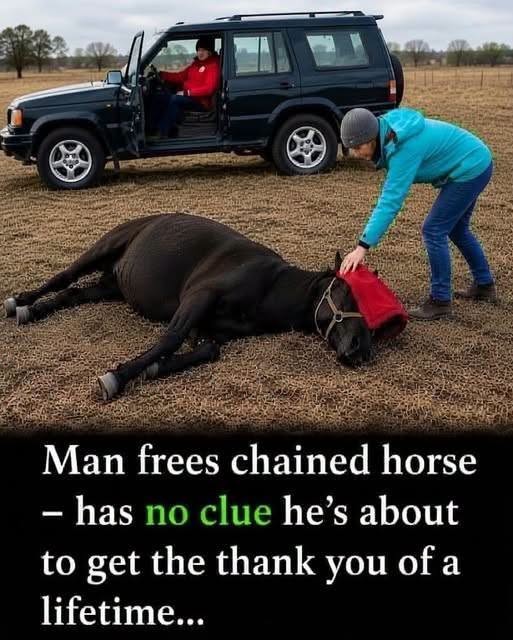
The mare could barely move.
Her front legs were restricted by heavy metal chains, leaving her vulnerable every time she tried to take a step.
She was frightened, uncomfortable, and unable to move normally.
When veterinarian Ovidiu Roșu found her in Romania, the priority was clear: she needed to be freed, but doing so safely would require patience and expertise.
A frightened horse is powerful even when injured. Trying to remove restraints from a panicked animal can put both the horse and the people helping her at serious risk.
So Roșu carefully sedated the mare before approaching the chains.
Once the restraints were removed, the animal could finally move her legs more naturally.
Her condition was stabilized.
But what happened next was the moment that stayed with everyone who witnessed the rescue.
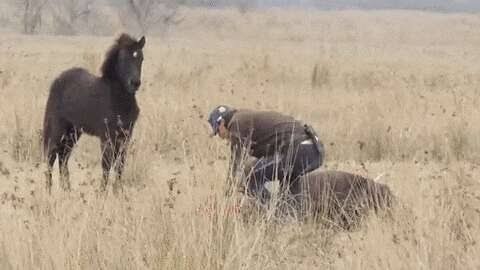
Another free-roaming horse approached.
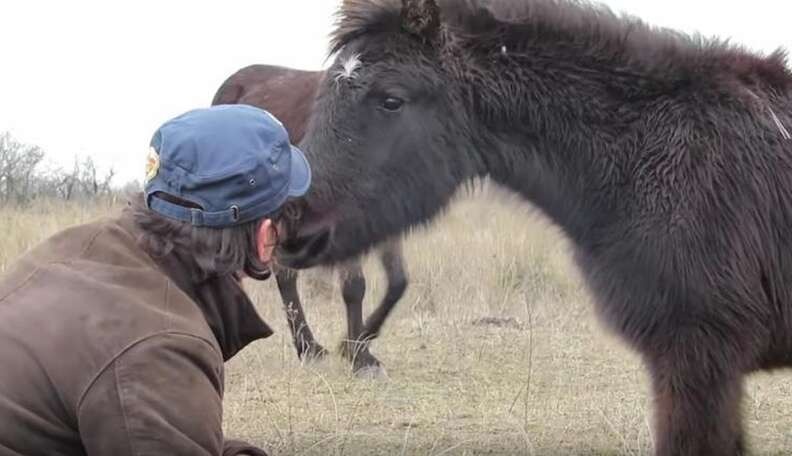
It came close to the newly freed mare and appeared to nuzzle her, remaining beside her after the stressful ordeal.
To a human observer, the scene can look almost like a thank-you.
But animal behavior tells a more interesting story.
The second horse probably wasn’t expressing gratitude in the human sense.
It was more likely responding to another horse’s condition through the natural social bonds that help members of a herd remain connected after stressful experiences.
And that small interaction points toward a much bigger story about Romania’s free-roaming horses.
A Mare That Could No Longer Move Freely
Horses rely heavily on movement.
Walking, grazing, resting, avoiding danger, and maintaining distance from other animals are all part of normal equine behavior.
Restricting the front legs with chains can interfere with those basic activities.
It can also create serious welfare concerns.
A horse struggling against a restraint may injure itself. Metal restraints can rub against the legs, create wounds, interfere with circulation, and increase the risk of infection.
There is also the psychological stress of being unable to move normally.
For a free-roaming animal, the restriction can be particularly disruptive.
That is why simply deciding to remove a chain is not always as straightforward as it sounds.
A frightened horse may kick, rear, pull away, or struggle suddenly.
Even a well-intentioned rescuer can be injured.
In this case, sedation allowed the veterinarian to work more safely and carefully.
The goal wasn’t simply to get the chains off.
It was to free the animal while minimizing additional stress and injury.
Why the Second Horse Came Closer
After the mare was freed, another horse approached her.
The animal appeared to nuzzle her and remain close.
Human beings naturally interpret scenes like this through familiar emotions.
We might call it compassion.
We might describe it as friendship.
Some might even say the horse was thanking the veterinarian.
But those interpretations go beyond what we can actually know.
Horses are highly social animals.
They communicate through body language, posture, touch, vocalizations, and proximity.
Members of a group may spend time close together, groom one another, and respond to changes in the behavior of other horses.
After a stressful event, staying close to another animal may provide reassurance simply because social contact is part of normal herd behavior.
The important point is not whether the horse understood the rescue in the same way a person would.
The important point is that the mare was no longer alone.
She was back among other horses.
And for a social animal, that matters.
Romania’s Remarkable Free-Roaming Horses
The rescue took place against the backdrop of one of Romania’s most unusual wildlife and animal-welfare stories.
Free-roaming horses are particularly associated with areas such as the Danube Delta and Letea Forest.
These animals are not necessarily the same as wild horses in the strict biological sense.
Many descend from domestic horses that were released, abandoned, or became unmanaged over generations.
Their history is closely connected with changes in land ownership, agriculture, rural life, and human management.
After the political and economic changes that followed the fall of communism in 1989, some horses were left without the level of human management they had previously received.
Over time, free-roaming populations grew.
What might initially have looked like a simple story of horses living freely in nature became much more complicated.
When Freedom Created a Conservation Debate
A large population of free-roaming horses can affect its environment.
Horses graze.
They trample vegetation.
They move through sensitive habitats.
When numbers become too high for the available resources, their presence can place additional pressure on ecosystems.
That created a difficult question for conservationists and authorities.
How should the population be managed?
Some argued that population numbers needed to be reduced to protect fragile habitats.
Animal-welfare organizations, meanwhile, emphasized that management should not come at the expense of the horses themselves.
By the early 2010s, debates surrounding Romania’s free-roaming horses had become increasingly intense.
The disagreement revealed a problem that has no simple solution.
Protecting animals and protecting ecosystems are not always separate challenges.
Sometimes they are connected.
The Case for Humane Population Management
One approach promoted by animal-welfare organizations has been nonlethal population management.
Organizations such as FOUR PAWS have supported programs involving veterinary intervention and immunocontraception.
The basic idea is straightforward.
Instead of relying on mass removal or lethal population reduction, fertility can be managed so that herd numbers gradually become more stable.
This approach doesn’t produce an instant solution.
That is precisely why it requires long-term planning.
Veterinarians and conservation teams need to identify animals, monitor populations, provide appropriate care, and continue working with authorities and local communities.
But gradual management can offer a way to address ecological concerns while reducing the need for drastic interventions.
The challenge is maintaining the program over time.
Why One Rescue Isn’t Enough
The mare’s rescue is emotionally powerful because it has a clear beginning and end.
There was an animal in distress.
A veterinarian arrived.
The restraint was removed.
The horse was stabilized.
Another horse came closer.
It feels like a complete story.
But animal welfare rarely works that way.
Removing one dangerous restraint can save one animal from immediate suffering.
It doesn’t automatically solve the conditions that allowed the situation to happen.
If free-roaming horses continue to face neglect, abandonment, illegal restraint, injury, inadequate veterinary care, or unmanaged population growth, individual rescues will always be needed.
That is why the larger solution involves more than dramatic moments caught on camera.
It requires prevention.
It requires responsible ownership.
It requires enforcement.
It requires veterinary access.
And it requires communities to understand how to interact safely with free-roaming animals.
Chains Can Turn Into a Serious Welfare Problem
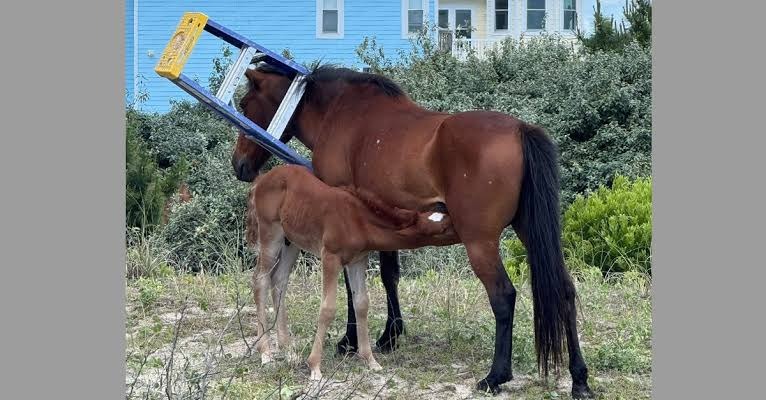
A restraint may appear simple from a distance.
But a horse doesn’t understand why it has been tied.
If the animal becomes frightened, it may pull against the restraint.
Repeated pressure can worsen an existing injury or create new problems.
A chain can also become caught on vegetation, fencing, rocks, or other objects.
In the wrong circumstances, the animal may struggle even more.
That is why members of the public should not attempt to free a restrained or distressed horse themselves unless they have the appropriate training and support.
A professional can assess the animal’s condition and determine the safest way to approach.
In some cases, sedation may be necessary.
The goal should always be to reduce risk rather than create another emergency.
The Danube Delta’s Larger Conservation Challenge
Romania’s Danube Delta is one of Europe’s most important wetland regions.
Its landscapes support a remarkable variety of plants and animals.
The region’s ecological value also means that human activity must be managed carefully.
Free-roaming horses are only one part of that broader environmental picture.
There are questions about grazing pressure, habitat protection, tourism, land management, animal welfare, and local livelihoods.
That makes the horse debate much more complicated than simply asking whether the animals should be allowed to roam.
The real question is how humans can balance the needs of animals, ecosystems, and communities.
What Visitors Should Do Around Free-Roaming Horses
For visitors who encounter horses in natural areas, the safest approach is usually simple.
Give them space.
Do not chase them.
Do not surround them for photographs.
Avoid sudden movements.
Do not attempt to feed them unless local authorities specifically permit it.
And never assume that a calm-looking horse is automatically safe to approach.
A horse can appear relaxed and still react suddenly if it feels threatened.
Visitors should also follow local conservation guidance and respect protected areas.
Responsible tourism can reduce stress on animals while helping preserve the places where they live.
A Rescue That Became Something Bigger
The image of the freed mare standing near another horse is easy to remember.
There is something deeply comforting about seeing a distressed animal finally able to move freely while another member of its species comes close.
But the real lesson may be larger than the emotional moment.
The veterinarian’s intervention addressed an immediate welfare problem.
The other horse’s presence reminded us of the social nature of these animals.
And Romania’s broader experience with free-roaming horses shows why long-term solutions matter.
A population cannot be protected simply by rescuing individual animals one at a time.
The conditions surrounding them have to change too.
That means responsible management, humane veterinary programs, habitat conservation, enforcement against harmful treatment, and continued cooperation between authorities, conservationists, animal-welfare groups, and local communities.
The Meaning Behind the Mare’s Second Chance
We don’t know what the mare understood about what happened to her.
We shouldn’t turn natural animal behavior into a human story without evidence.
But we can still appreciate what the moment represents.
One horse had been unable to move freely.
A veterinarian intervened.
The restraint was removed.
And shortly afterward, another horse came close.
Whether that was reassurance, curiosity, social bonding, or simply normal herd behavior, the result was a quiet reminder that horses are not solitary creatures.
They depend on relationships.
They recognize familiar individuals.
They communicate constantly through movement and touch.
And when one member of a group is distressed, the others may respond in ways that are subtle but meaningful.
Perhaps that is why the rescue feels so powerful.
It wasn’t only about removing a chain.
It was about giving an animal back the ability to move, interact, and live more naturally.
Protecting Animals Means Thinking Beyond the Moment
Stories of animal rescues often end when the animal is safe.
But real conservation begins where the rescue story ends.
The mare needed immediate veterinary attention.
Other horses may need protection from similar situations.
The habitat needs to remain healthy.
Population numbers need to be monitored.
Communities need practical ways to manage animals responsibly.
And visitors need to understand that wild-looking horses are still powerful animals deserving of distance and respect.
Romania’s free-roaming horses have become a symbol of the complicated relationship between humans, animals, and nature.
Their story contains freedom, neglect, conservation, responsibility, and the difficult decisions that arise when animal populations live alongside sensitive ecosystems.
The mare who was freed from chains represents one small part of that story.
Her rescue mattered.
But the deeper goal is to create a world where fewer animals need to be rescued in the first place.
Because the best animal-welfare story isn’t always the dramatic moment when someone arrives to save an animal.
Sometimes, it’s the quieter story that follows:
A healthier habitat.
A responsibly managed population.
A community that knows how to coexist with wildlife.
And an animal that can simply walk away, free to live as naturally as possible.
Sources
-
FOUR PAWS — Animal welfare and conservation programs involving free-roaming horses in Romania.
-
Danube Delta Biosphere Reserve — Information on conservation and protected habitats in the Danube Delta.
-
European Commission — Background on biodiversity and habitat conservation in the Danube Delta.
-
Romanian environmental and local authorities — Information concerning management of free-roaming horse populations and protected areas.
-
Scientific literature on equine social behavior and welfare — Research into horse communication, social bonding, stress, and management.