It started with a glance across the lawn.
The afternoon was quiet, sunlight spread gently across the grass, and nothing seemed unusual.
Then something caught my eye.
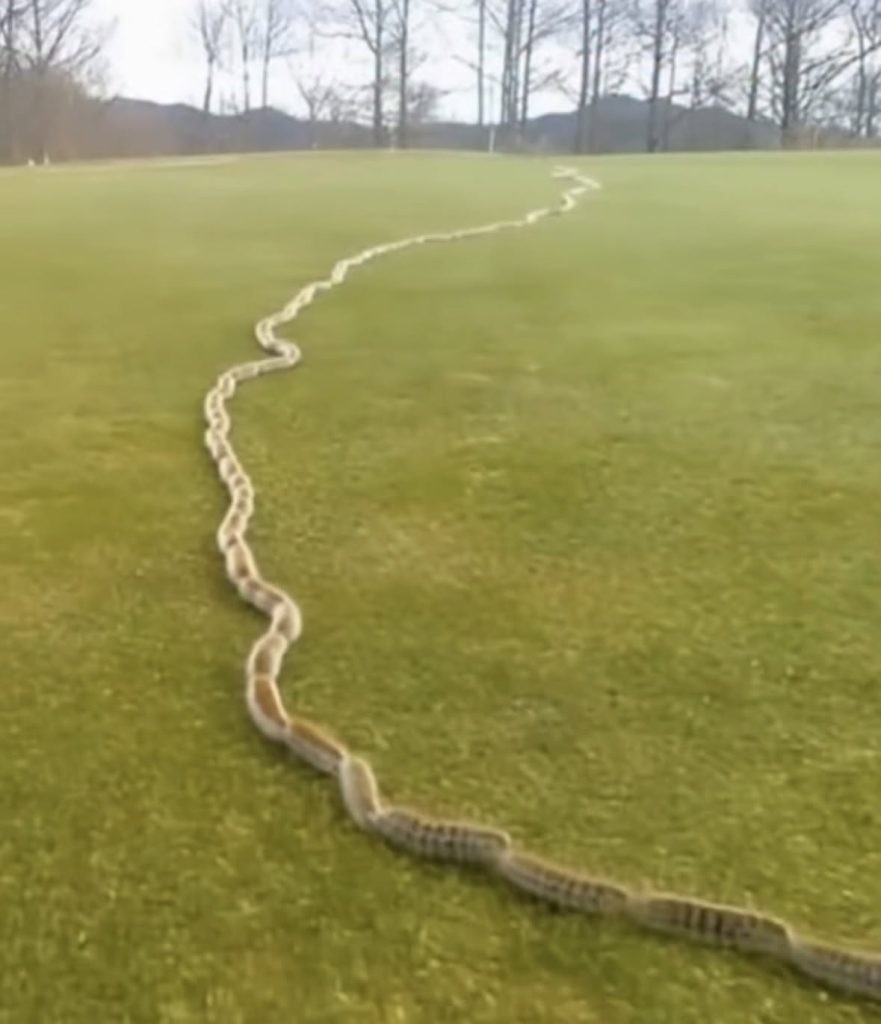
Near the edge of the yard was a long, narrow shape stretching across the ground.
From a distance, it looked almost like a piece of rope.
Perhaps someone had left behind a garden tool.
Maybe it was a length of old string tangled in the grass.
I almost ignored it.
Then the object moved.
Not all at once, but slowly, steadily, as though the entire shape were traveling in the same direction.
Curiosity won.
I walked closer.
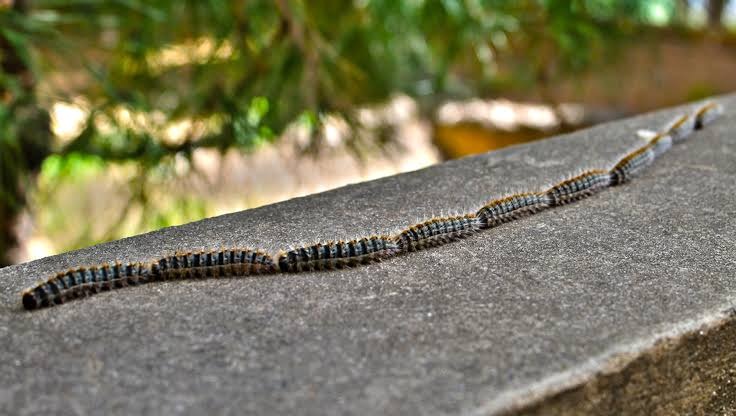
What appeared to be a single rope was actually made up of dozens of tiny creatures moving together.
They were caterpillars.
One followed another, forming a remarkably organized procession that looked almost like a living ribbon moving across the lawn.
It was the kind of sight that could easily be missed during an ordinary afternoon.
Yet behind that strange-looking line is a fascinating example of animal behavior, communication, and survival.
Why Do Some Caterpillars Travel in Lines?
Not every caterpillar species travels this way.
Some species are solitary, spending most of their time feeding and moving independently.
Others can display highly coordinated group behavior.
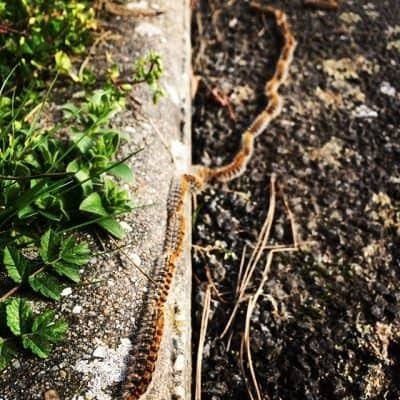
When caterpillars travel together, following one another closely, they can create a striking procession that appears almost organized by an invisible rule.
For the caterpillars, however, there is no mystery.
They are responding to signals and environmental cues that help guide their movement.
In some species, chemical trails play an important role.
A caterpillar moving at the front of a group can leave behind chemical information that other caterpillars detect.
Those behind it may then follow the same route.
The result can be a remarkably consistent line.
To a human observer, it may look like the animals have somehow agreed on a destination.
In reality, the behavior can emerge from simple biological responses repeated across many individuals.
A Living Trail Across the Ground
Imagine watching the procession closely.
The first caterpillar moves forward.
The next follows.
Then another.
Then another.
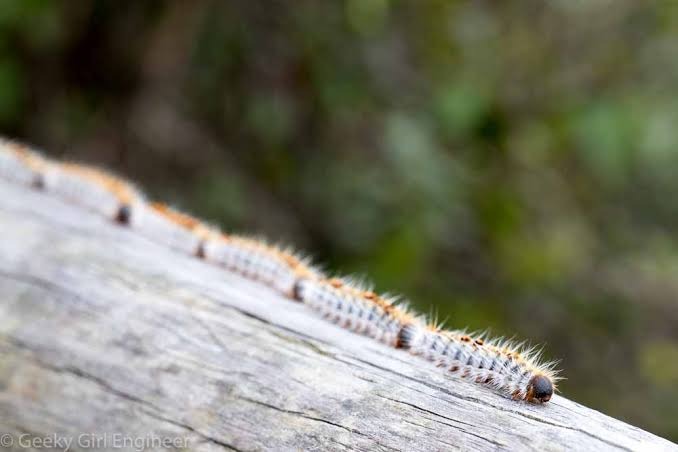
Instead of spreading randomly across the grass, the individuals remain close together.
This creates a visual illusion.
From a distance, the entire group can look like one long creature.
That is what makes the phenomenon so memorable.
The human brain is naturally drawn to patterns.
When dozens of small animals move in coordination, our minds immediately try to interpret the movement as a single organized action.
But the group does not necessarily need a central leader giving instructions.
Complex behavior can emerge when individual animals follow simple cues.
This is a principle scientists observe throughout nature.
Chemical Communication Is More Common Than We Realize
Animals communicate in many ways.
Humans rely heavily on sound and visual signals.
Other animals may depend much more on scent and chemical information.
Insects are particularly well known for using chemical signals to communicate.
Ants leave trails that help colony members find food.
Moths use chemical signals to locate potential mates.
Many other insects rely on chemical information to identify food, shelter, or members of their own species.
Some procession-forming caterpillars also use chemical cues to help maintain their movement patterns.
A chemical trail may provide information about where another individual has traveled.
Following that trail can help the group remain together.
The process is simple at the individual level but fascinating at the group level.
Why Staying Together Can Be Useful
Group behavior can provide several potential advantages.
One is efficiency.
If one caterpillar discovers a useful route toward food or shelter, others may benefit by following the same path.
There is no need for every individual to explore independently.
Following an established route can reduce unnecessary wandering.
Staying together can also help maintain contact between individuals.
For species that spend part of their lives in groups, separation could make it more difficult to reach the same destination.
However, the exact benefits depend on the species and the circumstances.
Scientists do not assume that every caterpillar procession exists for exactly the same reason.
Does the Line Protect Caterpillars From Predators?
This is one of the more interesting possibilities.
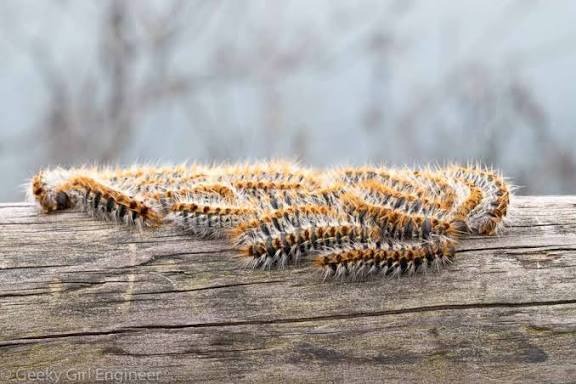
A large group may create a different visual appearance from a single small caterpillar.
Several individuals moving together can form a conspicuous pattern.
In some animals, coordinated group behavior can make it harder for predators to focus on one individual.
But the idea should be treated carefully.
Not every procession is necessarily a deliberate attempt to appear larger.
Animal behavior usually reflects multiple factors.
Food availability.
Temperature.
Habitat.
Species-specific instincts.
Chemical signals.
Predator pressure.
Movement toward shelter.
These factors can interact.
A behavior that appears to provide protection may also have other functions.
The Importance of Species
One reason scientists are cautious about generalizing caterpillar behavior is that “caterpillar” describes the larval stage of many different moths and butterflies.
These species can behave very differently.
Some caterpillars are solitary.
Some feed in groups.
Some travel in visible processions.
Others spend most of their time hidden among leaves or vegetation.
The behavior of one species should therefore not automatically be applied to every caterpillar.
This is a useful reminder whenever we encounter interesting wildlife behavior.
Nature rarely follows a single universal rule.
Why Caterpillars Travel Together at Certain Times
Movement patterns can also be influenced by environmental conditions.
Temperature may affect insect activity.
Food availability can influence where groups move.
The life stage of the caterpillar can also matter.
Some species may travel between feeding areas and protected locations.
Others may move as part of a larger developmental cycle.
This means that seeing a caterpillar procession does not necessarily indicate anything unusual.
It may simply be part of a normal stage of the species’ life.
The Remarkable World of Caterpillar Development
Caterpillars are temporary stages in the life cycles of butterflies and moths.
During this stage, their primary biological priorities often include feeding and growing.
They can change dramatically in size during development.
Eventually, many species enter another stage of their life cycle before becoming adult moths or butterflies.
This transformation is one of the most familiar examples of biological change.
Yet the caterpillar stage itself is incredibly diverse.
Different species have evolved different colors, body shapes, feeding strategies, movement patterns, and defensive behaviors.
The procession observed in a garden is therefore only one small example of a much larger world.
Why the Movement Looks So Synchronized
The visual synchronization can be especially impressive.
When each individual responds to the position or chemical trail of the caterpillar ahead, the entire group can move in a relatively consistent direction.
No central controller is required.
This is similar to other collective behaviors found throughout nature.
Fish can form schools.
Birds can create coordinated flocks.
Insects can organize movement across large groups.
These systems demonstrate how relatively simple individual behaviors can produce surprisingly complex group patterns.
Scientists sometimes study such behavior because it provides insight into how biological systems organize themselves.
Nature Does Not Need a Conversation to Create Coordination
Humans often associate coordination with communication through language.
But animals do not need words to behave collectively.
A chemical signal.
A touch.
A movement.
A vibration.
A change in light.
Any of these can provide information.
When individuals respond consistently to the same cues, coordinated behavior can emerge.
A caterpillar does not need to understand the entire procession.
It may simply respond to what is immediately in front of it.
Yet the combined effect produces an organized line.
That is what makes collective animal behavior so fascinating.
What Happens When the Line Is Interrupted?
If the trail or physical connection is disturbed, the group may respond differently depending on the species.
Some individuals may pause.
Others may continue.
Some may search for the chemical trail again.
This is another reason scientists study these behaviors carefully.
What looks like a single unified organism is actually a collection of individual animals responding to their environment.
The apparent coordination emerges from many small interactions.
Why We Rarely Notice These Events
Most people spend their days looking at the world from human eye level.
We focus on roads, buildings, phones, conversations, and daily responsibilities.
The ground beneath us can contain an entirely different world.
Tiny insects move through grass.
Spiders build structures between plants.
Beetles search for food.
Caterpillars feed on leaves.
Small changes happen continuously.
We simply do not notice most of them.
That is why an unusual procession can feel so extraordinary.
It interrupts our normal visual landscape.
Something we might normally walk past suddenly becomes the center of our attention.
The Importance of Looking More Closely
A closer look can completely change an ordinary scene.
A rope becomes caterpillars.
A pile of leaves becomes an insect habitat.
A tiny movement in the grass becomes a carefully coordinated biological process.
Curiosity changes what we see.
This is one of the reasons nature observation remains valuable even in urban environments.
You do not necessarily need to travel to a remote forest or national park to discover something interesting.
Sometimes the most fascinating behavior is happening in a backyard.
Should You Touch a Caterpillar Procession?
It is generally better to observe unfamiliar wildlife rather than handling it.
Some caterpillar species have hairs or structures that can irritate the skin.
Others may be harmless.
Because identification is difficult without knowing the species, observation from a comfortable distance is the safer choice.
Children and pets should also be discouraged from handling unfamiliar caterpillars.
There is no need to disturb a procession simply to understand it.
Watching carefully can provide plenty of information.
What If You Find One in Your Yard?
For most people, the best response is simply observation.
Look at where the caterpillars are coming from.
Notice which direction they are traveling.
Check whether they are associated with particular plants.
If you are interested in identifying them, photographs can be useful.
Local nature organizations, university extension services, or reputable identification resources may be able to help determine the species.
Knowing the species makes it easier to understand why the animals are behaving the way they are.
A Lesson in Collective Behavior
The caterpillar procession also illustrates a broader scientific concept.
Complex group behavior does not always require complex individual decision-making.
Each caterpillar may be following a relatively simple set of biological cues.
Yet when many individuals respond to those cues, a larger pattern appears.
This principle can be seen in many natural systems.
Birds move together.
Fish change direction almost simultaneously.
Ant colonies organize movement.
Bees coordinate activity around a shared environment.
The individual behavior may be relatively simple.
The group behavior can be remarkably sophisticated.
Why Scientists Study Animal Cooperation
Understanding collective behavior can teach researchers more about evolution, communication, ecology, and animal decision-making.
It can also inspire ideas in fields far removed from biology.
Researchers studying robotics and artificial intelligence have explored how simple rules can produce coordinated movement among many machines or computational agents.
Nature provides countless examples of systems that operate without a single central controller.
The humble caterpillar procession is one small illustration of this principle.
Not Every Strange Pattern Has a Hidden Meaning
There is also a valuable lesson in resisting overinterpretation.
When we see something unusual, it is tempting to search for a dramatic explanation.
Perhaps the caterpillars are following a mysterious leader.
Perhaps they are displaying extraordinary intelligence.
Perhaps the formation has a single sophisticated purpose.
The reality can be more subtle.
Natural behavior often emerges from several interacting factors.
Chemical cues may guide movement.
Environmental conditions may influence activity.
Biological instincts may keep individuals together.
The result can look astonishing without requiring a mysterious explanation.
That does not make it less beautiful.
If anything, the scientific explanation can make the event even more impressive.
The Hidden Complexity of an Ordinary Lawn
A lawn may look quiet.
But beneath that apparent stillness is constant activity.
Plants respond to sunlight.
Insects search for food.
Microorganisms interact with soil.
Birds move overhead.
Small animals navigate through vegetation.
A caterpillar procession is simply one visible moment in this enormous network of activity.
The more closely we observe nature, the more obvious it becomes that the world around us is rarely as still or simple as it appears.
When a Strange Object Becomes a Natural Discovery
That first glimpse of a “rope” in the grass could easily have ended with someone walking past it.
Instead, curiosity encouraged a closer look.
The result was a completely different understanding of what was happening.
This is perhaps one of the most rewarding aspects of observing nature.
The unfamiliar does not always need to be frightening.
Sometimes it is simply an invitation to look closer.
A strange movement may be an insect.
An unusual sound may come from a bird.
A pattern in the grass may reveal an entire miniature ecosystem.
The world contains countless details waiting to be noticed.
A Living Reminder to Slow Down
Modern life encourages speed.
We hurry to work.
We check notifications.
We complete errands.
We move from one responsibility to another.
Sometimes we forget to look down.
A line of caterpillars crossing the grass asks for something very different.
It asks us to stop.
Observe.
Wonder.
Ask a question.
Then look again.
There is no need for the discovery to be dramatic.
The simple realization that dozens of tiny creatures are following chemical and environmental cues can be enough to make an ordinary afternoon memorable.
The Beauty of Nature’s Smallest Mysteries
A procession of caterpillars may look strange at first.
But behind that strange appearance is a story of development, communication, movement, and adaptation.
The animals are not simply crawling across the ground.
They are participating in a behavior shaped by biology and environment.
Their movement may help them remain together, find resources, or navigate between important locations.
The precise explanation depends on the species and circumstances.
And that uncertainty is part of what makes nature worth studying.
There is always another question.
Why this path?
Why now?
Why this formation?
What signal are they following?
What happens when the environment changes?
Every observation can lead to another question.
And that is where science begins.
Perhaps the most memorable part of discovering a caterpillar procession is not the unusual appearance itself.
It is the reminder that remarkable things are happening all around us, even when we are not looking for them.
A simple afternoon on the lawn can become a lesson in animal communication.
A strange shape can become a glimpse into collective behavior.
And a few minutes of curiosity can transform something ordinary into something unforgettable.
Nature does not always announce its wonders.
Sometimes, it simply moves quietly across the grass and waits for someone to notice.