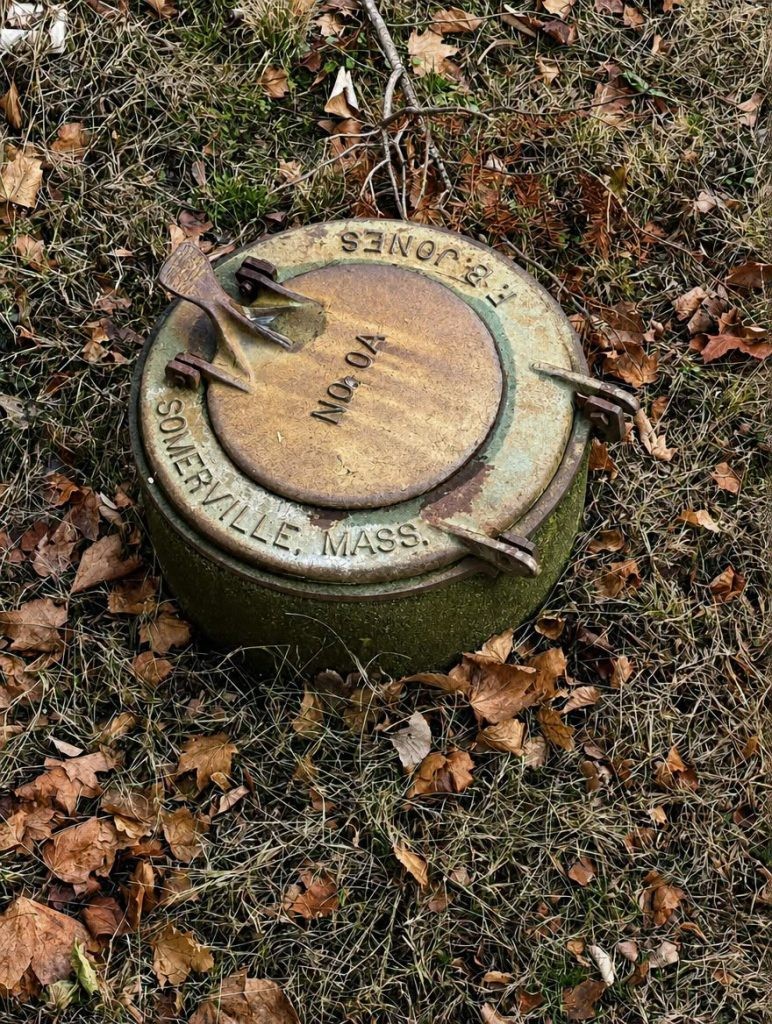
My friend Mike called one day saying he’d found something strange in his backyard—maybe even an old underground bomb shelter. Curious, I went over immediately.
Introduction: An Unexpected Discovery
One ordinary afternoon, a simple phone call led to an extraordinary exploration into the past. When my friend Mike called to report something odd beneath the surface of his backyard, our curiosity was immediately piqued. At first glance, the find—a heavy, rusted metal hatch—seemed mysterious, even potentially hazardous, with its bold stamp reading “Somerville, Mass.” The speculation that it could be an old bomb shelter only grew our anticipation.
Unveiling the Mystery Object
Upon closer inspection, it became evident that the structure was not a remnant of Cold War fears, but rather a forgotten piece of mid-century urban infrastructure. Underneath a thick mat of fallen leaves, we discovered the entrance to an underground garbage bin, a system that once characterized the practical ingenuity of neighborhoods throughout New England. This accidental excavation led us down a journey through the history of municipal waste management and urban design, highlighting how communities once dealt with the fundamental challenge of household waste disposal.
The Origin of Underground Garbage Bins in New England
In the early-to-mid 20th century, rapid urbanization and population growth in regions like New England introduced new challenges for keeping growing neighborhoods clean and sanitary. Before the now-familiar curbside pickup existed, residents struggled with outdoor metal trash cans, which proved cumbersome in harsh weather and attracted pests. Rodents and raccoons often rummaged through exposed waste, and snow or rain easily corroded unprotected metal, rapidly reducing the lifespan of these cans.
Municipalities in areas such as Somerville, Massachusetts, sought innovative solutions to these recurring problems. The answer arrived in the form of underground metal waste containers installed within concrete wells at the edge of residential properties. These subterranean bins, capped with flush metal lids, were designed to protect the garbage from weather, contain odors, and deter pests. For a time, this inventive system represented urban ingenuity and a significant step forward in public sanitation and daily convenience.
How Underground Garbage Bins Worked
The simplicity of these underground waste systems masked their clever engineering. Homeowners would drop their refuse into an inner metal container, which rested in a cylindrical concrete well beneath the surface. The wide, flush-fitting lids were crafted for durability and easy access while blending discreetly into the landscape. On designated collection days, municipal workers would lift out the bin’s inner container, empty its contents into a collection truck, and return the empty can to its hidden abode.
This method effectively concealed trash from view, reduced the prevalence of pungent odors, and made it more difficult for animals to scavenge. Additionally, the much lower temperatures underground slowed the decomposition of refuse, helping to further control unpleasant smells during warmer months.
The Advantages of Early Underground Refuse Systems
Compared to above-ground metal cans, these underground bins offered several notable advantages:
- Pest Prevention: Sealed, steel lids and concrete wells greatly reduced accessibility for rodents and other scavengers.
- Odor Control: The earth itself helped insulate smells, while the contained environment prevented them from escaping into the yard.
- Weather Protection: Bins were shielded from rain and snow, meaning they rusted more slowly and garbage stayed drier.
- Aesthetics: With only a small metal hatch visible, yards remained neat and uncluttered.
- Municipal Efficiency: Lifting a single, standardized container made waste collection easier and more consistent for workers.
This system was hailed by local newspapers and urban planners as a modern convenience, representing progress in the American effort to create cleaner streets and healthier neighborhoods.
The Drawbacks and Eventual Obsolescence
Despite their ingenuity, underground garbage bins were not without flaws, and many issues led to their gradual decline:
- Moisture and Rust: Even well-sealed bins could collect water, especially with New England’s heavy seasonal rains and melting snow. Over time, these damp conditions were ideal for rust, which weakened both the lid and container.
- Structural Problems: Repeated cycles of freezing and thawing, common in the Northeast, put stress on the concrete wells, sometimes resulting in cracks or shifting that made bins hard to open or remove.
- Maintenance Challenges: Accessing the bins for repairs or cleaning could be laborious. Debris or soil often accumulated around the lids, requiring extra work to keep them functional.
- Water Contamination: In rare cases, poorly maintained bins risked leaking garbage or runoff into the surrounding soil, a concern as suburban areas became more environmentally conscious.
As waste management technology advanced in the late 20th century, these issues became increasingly apparent. Newer systems—lightweight, above-ground plastic or metal bins—emerged as the standard. These were not only cheaper and easier to mass-produce, but also simpler for residents to use and for cities to service. By the 1970s, curbside collection had largely supplanted underground bin systems throughout New England and other regions, marking a significant transition in urban waste management practices.
The Disappearance of Underground Bins: From Mainstream to Memory
As cities modernized, many underground bins were disconnected, filled in with concrete or soil, or paved over during landscaping and street renovations. Others were simply forgotten as new property owners came and went. In most neighborhoods, they faded into obscurity, becoming little more than a local legend or a peculiar curiosity occasionally encountered by landscapers or homeowners.
Discovering one today, as Mike and I did, is a rare event that brings to life the invisible layers of history beneath our feet. The rusty hatch beneath the lawn is a physical reminder of the everyday challenges and practical innovations of previous generations.
Rediscovery and Modern Reuse
For those who stumble across these old bins, the question arises: what can you do with an underground garbage container in the 21st century?
Some homeowners have embraced creative repurposing. Vintage bins—once cleaned and made safe—have been transformed in a variety of innovative ways:
- Garden Planters: The robust, well-drained structure makes an excellent container for deep-rooted flowers or small shrubs.
- Root Cellars or Coolers: Taking advantage of the thermal insulation of underground spaces, some use these as cool spots for storing drinks during backyard gatherings.
- Decorative Features: A few turn their finds into garden art, showcasing the unique industrial design as a conversation piece.
- Tool Storage: With minor modifications, these bins can be used to stash yard tools or hoses out of sight.
Local historical societies occasionally salvage lids and bins as artifacts, preserving them for display in museums to document changing trends in public health and urban design. Rediscovering these relics has spurred renewed interest in the evolution of waste management and infrastructure among historians and the general public alike.
Expert and Societal Perspectives
According to urban historians and municipal planners, the rise and fall of underground garbage bins illustrate the continual adaptation of cities to technological advances and shifting public health priorities. Dr. Jane Gregory, a public infrastructure historian, notes: “The quest to manage waste is as old as urban civilization itself. Systems like underground bins, though now obsolete, show how communities once balanced convenience, sanitation, and the limitations of contemporary technology.”
Contemporary waste management experts view the transition toward easy-to-handle, weatherproof curbside bins as a key advance. Dr. Michael Hayes, a municipal waste consultant, explains: “Standardization, lightweight materials, and automation have improved safety, efficiency, and hygiene in waste collection. While earlier methods had merit in their day, modern systems align better with the needs and realities of today’s cities.”
Internationally, some cities in Europe and Asia are investigating modern versions of underground bins—equipped with waterproof liners, automated lifts, and electronic monitoring—to control urban litter and optimize pickup schedules. This demonstrates a global trend to innovate based on past successes while resolving their earlier shortcomings.
Cultural Significance and Lasting Legacy
The story of underground garbage bins in New England serves as a microcosm of broader shifts in urban planning and public health awareness. While the bins themselves may have largely disappeared, they are poignant reminders of how everyday technologies both shape and respond to societal change.
These relics, now scattered beneath lawns in quiet neighborhoods, invite us to reflect on how we manage our impact on the environment and our communities. Rediscovering one is not just a curiosity—it is a bridge to understanding how ordinary people coped with challenges that, though once common, now seem distant. They bear witness to an era when community resourcefulness and local solutions were crucial to daily life.
Conclusion: Uncovering the Hidden History of Suburban Yards
The chance discovery of an underground garbage bin in a modern backyard offers an intriguing glimpse into the evolving history of urban living. These installations, once standard and now largely forgotten, speak to a time when city dwellers and municipal planners worked together to solve practical challenges in creative ways. Whether repurposed, preserved, or simply admired as historic curios, these underground bins continue to hint at the layers of innovation and adaptation that make up the fabric of our built environment.
As our understanding of urban infrastructure develops, perhaps these reminders of past ingenuity will inspire new ideas for sustainable, efficient waste management in cities around the world.
Sources
- BBC
- Reuters
- The New York Times
- Smithsonian Magazine
- United States Environmental Protection Agency (EPA)
Disclaimer: This content is intended for entertainment purposes only and is not based on real events.