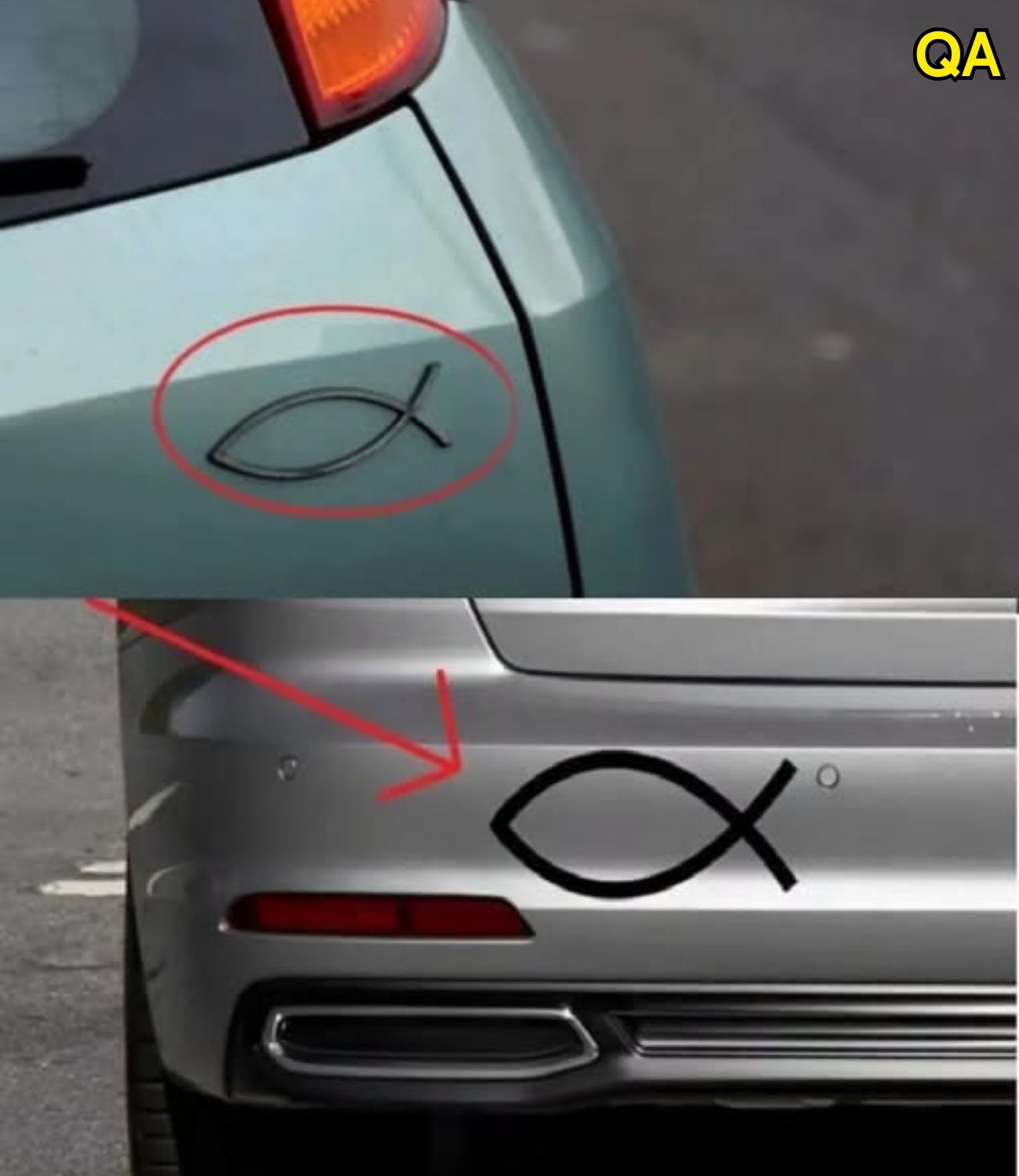
Imagine sitting at a red light during the morning commute. As traffic slowly inches forward, your eyes wander to the vehicle ahead. Just above the bumper, you notice a small silver fish attached to the trunk. It is simple, understated, and easy to miss, yet somehow memorable.
Many drivers have seen this familiar symbol without knowing its story. Some assume it is merely a decorative accessory or a unique brand logo. Others recognize it immediately as something connected to faith or history. The truth is both more fascinating and more meaningful than many people realize.
The small fish emblem has traveled through centuries of cultural tradition before finding its place on modern automobiles. Today, it serves different purposes for different people. For some, it represents religious identity. For others, it is simply a reminder to practice patience, kindness, and respect while sharing the road.
Understanding where this symbol came from and what it represents reveals a remarkable journey from ancient history to everyday life.
What Is the Fish Symbol Called?
The fish emblem commonly displayed on cars is known as the Ichthys, sometimes spelled Ichthus. The word comes from ancient Greek, where ichthys simply means “fish.”
Although the shape appears uncomplicated, it carries centuries of historical and cultural significance.
Its elegant outline can be drawn using two intersecting arcs, creating the familiar fish silhouette recognized around the world.
Today, the emblem appears on vehicles, jewelry, artwork, books, and homes, making it one of the most recognizable symbols associated with Christianity.
The Historical Origins of the Ichthys
The history of the fish symbol dates back nearly two thousand years.
Historians believe that early Christians adopted the fish as a discreet way of identifying one another during periods when openly expressing their faith could be difficult in parts of the Roman Empire.
Rather than displaying elaborate public symbols, believers sometimes used the simple fish outline as a quiet sign of shared identity.
According to historical tradition, one person might draw a curved line in the sand, and another would complete the shape if they recognized its meaning. While some details of these traditions are difficult to verify with certainty, the fish became an enduring emblem within early Christian communities.
Over time, the symbol evolved from a subtle identifier into a widely recognized representation of Christian faith.
The Meaning Behind the Name
The Greek word Ichthys also came to be understood as an acronym by early Christians.
Each letter corresponded to the first letter of a Greek phrase referring to Jesus Christ.
The phrase translates into English as:
Jesus Christ, Son of God, Savior.
This layered meaning helped transform an ordinary image of a fish into a powerful symbol of belief and hope.
Rather than relying on elaborate artwork, the simple design communicated profound spiritual ideas through a familiar everyday object.
Why Is the Fish Symbol Found on Cars?
Centuries after its earliest use, the Ichthys found a new home on automobiles.
Beginning in the late twentieth century, many Christians started placing metallic fish emblems on their vehicles as a personal expression of faith.
Unlike large signs or bold slogans, the fish remains subtle.
It does not demand attention.
Instead, it quietly reflects something important to the driver.
For many people, attaching the emblem to a car serves as a reminder that personal values should extend beyond places of worship into everyday activities, including driving.
More Than a Religious Statement
Although the fish symbol is widely associated with Christianity, many people view it as representing broader principles as well.
Drivers who display the emblem often describe it as reminding them to practice qualities such as:
Patience during heavy traffic.
Courtesy toward other drivers.
Respect for pedestrians and cyclists.
Kindness during stressful situations.
Personal responsibility behind the wheel.
These values are not exclusive to any one community, which helps explain why the symbol often resonates even with people who simply appreciate its message of consideration.
A Symbol in Everyday Life
Roads can become stressful environments.
Traffic delays, unexpected detours, crowded intersections, and long commutes can test anyone’s patience.
In these moments, small reminders sometimes influence behavior more than people realize.
For some drivers, seeing the fish emblem before starting the engine encourages a moment of reflection.
Instead of rushing, they may choose to remain calm.
Instead of reacting impulsively, they may pause before responding.
Whether these reminders change behavior cannot be measured universally, but many individuals describe the symbol as reinforcing the values they hope to practice each day.
Scientific Perspectives on Symbols and Human Behavior
Psychologists have long studied how symbols influence thought and behavior.
Research suggests that visual cues associated with personal values can help reinforce identity and encourage consistency between beliefs and actions.
This phenomenon is sometimes referred to as self-signaling.
When people publicly display symbols representing values they care about, those symbols may also serve as personal reminders.
For example, someone who wears a fitness tracker may become more aware of daily activity goals.
Similarly, a bracelet, photograph, or meaningful emblem can reinforce personal commitments throughout the day.
The fish symbol may function in a similar way for some individuals.
Rather than changing personality, it can act as a gentle reminder of principles they already value.

Cultural Significance Across Generations
One reason the Ichthys remains recognizable is its remarkable continuity across centuries.
Unlike many modern logos that change with fashion, the fish has retained its basic appearance for generations.
Parents sometimes explain its meaning to children during family conversations.
Church communities may incorporate it into educational materials.
Artists continue to reinterpret it in contemporary designs while preserving its recognizable outline.
Its enduring presence illustrates how cultural symbols can adapt to changing societies while maintaining historical connections.
Common Variations of the Fish Symbol
Although the traditional silver fish remains the most familiar version, several variations exist.
Some include a cross inside the outline.
Others feature the Greek word “Ichthys.”
Some designs incorporate decorative patterns or artistic styling.
There are also versions created as expressions of humor or cultural commentary.
These adaptations demonstrate how widely recognized the fish has become in popular culture.
Regardless of appearance, the traditional emblem continues to represent faith for millions of people worldwide.
Misconceptions About the Fish Emblem
Several misunderstandings surround the symbol.
One common misconception is that it promises protection or guarantees good fortune while driving.
In reality, the emblem is generally understood as a personal expression of belief rather than a claim of special protection.
Another misunderstanding is that everyone displaying the fish shares identical views or practices.
Like any widely recognized symbol, personal interpretations vary.
For some, it primarily reflects religious identity.
For others, it serves as a reminder to live thoughtfully and respectfully in everyday situations.
Why Such a Small Symbol Continues to Matter
Modern vehicles often display stickers supporting sports teams, universities, charities, travel destinations, or favorite hobbies.
The fish stands apart because of its simplicity.
It does not rely on bright colors or large graphics.
Its quiet presence encourages curiosity rather than demanding attention.
In an increasingly fast-paced world, subtle symbols often invite deeper reflection than louder messages.
They encourage conversations about history, values, and the traditions that continue shaping everyday life.
The Fish Symbol and Shared Roads
Whether people recognize its historical roots or simply appreciate its appearance, the fish emblem carries a message that fits naturally within the experience of driving.
Roads are shared spaces where countless individuals with different backgrounds, beliefs, and destinations travel together.
Courtesy and patience benefit everyone regardless of personal convictions.
The symbol gently reminds some drivers of that shared responsibility.
While no emblem alone can transform traffic, small reminders of empathy and respect can contribute to more thoughtful interactions between people navigating the same journey.
Conclusion
The small silver fish seen on the backs of many cars is far more than a decorative accessory. Known as the Ichthys, it traces its origins to early Christian communities and has remained an enduring symbol for nearly two thousand years. Over time, it has evolved from a discreet expression of shared faith into a familiar emblem displayed in everyday life.
For many drivers, the fish represents a quiet commitment to patience, kindness, and responsible behavior rather than a public declaration or promise of special protection. Scientific perspectives suggest that meaningful symbols can reinforce personal values, while cultural history explains why this simple design continues to resonate across generations.
Human beings have always attached meaning to symbols, transforming ordinary shapes into powerful reminders of identity, tradition, and shared ideals. The enduring presence of the small fish on modern vehicles reflects our natural curiosity and our desire to carry meaningful values with us, even during the most ordinary daily journeys.
Sources
- Encyclopaedia Britannica. Ichthys (Christian Symbol).
- Encyclopaedia Britannica. Early Christianity.
- The Metropolitan Museum of Art. Early Christian Art and Symbols.
- American Psychological Association. Identity, Symbols, and Human Behavior.
- Primedailys. What the Small Fish Symbol on Some Cars Really Means.