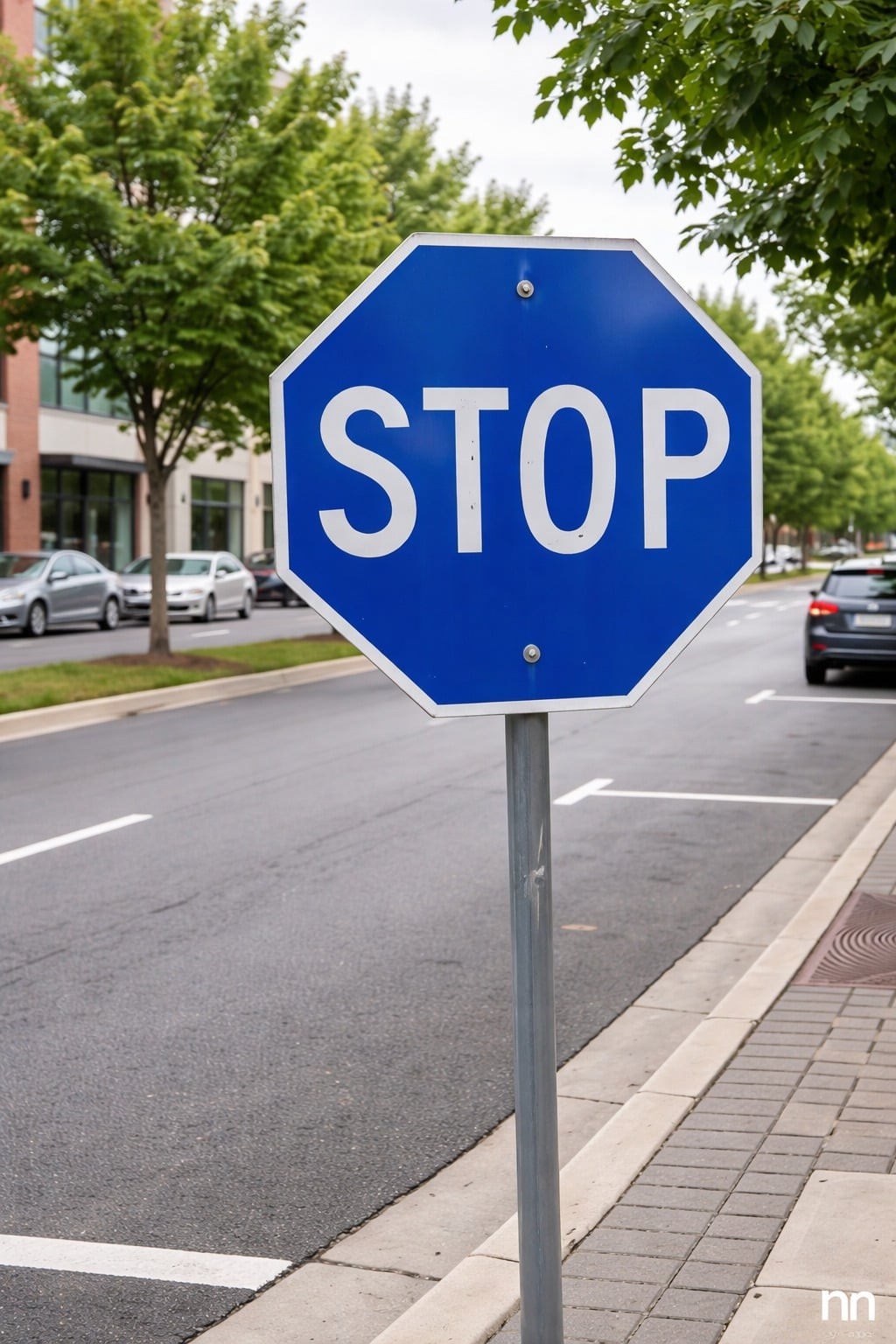
Most drivers recognize a red stop sign instantly. Its familiar eight-sided shape and white lettering send a clear message: bring your vehicle to a complete stop before proceeding.
But what happens when you encounter a blue stop sign instead?
At first glance, it may seem like an ordinary traffic sign with an unusual color. Some drivers assume it is simply decorative, while others believe it has a special meaning or no legal authority.
The reality is more complicated.
In the United States, the standard STOP sign used on public roads is red with white lettering and a white border. However, signs that look similar may appear on private property, in parking facilities, or in restricted communities. Their legal status depends on where they are installed and which local rules apply.
Understanding the difference can help drivers avoid confusion and make safer decisions.
Why Are Standard Stop Signs Red?
The familiar red stop sign is part of a nationwide system designed to make traffic instructions easy to recognize.
The Federal Highway Administration (FHWA) publishes the Manual on Uniform Traffic Control Devices, commonly known as the MUTCD. This manual establishes national standards for traffic signs, signals, and road markings.
Under Section 2B.04 of the 11th Edition, the standard STOP sign, identified as R1-1, uses an octagonal shape with a white legend and border on a red background.
The design helps drivers recognize the instruction quickly, even when they cannot immediately read the word on the sign.
Red is also widely associated with warnings and the need to stop in traffic environments. Its consistent use helps reduce confusion between different road signs.
This is why a blue sign should not automatically be treated as an ordinary official STOP sign.
What Does a Blue Stop Sign Usually Mean?
A blue STOP sign is generally an alternative sign used in a setting where a property owner or organization has installed its own traffic instructions.
You might encounter unusual traffic signs in places such as:
-
Private residential communities
-
Gated developments
-
Business properties
-
Private campuses
-
Parking facilities
-
Recreational or industrial properties
In some locations, property managers use different colors to distinguish their signs from standard public-road traffic signs. A blue sign may communicate that drivers should stop at a particular entrance, internal road, or controlled area.
However, there is no single nationwide meaning that applies to every blue STOP sign.
Its purpose depends on the property, the sign’s placement, and the rules governing that location.
It is therefore inaccurate to assume that every blue stop sign is merely decorative or that every one has the same legal status.
Are Blue Stop Signs Legally Enforceable in the United States?
This is one of the most interesting questions surrounding these unusual signs.
The answer depends on the road and the applicable state or local regulations.
The MUTCD is the national standard for traffic control devices on roads and other facilities open to public travel. Under federal regulations, this can include certain privately owned roads where the public is allowed to travel without access restrictions.
According to FHWA guidance, roads inside private gated properties where public access is consistently restricted are generally outside the MUTCD’s scope. Parking areas and their internal driving aisles are also excluded from its definition of facilities open to public travel.
This distinction matters because a property owner may have authority to establish traffic and access rules within the property.
Whether ignoring a blue sign can result in a traffic citation, a property-related consequence, or another legal issue depends on the circumstances and local law.
A blue STOP sign should therefore not be interpreted as automatic permission to continue driving.
Why You Should Still Stop at a Blue Sign
Regardless of its legal classification, a stop instruction should be taken seriously.
A blue sign may be positioned near a blind intersection, pedestrian crossing, driveway, loading area, or entrance where vehicles regularly move in different directions.
Ignoring it could increase the risk of a collision.
Even when a sign is installed on private property, drivers still need to pay attention to pedestrians, cyclists, security vehicles, and other road users.
The safest response is straightforward: stop completely, look in every direction, and proceed only when the route is clear.
The color of the sign should never be the reason to ignore a potential hazard.
How to Tell Whether a Traffic Sign Is Official
When you encounter an unusual traffic sign, consider its surroundings.
A standard red STOP sign on a public road is part of the recognized traffic-control system. A differently colored sign inside a private development may have been installed by the property owner or management company.
You can also look for nearby information, such as:
-
Signs identifying private property
-
Gate or security instructions
-
Parking and access restrictions
-
Posted community traffic rules
-
Notices explaining the property’s requirements
If you are uncertain about the sign’s legal status, avoid making assumptions based on its color alone. Local traffic authorities or the property manager may be able to clarify its purpose.
The Important Difference Between Public Roads and Private Property
One common misconception is that all roads on privately owned land are automatically outside federal traffic-sign standards.
That is not necessarily true.
Some privately owned roads are open to public travel and can fall within the MUTCD framework. For example, the FHWA identifies certain roads within shopping centers, airports, and similar facilities as potentially covered when the public can use them without full-time access restrictions.
By contrast, a private gated community with restricted access and an ordinary parking-lot driving aisle may be treated differently.
This is why the location of a blue stop sign matters more than its appearance alone.
What Should Drivers Do When They See a Blue Stop Sign?
The best approach is to prioritize safety rather than attempt to interpret the sign while driving.
Slow down as you approach it. Stop fully if the sign directs you to do so. Check for pedestrians and approaching vehicles, then proceed carefully when it is safe.
If the sign appears damaged, confusing, or inconsistent with other traffic instructions, follow the safest available course and seek clarification from the responsible authority when appropriate.
A few extra seconds at an intersection are far better than taking an unnecessary risk.
Final Thoughts: The Color May Be Different, but Safety Still Matters
A blue STOP sign can certainly catch a driver’s attention, especially in a country where red stop signs are so familiar.
But its unusual color does not tell the whole story.
Standard STOP signs on roads covered by the MUTCD follow a red-and-white design. Blue versions may appear in private or controlled settings, where the rules governing their use and enforcement can differ.
The important lesson is not to assume that a blue sign has no authority simply because it looks unusual.
When it comes to driving, understanding the surroundings, respecting traffic instructions, and protecting other road users should always come first.