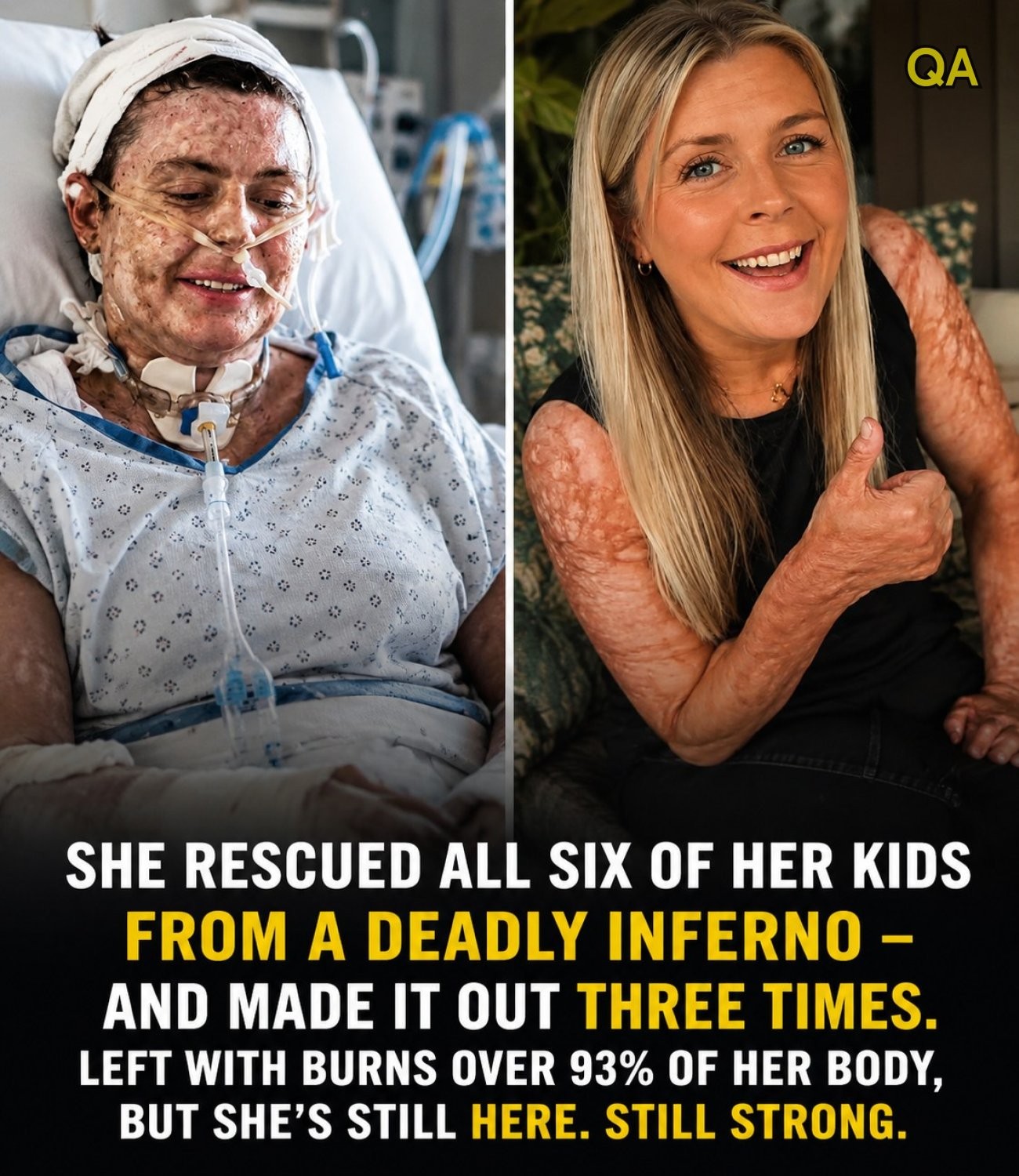
Early on the morning of September 3, 2019, Emma Schols was at home with her six children in Edsbyn, Sweden.
Two of her youngest sons had gone downstairs to play while their siblings remained upstairs.
Then Emma heard screaming.
She rushed downstairs and discovered that the television room had filled with flames. Her two sons were trapped, with the fire blocking their route toward the exit.
What happened next would change Emma’s life forever.
She moved toward her children and helped them reach the front door. Once they were outside, however, Emma realized that four more children were still upstairs.
The danger had not ended.
She went back inside.
The staircase had become difficult to navigate, but Emma continued upward and worked with her eldest son to help the remaining children reach a balcony. From there, they were able to reach safety using a ladder.
Then came the realization that one of her youngest children was still inside.
Emma returned once more.
By the time all six children were safely outside, Emma herself had suffered burns over most of her body.
Her recovery would become a remarkable story of medical care, rehabilitation and determination.
Today, Emma Schols is remembered in Sweden not only for what happened inside her home that morning, but also for everything that followed.
The Morning Everything Changed
The events unfolded in a matter of minutes.
A family morning that had begun normally suddenly became an emergency.
Emma’s two youngest sons were downstairs when she heard them calling out. When she reached the television room, she found that the fire had already spread significantly.
The boys were unable to reach the exit on their own.
Emma acted immediately.
Her priority was getting them out of the house.
Once the boys were outside, she could have remained there and waited for emergency services.
But four other children were still upstairs.
That meant the situation was far from over.
Emma returned to the house.
The staircase was already affected by the fire, making the journey upstairs extremely difficult. Nevertheless, she continued toward her children.
She eventually helped the children reach a balcony, where they could use a ladder to get down.
Then she realized that one child was still missing.
Instead of remaining outside, Emma went back again.
That decision became one of the defining moments of her story.
All Six Children Reached Safety
By the time emergency responders arrived, all six children had escaped.
The children reportedly survived with comparatively limited injuries despite the seriousness of the incident.
Emma’s condition was dramatically different.
She had suffered burns across approximately 93 percent of her body.
She was placed on a ventilator and spent an extended period receiving intensive medical treatment.
Her survival was only the beginning of the journey.
Severe burns can affect far more than the surface of the skin. They can interfere with the body’s ability to regulate temperature and protect itself from infection, while extensive injuries can also create challenges involving movement, hydration and healing.
For someone with such extensive injuries, recovery can become a long process involving multiple medical specialties.
Emma faced that process while also trying to rebuild her everyday life.
The Science Behind Severe Burn Recovery
The skin is the body’s largest organ and performs several essential functions.
It forms a barrier between the body and its environment, helps regulate temperature and plays an important role in sensation.
When large areas of skin are damaged, the body can lose some of those protective functions.
Modern burn medicine therefore focuses on much more than healing the visible injury.
Patients with extensive burns may require intensive monitoring, specialized wound care, surgery, rehabilitation and long-term follow-up.
Recovery can also involve physical therapy designed to preserve movement and flexibility.
As healing occurs, scar tissue can sometimes become less flexible than normal skin. Rehabilitation may therefore be important for maintaining mobility and helping patients adapt to changes in their bodies.
Emma’s recovery demonstrates why surviving a major medical emergency is not necessarily the end of the journey.
For many patients, it marks the beginning of another long chapter.
Waking Up With One Question
After spending weeks receiving intensive care, Emma eventually regained consciousness.
According to accounts of her recovery, her first concern was not her own condition.
She wanted to know whether her children were safe.
That reaction captures something central to the entire story.
Everything Emma had done during the fire had been focused on her children.
When she finally had an opportunity to ask about the situation, they remained her first priority.
Her recovery was therefore not simply about returning to physical health.
It was about returning to her family.
The Long Road of Rehabilitation
The human body has a remarkable ability to heal, but recovery from extensive burns can require patience.
Rehabilitation may include physical exercises, stretching, mobility work and other forms of therapy.
For burn survivors, rehabilitation can also involve learning how to manage changes in skin flexibility and appearance.
There is an emotional dimension as well.
A person recovering from major injuries may have to adjust to a body that looks and feels different from before.
That adjustment can take time.
Emma eventually became open about her scars rather than hiding them.
Her approach offers an important perspective on recovery.
A scar can be a reminder of something difficult, but it can also become part of a person’s identity and story.
Emma Chose Not to Hide Her Scars
One of the most powerful aspects of Emma’s story is the way she has spoken about her scars.
Rather than treating them as something that needed to disappear before she could move forward, she has described them as symbols of her love for her children.
That perspective does not erase the difficulty of her recovery.
Instead, it gives the scars a different meaning.
For many people who experience serious injuries or medical conditions, changes to their appearance can become one of the hardest parts of returning to everyday life.
Society often places considerable emphasis on appearance.
Emma’s willingness to be visible can therefore be understood as a statement about acceptance and identity.
Her scars are part of what happened to her, but they do not define everything about who she is.
Recognition at the Svenska Hjältar Gala
In December 2020, Emma was named Lifesaver of the Year at Sweden’s Svenska Hjältar gala.
The award recognized her actions during the fire and the extraordinary circumstances surrounding her efforts to get all six children to safety.
The recognition also brought wider public attention to her recovery.
However, awards can capture only one moment.
Emma’s story continued long after the ceremony.
She still had rehabilitation and everyday life ahead of her.
She still had to adapt to the physical consequences of her injuries.
And she still had a family to care for.
From Survival to a New Kind of Strength
One particularly striking part of Emma’s later journey was her return to physical activity.
After facing uncertainty about her mobility, she eventually returned to exercise and took up running.
She also participated in demanding physical challenges.
That progression illustrates an important principle of rehabilitation.
Recovery is not always about returning exactly to the person someone was before an injury.
Sometimes it means discovering what is possible afterward.
Goals may change.
Methods may change.
The body may change.
But progress can still happen.
For Emma, running became one expression of that progress.
What once might have seemed impossible eventually became part of her life again.
Her Story Became a Book
Emma later shared her experiences in the memoir Ärren bär jag med stolthet, translated as I Carry My Scars With Pride.
The book was written with journalist Frida Funemyr and published in 2022.
A memoir can offer something that a news report cannot.
A news story may describe what happened.
A memoir can explore what it felt like afterward.
For Emma, that meant sharing not only the events of the fire but also the long process of recovery, adaptation and learning to live with the physical reminders of that morning.
The title itself captures the perspective that has become associated with her story.
Her scars are not something she needs to erase in order to move forward.
They are part of her history.
What Science Can Teach Us About Resilience
Stories of extreme recovery often lead people to ask where resilience comes from.
There is no single answer.
Psychological resilience is influenced by many factors, including social relationships, access to professional support, personal beliefs, environment and individual coping strategies.
Resilience also does not mean that a person never struggles.
Someone can experience fear, frustration or sadness while still continuing to recover.
This distinction is important.
Real resilience is not necessarily about feeling strong every day.
It can mean continuing with the next step even when the larger journey feels overwhelming.
For someone undergoing lengthy rehabilitation, that next step might be a medical appointment, a physical therapy exercise or simply getting through another difficult day.
Over time, those small steps can become meaningful progress.
Why Family Can Become a Powerful Source of Motivation
Emma’s story also highlights the role family can play during recovery.
Her children were central to the events of the fire, but they were also part of the life she was working to return to afterward.
Having meaningful relationships can provide motivation during challenging periods.
Family members can offer practical support, companionship and encouragement.
For parents, children may also provide a powerful reason to focus on the future.
This does not mean family relationships make recovery easy.
Rather, they can become one part of the network of support that helps a person continue moving forward.
A Different Way to Think About Scars
Scars are often described only in terms of appearance.
But medically, scars represent the body’s repair process.
When skin is injured, the body begins a complex sequence of biological responses designed to restore the damaged area.
The resulting tissue may look different from the original skin.
Its texture and flexibility can also differ.
Yet a scar can simultaneously represent healing.
That is why Emma’s attitude toward her scars carries such symbolic meaning.
She does not describe them simply as reminders of a difficult morning.
She has also connected them with the love she has for her children.
The same physical marks can therefore carry both difficult memories and deeply personal meaning.
The Human Side of an Extraordinary Story
It is easy to focus on the dramatic numbers in Emma’s story.
Six children.
93 percent of her body affected by burns.
Weeks of intensive medical care.
A long rehabilitation.
An award.
A memoir.
A return to running.
But behind those numbers is a mother rebuilding an ordinary life.
She still has family routines.
She still has everyday challenges.
She still has moments that have nothing to do with the fire.
That may be one of the most important parts of the story.
Survival is not simply about one dramatic moment.
It is also about everything that comes afterward.
Final Thoughts: A Story About Love, Recovery and Moving Forward
Emma Schols’ story began with a terrifying morning in Sweden in 2019.
It became a story of a mother trying to get all six of her children to safety.
But it did not end when the children reached safety.
Emma then faced a long medical journey, extensive rehabilitation and the challenge of adapting to a body permanently changed by the experience.
She eventually turned that experience into a story she was willing to share.
She received national recognition.
She returned to physical activity.
And she chose not to hide the scars that had become part of her life.
Perhaps the most meaningful part of her story is not the dramatic moment inside the house.
It is everything that came afterward.
Healing takes time.
Recovery rarely follows a perfectly straight path.
And strength does not always look like a dramatic achievement.
Sometimes strength is simply continuing.
One appointment.
One exercise.
One ordinary morning.
One step at a time.
Emma’s story reminds us that difficult experiences can leave lasting marks without taking away a person’s ability to build a meaningful future.
Her scars tell part of her story.
But they are not the whole story.
And perhaps that is why her words about carrying them with pride resonate so strongly.
They represent not just what happened to her, but how she chose to move forward.
Sources and Further Reading
Svenska Hjältar, the Swedish awards initiative associated with Emma Schols’ recognition as Lifesaver of the Year.
Ärren bär jag med stolthet by Emma Schols and Frida Funemyr, published in 2022.
Mayo Clinic, information about burns, treatment and recovery: Mayo Clinic
American Burn Association, educational resources concerning burn care and recovery: American Burn Association
National Institute of General Medical Sciences, information about wound healing and the body’s repair processes: NIGMS
World Health Organization, information concerning burns and burn care: World Health Organization