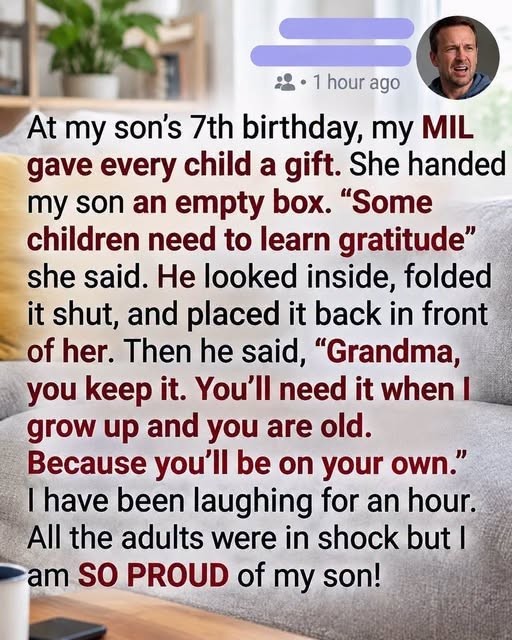
A seventh birthday should be a day filled with laughter, colorful decorations, exciting presents, and the warmth of family. For Leo, however, one unexpected gift turned what should have been a joyful celebration into an uncomfortable family moment.
While the other children were opening their presents, Leo’s grandmother, Eleanor, handed him a small box. At first, the little boy probably expected to find a toy, a book, or something special inside. Instead, he discovered that the box was completely empty.
Eleanor called it a lesson in gratitude. But to Leo’s mother, it looked less like a meaningful lesson and more like a public humiliation.
The adults around the table watched in silence. Some appeared uncomfortable, while others did not know how to respond. Leo’s mother was furious, but before she could say anything, her seven-year-old son did something unexpected. He gently pushed the empty box back toward his grandmother and spoke a few words that changed the atmosphere of the room.
An Empty Box on a Child’s Special Day
Children often look forward to their birthdays for weeks. They imagine the cake, the decorations, the games, and the presents waiting for them. More importantly, they look forward to feeling special and loved by the people closest to them.
Leo was no different.
His seventh birthday brought together family members and young guests for an afternoon of celebration. The children gathered around the presents, excited to discover what everyone had received.
When Eleanor handed Leo a box, he naturally expected something inside.
But when he opened it, there was nothing.
Rather than explaining that she had forgotten his present or made a mistake, Eleanor presented the empty box as a lesson in gratitude. Her message suggested that Leo should appreciate what he had, even when he received nothing.
Perhaps she believed she was teaching him humility. Perhaps she thought the experience would make him more appreciative of future gifts.
Whatever her intention, the result was uncomfortable.
A birthday party is not an appropriate place to make a child feel small in front of relatives and friends. Gratitude is important, but it should grow from understanding, kindness, and positive examples rather than embarrassment.
Leo’s mother immediately recognized that something was wrong. She had watched her son approach the box with excitement, only to discover that the moment had become something entirely different.
Leo’s Unexpected Response Left the Adults Speechless
Before his mother could fully react, Leo looked at his grandmother and pushed the empty box back toward her.
Then he said:
“Grandma, you should keep it. You might need it when you’re old and alone.”
The words were unexpected, especially coming from a seven-year-old.
Eleanor appeared ready to respond, but she did not immediately find the words. Mark stared at the situation in surprise, while Leo’s aunt struggled to hide her laughter.
Leo, meanwhile, returned to his cake and drink.
For him, the moment seemed to be over. He had said what he wanted to say, and he was ready to enjoy the rest of his birthday.
His mother eventually laughed, and the tension began to ease. Other family members followed. Eleanor collected her handbag and left the celebration.
Soon, the children returned to their games, and the birthday party slowly became what it should have been from the beginning: a happy afternoon centered on a little boy celebrating another year of life.
Yet the exchange left an important question behind. What should adults do when a child is treated unfairly by someone they are expected to respect?
Why Public Humiliation Is Not an Effective Way to Teach Gratitude
Gratitude is a valuable quality for children to develop. Learning to appreciate gifts, relationships, opportunities, and everyday acts of kindness can help them become more thoughtful and considerate.
However, the way adults teach gratitude matters.
Children learn not only from what adults say but also from how adults treat them. If a parent or relative uses embarrassment to make a point, the child may remember the uncomfortable experience more strongly than the intended lesson.
An empty birthday box might have been intended as a symbolic gesture, but Leo was still a young child experiencing a special occasion. He had every reason to expect kindness from his family.
There is an important difference between teaching a child that they cannot always receive everything they want and deliberately making them feel unimportant.
A healthy lesson in gratitude might involve encouraging children to write thank-you notes, help others, share their belongings, or recognize the effort behind a thoughtful gift. These activities allow children to understand appreciation through everyday experiences.
Humiliation, on the other hand, can damage trust and make a child question whether family gatherings are emotionally safe.
Adults should remember that children are still learning how to understand their feelings. They need guidance, patience, and examples of respectful behavior.
A Child Deserves Respect, Even From Older Family Members
In many families, children are taught to respect their grandparents, parents, and older relatives. This is an important value in many cultures, including Vietnamese culture, where respect for elders is often deeply emphasized.
However, respect should not mean that children must accept every action without question.
Being older does not automatically make someone right. Being a grandparent does not give a person permission to embarrass a grandchild or dismiss their feelings.
Children can learn to respect adults while also understanding that their own feelings matter.
Leo’s mother recognized this distinction when she spoke with him after the party. She wanted him to understand that he deserved kindness and that no family member had the right to humiliate him simply because of their position in the family.
This conversation was important because children need to know that they can speak up when something feels unfair.
At the same time, they need help understanding how to express disagreement without intentionally hurting another person.
What Leo’s Mother Taught Him After the Birthday Party
Later that afternoon, when the guests had settled down, Leo’s mother talked with him about what had happened.
She explained that he deserved to be treated with kindness and respect. His grandmother’s age and family position did not make the empty-box gesture acceptable.
But she also wanted him to understand another lesson.
Defending himself did not mean he had to make someone else feel lonely or unwanted. His response had been understandable in the moment, but he could learn other ways to communicate when someone treated him unfairly.
This is an important part of helping children develop emotional awareness.
Parents do not need to teach children to remain silent when they are hurt. Nor should they encourage children to respond to every unkind action with another unkind action.
Instead, they can help children recognize their feelings, explain what happened, and establish appropriate boundaries.
For example, a child might learn to say:
“That made me feel sad.”
“I don’t think that was kind.”
“Please don’t make fun of me.”
These simple statements allow children to express themselves without turning every disagreement into a personal attack.
Leo listened to his mother. Then, as the conversation came to an end, he asked whether there was any cake left.
It was a small but memorable reminder that he was still only seven years old. He did not need to carry the responsibility of repairing every adult relationship or teaching his grandmother how to behave.
He needed to enjoy his birthday.
The Role of Parents When Family Members Cross Boundaries
Situations like Leo’s can be especially difficult because they involve close relatives. Parents may feel pressure to avoid conflict, preserve family relationships, or respect older generations.
However, protecting a child’s emotional well-being should remain a priority.
When a family member behaves in a way that embarrasses or belittles a child, parents can take several constructive steps.
First, they should acknowledge the child’s feelings. Telling a child that they are being too sensitive may make them less willing to share future concerns.
Second, parents should address inappropriate behavior calmly and clearly. A simple statement such as “We do not make a child feel embarrassed on their birthday” can establish an important boundary.
Third, they should speak with the child privately afterward. Children may need reassurance that they did nothing wrong by feeling disappointed or upset.
Finally, parents should demonstrate the behavior they want their children to learn. If they expect children to communicate respectfully, they should also model respectful communication themselves.
Maintaining family relationships does not require accepting every action. Healthy relationships depend on mutual consideration, regardless of age or family position.
A Birthday Should Be Remembered for Love, Not Embarrassment
By the time the party continued, the children had returned to their games. The cake was still on the table, the decorations remained in place, and Leo could once again enjoy the celebration.
The empty box, however, had created a moment that the adults were unlikely to forget.
It was not the absence of a present that made the situation uncomfortable. A child can understand that gifts are not the most important part of a birthday. What matters more is the feeling that people care enough to celebrate with them.
A thoughtful conversation, a warm hug, or simply spending time together can mean far more than an expensive present.
Eleanor may have intended to teach gratitude, but the experience raised a different lesson for everyone in the room: children should never have to earn kindness by accepting humiliation.
Leo’s response may have surprised the adults, but his mother’s conversation afterward was perhaps the more meaningful moment. She reminded him that he deserved respect while also teaching him that kindness should remain part of the way he responds to others.
Ultimately, a seventh birthday should not become a test of a child’s patience or maturity.
A child should be allowed to laugh, play, open presents, eat cake, and feel loved.
Because the greatest gift a family can give a child is not always something wrapped in colorful paper. Sometimes, it is the simple reassurance that they are valued, respected, and welcome exactly as they are.
And that is a lesson worth remembering long after the birthday candles have been blown out.