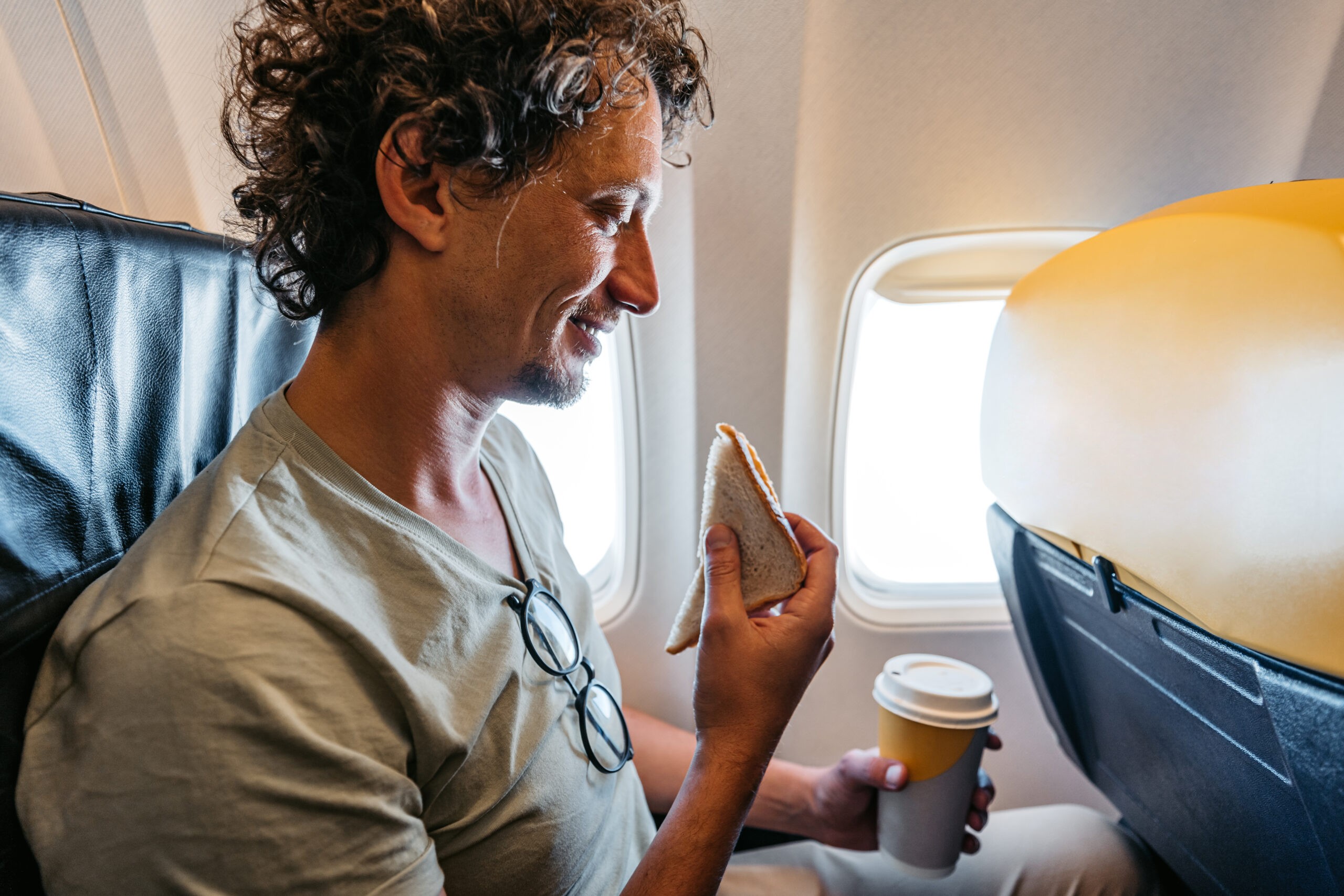
A quiet airplane journey can feel like a small luxury. After finding your seat, stowing your belongings and settling in, you may simply hope for a peaceful flight.
But sometimes, the smallest habits can become surprisingly difficult to ignore.
For British travel creator Risky Regg, one such moment happened during a flight when he noticed the passenger sitting beside him eating with his mouth open. What followed was a brief confrontation that quickly became an online talking point.
The video attracted millions of views and divided viewers into two very different camps. Some believed the influencer was right to speak up about an irritating eating habit. Others felt that his reaction was unnecessarily confrontational and that recording another passenger raised a separate etiquette question.
The incident highlights a broader issue with modern travel: where should we draw the line between politely addressing an annoyance and respecting another person’s personal space?
A Simple Airplane Meal Turns Into a Viral Moment
Risky Regg, a British travel creator with a large following on TikTok and Instagram, was eating during a flight when he noticed the passenger next to him chewing with his mouth open.
Rather than quietly putting on headphones or asking a flight attendant for assistance, he decided to address the issue directly.
In the video, he asks the passenger if he could eat with his mouth closed. He then imitates the chewing before asking the man how old he is.
The passenger’s response is difficult to hear in the recording, and the interaction eventually ends without a clear resolution.
Risky Regg puts in his earbuds and returns to his meal.
What might have been an ordinary disagreement between two travelers became something much larger once the footage appeared online.
The video reportedly attracted more than 14 million views, turning an everyday airplane annoyance into a debate about manners, personal boundaries and social media.
Why Open-Mouth Chewing Bothers People
Eating habits can be surprisingly personal.
For some people, the sight or sound of someone chewing with their mouth open is simply unpleasant. Certain repetitive eating sounds can also feel disproportionately distracting to people who are particularly sensitive to them.
On an airplane, those reactions can become stronger.
Passengers are sitting close together in a confined environment for extended periods. Unlike a restaurant, there may be little opportunity to move to another table.
The person beside you might be only a few inches away, meaning ordinary sounds can become much more noticeable.
This is one reason airplane etiquette can feel more important than etiquette in many everyday situations.
The People Who Supported Risky Regg
Some viewers believed the travel creator had simply said what many passengers would have wanted to say.
They argued that eating quietly and keeping one’s mouth closed are basic social conventions.
For these viewers, the influencer’s frustration was understandable.
Some commenters even found his exaggerated imitation of the chewing amusing, interpreting the moment as humorous rather than serious.
From this perspective, the passenger’s behavior was the original problem.
If someone is sitting beside another person for several hours, supporters argued, showing basic consideration can make the journey more comfortable for everyone.
Others Thought the Influencer Went Too Far
Not everyone agreed.
A significant portion of the online reaction focused less on the chewing and more on Risky Regg’s response.
Critics argued that there was no need to imitate the passenger or question his age.
They felt that if the eating sounds were genuinely distracting, the situation could have been handled with a quieter and more respectful request.
This distinction is important.
There is a difference between saying, “Would you mind chewing a little more quietly?” and deliberately embarrassing someone.
The first approach communicates a personal boundary.
The second can easily turn an everyday disagreement into a confrontation.
The Privacy Question
Another issue raised by viewers was the recording itself.
Some commenters argued that the airplane passenger’s behavior was irritating but that filming him and sharing the footage online created a separate concern.
Social media has changed the nature of everyday disagreements.
In the past, an awkward interaction between two strangers might have ended when the flight landed. Today, a short recording can potentially be watched by millions of people.
That changes the consequences of even a minor disagreement.
A passenger who makes an annoying sound may expect another traveler to be irritated.
They may not expect the moment to become online entertainment.
This raises an increasingly relevant question about digital etiquette: just because something happens in public, does that automatically mean it should become content?
Airplane Etiquette Is About Mutual Consideration
The debate is ultimately less about chewing than it is about consideration.
Air travel requires people with different personalities, routines and preferences to share a very small space.
One passenger may want to sleep.
Another may want to watch a movie.
Someone else may want to read, work or simply look out the window.
Food adds another layer.
Passengers have different eating habits, and what seems perfectly normal to one person may be distracting to another.
The challenge is finding ways to accommodate those differences without turning every irritation into a confrontation.
A Better Way to Handle an Annoying Passenger
If another passenger’s behavior is genuinely distracting, there are several relatively simple approaches.
The first is to create some distance where possible.
Putting on headphones or changing your attention to another activity may be enough to make the problem less noticeable.
If the issue continues, a polite request can sometimes work.
A simple sentence such as, “Sorry, would you mind chewing a little more quietly?” communicates the problem without turning it into a personal criticism.
If speaking directly feels uncomfortable, particularly in a confined environment, asking a member of the cabin crew for assistance may be another option.
The goal should generally be to solve the problem rather than win an argument.
Why Travel Makes Small Problems Feel Bigger
There is also a psychological side to airplane disagreements.
Travel can be tiring. Long flights, unfamiliar surroundings, delays and limited personal space can all reduce patience.
A small irritation that would normally be easy to ignore may therefore become much harder to tolerate.
The person chewing may not even realize that they are making noticeable sounds.
That is another reason calm communication can be valuable.
What feels obvious to one person may be completely invisible to another.
Good etiquette is therefore not simply about following a universal list of rules. It is also about recognizing that people may have different expectations.
The Larger Debate Around Social Media Travel Content
Risky Regg’s video also reflects the changing relationship between travel and social media.
Travel influencers regularly turn everyday experiences into entertainment.
A meal, hotel room, airport interaction or conversation with a stranger can become part of a creator’s content.
This can make travel videos relatable because viewers recognize situations they have experienced themselves.
At the same time, the format creates ethical questions.
When does a funny travel observation become unfair criticism of another person?
When does documenting an experience cross into exposing someone who did not expect to become part of a public story?
There are no universally accepted answers.
Different countries, platforms and audiences have different expectations regarding privacy and filming.
But the debate surrounding this airplane video shows that audiences are increasingly thinking about those questions.
Risky Regg’s Earlier Controversies
The chewing video was not the first time the travel creator had attracted criticism online.
Earlier in the year, Risky Regg faced backlash surrounding content filmed with a Chinese woman in Xi’an.
One video was titled “Winning Over a Chinese Girlfriend,” while comments he reportedly made about meeting and pursuing a Chinese woman within a short period attracted criticism from some viewers.
Critics argued that the framing could reinforce stereotypes about Chinese women and culture.
The woman involved reportedly defended her friendship with Risky Regg and said she had chosen to spend time with him.
The disagreement demonstrates how quickly travel content can become part of larger conversations about cultural sensitivity and representation.
For travel creators, that can be particularly complicated.
Their content often involves interactions with people from different cultural backgrounds, meaning humor or commentary that works for one audience may be interpreted very differently by another.
Is There a Universal Standard for Good Manners?
Probably not.
Manners vary across cultures, families and generations.
Eating quietly is widely considered polite in many settings, but expectations surrounding meals differ around the world.
The same applies to conversation, personal space, eye contact and public behavior.
Airplanes create an interesting environment because they bring people from different backgrounds together in a shared space.
That means passengers cannot realistically expect everyone to behave exactly as they would at home.
Instead, the most useful standard may simply be consideration.
Are you making an effort not to unnecessarily disturb the person beside you?
Are you willing to adjust your behavior when someone politely raises a concern?
And if another passenger irritates you, can you address the issue without unnecessarily escalating the situation?
Those questions may be more useful than trying to establish one rigid rule for everyone.
What Travelers Can Learn From the Viral Debate
The Risky Regg incident offers a simple lesson for both passengers and content creators.
For passengers, small acts of consideration can make shared travel much more comfortable.
For creators, viral content comes with another responsibility: remembering that the people appearing in a video may not have chosen to participate in the story.
And for viewers, it may be worth remembering that short clips rarely capture every detail of an interaction.
A few seconds of footage can encourage strong opinions, even when the audience does not know what happened immediately before or afterward.
That is especially important when deciding who was “right” or “wrong.”
Final Thoughts: A Small Annoyance With a Bigger Lesson
The airplane chewing debate may seem trivial at first.
One passenger found another person’s eating habits irritating. The creator spoke up. The interaction was filmed. Millions of people watched it and formed their own opinions.
But underneath that simple story are some surprisingly modern questions.
How should strangers communicate when they irritate one another?
How much patience should we expect from people sharing confined spaces?
And when does recording an everyday interaction turn a private disagreement into public entertainment?
There may never be one answer that satisfies everyone.
What seems clear is that travel works best when people show a little consideration for one another. Passengers cannot control every sound, habit or personality they encounter during a journey, but they can control how they respond.
Perhaps that is the real lesson from this viral airplane moment: good manners are not only about how quietly we eat. They are also about how respectfully we handle the people around us.
Sources
TikTok, public video posted by travel creator Risky Regg concerning the airplane eating incident.
Instagram, public social-media profile and travel content associated with Risky Regg.
Bored Panda, reporting and discussion surrounding the viral airplane etiquette video.
General travel and etiquette guidance concerning passenger courtesy and respectful behavior in shared spaces.