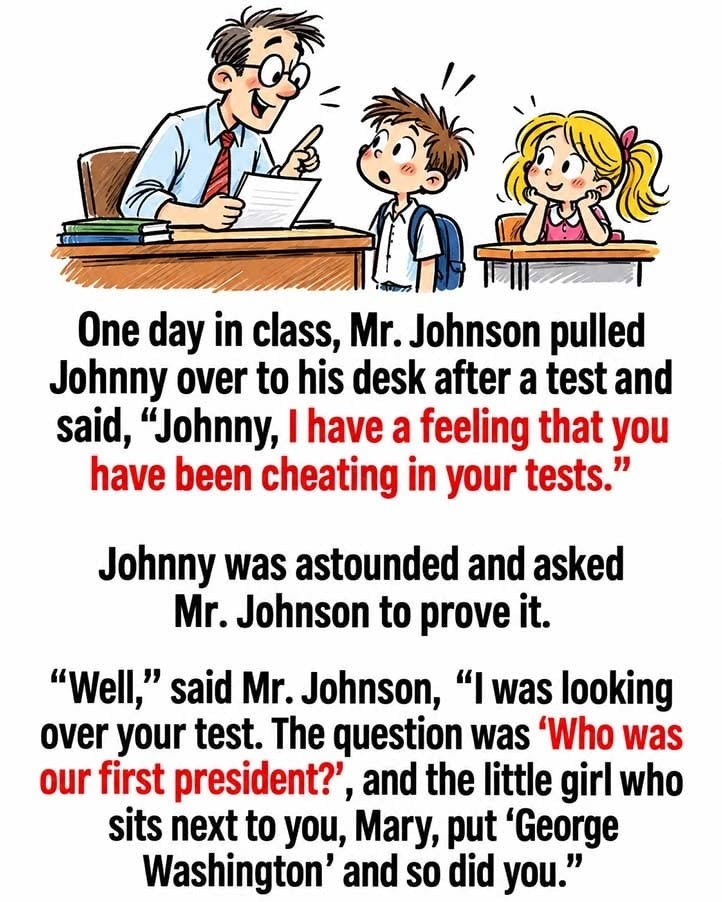
A History Test That Raised Suspicion
The classroom had been unusually quiet during the history test. Students sat at their desks, concentrating on their papers while Mr. Johnson walked slowly between the rows. Every now and then, he stopped to glance at a student’s work, but nothing seemed out of the ordinary.
Johnny, however, was about to discover that his test had attracted more attention than he expected.
After collecting the papers and reviewing the answers, Mr. Johnson noticed something that made him pause. Johnny’s responses seemed remarkably similar to those of Mary, the girl sitting beside him.
At first, the teacher considered the possibility of coincidence. After all, some history questions had straightforward answers that most students were expected to know. But as he continued comparing the two papers, his suspicion grew.
When the class was dismissed, Mr. Johnson asked Johnny to come to his desk.
“Johnny, I need to talk to you about your history test,” he said.
Johnny approached with a puzzled expression.
“What’s wrong, sir?”
Mr. Johnson looked at him seriously.
“I have reason to believe that you may have copied some of your answers from Mary.”
Johnny immediately looked surprised.
“Copied? I didn’t cheat! If you think I did, you should show me the evidence.”
The teacher nodded. He had expected Johnny to deny it, but he was prepared to explain exactly what had caught his attention.
The First Two Answers Seemed Too Similar
Mr. Johnson picked up the two test papers and pointed to the first question.
“Let’s start here. The question asked who the first president of the United States was. Mary wrote George Washington, and you wrote exactly the same answer.”
Johnny barely seemed concerned.
“Well, of course I did! Everyone knows George Washington was the first president. That’s not exactly a difficult question.”
Mr. Johnson didn’t respond immediately. Instead, he moved to the next question.
“All right. What about this one? The question asked who freed the slaves. Mary answered Abraham Lincoln, and so did you.”
Johnny shrugged.
“That’s another easy one. I read my history book last night. Abraham Lincoln is the answer.”
His confidence seemed almost impressive. He had an explanation for everything, and neither matching answer appeared to bother him.
But Mr. Johnson wasn’t ready to let the matter go.
He turned to the final question that had caught his attention.
The Final Answer That Exposed Everything
The teacher placed his finger on the question about the Louisiana Purchase.
“Now, Johnny, let’s look at this one. The question asked who was president during the Louisiana Purchase.”
Johnny glanced at the paper.
Mr. Johnson continued.
“Mary didn’t write a president’s name this time. She simply wrote, ‘I don’t know.'”
Johnny nodded, apparently waiting for the teacher to explain what that had to do with him.
Then Mr. Johnson pointed to Johnny’s answer directly beneath the same question.
There it was, written clearly in Johnny’s handwriting:
“Me neither.”
For a moment, the teacher said nothing.
Johnny’s earlier explanations had sounded reasonable enough. George Washington and Abraham Lincoln were well-known historical figures, and two students could easily arrive at the same answers independently.
But this final response was different.
Mary had admitted that she didn’t know the answer. Johnny had apparently agreed with her word for word, even though the question was asking for the name of a historical president.
And with those two little words, his entire defense fell apart.
Why This Classroom Joke Is So Funny
The humor in this story comes from the way Johnny tries to defend himself. Each explanation sounds plausible when considered separately. He argues that the first two answers are common knowledge and insists that he studied the night before.
The teacher, meanwhile, patiently saves the most convincing evidence for last.
The joke works because the audience can see the problem before Johnny’s defense reaches its conclusion. His answer, “Me neither,” is funny precisely because it is not a name at all. Instead of answering the historical question, Johnny appears to have copied Mary’s uncertainty.
It is a simple classroom joke built around timing, misunderstanding, and an unexpected final line.
Sometimes, the funniest evidence is not a complicated explanation or a long investigation. It is just two words written in the wrong place.