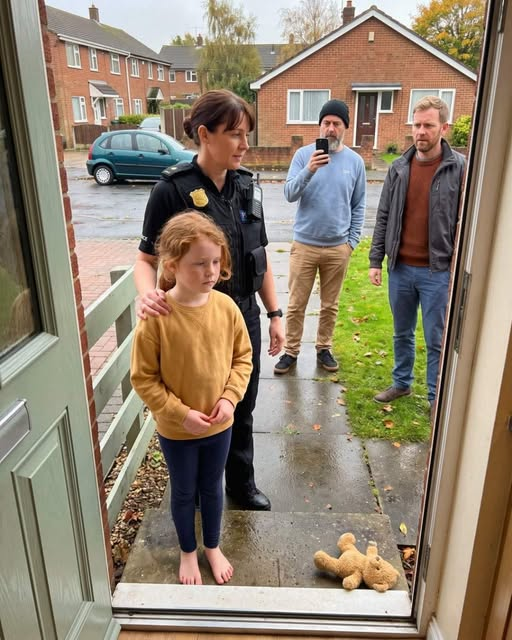
Seven-Year-Old Girl Calls 911 After Her Father Goes Missing for Four Days: A Story of Love, Hope, and Community
A little girl waits by the door, listening for the familiar sound of her father’s footsteps. Every evening, she expects him to return. But this time, the hours turn into days, and no one can tell her where he is.
In a story shared online, seven-year-old Ashley faces this frightening situation after her widowed father, Raymond Cole, leaves home to buy medicine for her kidney condition. When he does not return, the child eventually contacts emergency services, setting in motion a chain of events that brings an entire neighborhood together.
Although the account has not been independently verified, its central message is a powerful reminder of how important family support and community care can be.
A Father Determined to Get His Daughter’s Medicine
According to the online account, Raymond was raising Ashley alone after losing his wife. Their financial situation was difficult, and even everyday necessities required careful planning.
When Ashley needed her prescription medicine, Raymond faced a difficult choice. He had very little money available, but he knew that getting her medication was essential. He decided to pawn his wedding ring, a keepsake from the woman he had lost, to pay for the prescription and buy groceries.
For Raymond, the ring represented years of memories. Yet his daughter’s well-being mattered more than keeping a personal possession.
After making the purchases, he started walking home through the rain. He expected to return, give Ashley her medicine, and reassure her that everything would be all right.
But he never arrived.
Four Days Without an Answer
As the hours passed, Ashley became increasingly worried. Her father had promised to come back, but the familiar sounds of his return never came.
The story says Raymond had been struck by a vehicle while walking home. He was taken to a hospital and remained unconscious, without identification that could immediately connect him to his family.
Meanwhile, Ashley was left without the care she needed. Her health reportedly worsened, and she eventually required emergency treatment for severe dehydration and complications associated with her kidney condition.
The account describes a difficult situation for a young child who depended on her father for daily care. It also highlights how quickly an unexpected emergency can leave a family vulnerable when there is no immediate support system.
Ashley eventually contacted emergency services. Her call helped bring attention to the situation and began the process of finding out what had happened to her father.
How an Officer Helped Reconnect the Family
Officer Laura Benson is identified in the story as the person who helped trace Raymond’s movements.
Rather than treating the missing-person report as an isolated incident, she reportedly followed the available clues. The purchases Raymond had made before disappearing became an important part of the search.
By tracing those details, the officer located him in intensive care.
The discovery brought an answer to the question that had troubled Ashley for days: her father had not chosen to leave her. He had been unable to return.
Raymond eventually regained consciousness and learned that Ashley was safe and receiving medical attention. According to the account, he became emotional when he heard what had happened while he was away.
For a father who had spent his final moments before the accident trying to provide for his daughter, knowing she was safe meant everything.
Three Knocks and a Wedding Ring
The reunion described in the story is built around a small promise.
Before leaving home, Raymond had told Ashley that he would knock three times when he returned. It was their familiar signal, something simple that would let her know it was him at the door.
When Ashley finally visited her father in the hospital, she carried something special with her: his wedding ring.
The pawn shop owner had reportedly returned the ring after learning about the family’s situation. Its return gave the reunion another emotional meaning. The object Raymond had given up to buy medicine had found its way back to him.
Ashley entered the hospital room, and the two were finally together again.
The story says she had not forgotten the promise of three knocks. For a child who had spent days wondering whether her father would come home, that small family ritual represented comfort and security.
A Neighborhood Finds a Way to Help
The family’s experience also changed the way people around them responded to their needs.
After learning what had happened, neighbors reportedly began offering practical assistance. Some brought meals, while others helped with transportation and everyday responsibilities.
These gestures may seem ordinary, but they can make a meaningful difference to a family facing financial pressure, medical appointments, and an unexpected emergency.
Community support does not replace professional healthcare or long-term financial assistance. However, it can help families manage difficult periods and remind them that they do not have to face every challenge alone.
The story’s message extends beyond Raymond and Ashley. It shows how small acts of kindness can become part of a much larger support system.
Ashley’s Health and the Importance of Ongoing Care
The online account says Ashley’s condition was in remission a year later. However, it does not identify her specific kidney diagnosis or provide medical records, so that detail cannot be independently confirmed.
Kidney conditions in children vary widely. Treatment depends on the underlying cause and may involve medication, regular medical monitoring, and changes to diet or fluid intake recommended by a healthcare professional.
The National Institute of Diabetes and Digestive and Kidney Diseases explains that some childhood kidney conditions can improve with treatment. For example, many children with primary nephrotic syndrome respond to prescribed treatment and may experience periods of remission. This does not mean every kidney condition follows the same course.
Dehydration also deserves particular attention in children. Warning signs can include unusual tiredness, a dry mouth, dark urine, and passing urine less often than usual. Children with an existing medical condition may need individual advice about fluid intake, so parents and caregivers should follow guidance from their child’s healthcare team.
The most important lesson is not to wait when a child appears seriously unwell. Prompt medical assessment can help identify problems and ensure that appropriate care is provided.
A Promise That Became a Symbol of Home
The story ends one year after the events described.
Raymond reportedly continued a small evening tradition: three knocks, every night, to reassure Ashley that he was home.
It was a simple gesture, but its meaning had changed. What once served as an ordinary signal between a father and daughter had become a reminder of the days they had spent apart and the relief of being reunited.
The account of Raymond and Ashley has not been independently verified, and its details should be understood as an online narrative rather than a confirmed news report. Still, the themes it explores are familiar to many families: a parent’s determination to care for a child, the fear that comes with an unexpected emergency, and the comfort of having people nearby who are willing to help.
Sometimes, the most meaningful promises are also the simplest. For Ashley, three knocks meant that her father had made it home.