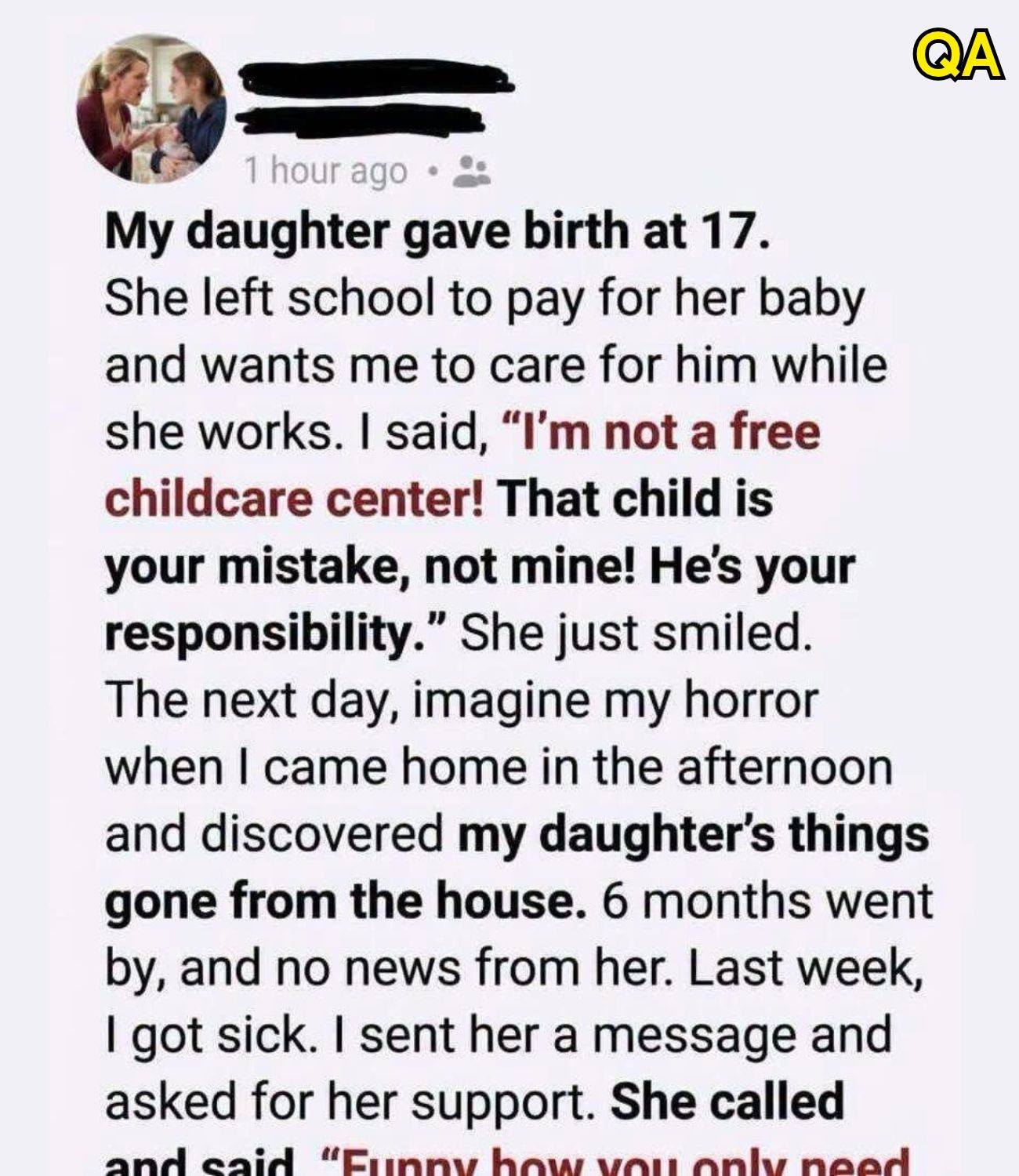
I always believed that teaching my daughter responsibility meant allowing her to face the consequences of her decisions. When she became a teenage mother, I thought she needed to learn how difficult life could be without relying on everyone around her.
But I never imagined that one angry sentence would drive such a deep distance between us.
My daughter, Emily, was only 17 when she gave birth to her little boy. She had left school and started working at a local grocery store to support her baby. Life was far from easy. She was still growing up herself, yet suddenly she had someone depending on her every day.
I knew she was tired. I knew she was struggling. But instead of recognizing how much she needed support, I convinced myself that helping her would only prevent her from becoming independent.
Then one evening, she asked me to watch her son while she went to work.
I was exhausted from my own responsibilities, and my frustration came out in the worst possible way.
“I’m not a free childcare center! That child is your mistake, not mine. He’s your responsibility!”
Emily did not argue. She did not raise her voice or try to defend herself. She simply looked at me with a quiet expression and whispered:
“Okay, Mom. I understand.”
At the time, I thought the conversation was over.
I had no idea it was the beginning of six months without my daughter.
The Morning I Discovered She Was Gone
The following afternoon, I returned home and noticed something unusual.
The house was quiet. Emily’s bedroom door was open, but the room looked different.
Her clothes were gone. The baby’s blankets had disappeared. The stroller was missing, along with a framed photograph that had once stood beside her bed.
On her pillow, I found a handwritten note.
“You were right, Mom. He’s my responsibility. I won’t ask you to carry it anymore.”
I read those words several times, hoping I had misunderstood them.
Then I called her phone.
No answer.
I tried again. And again.
I contacted her friends, visited her workplace, and asked anyone who might know where she had gone. But nobody gave me a clear answer.
At first, I was angry. I told myself that Emily was being dramatic and that she would eventually return when she realized how difficult it was to manage everything alone.
But the days became weeks, and the weeks slowly turned into months.
My anger began to fade. In its place came something much harder to live with: fear.
I started wondering whether she had somewhere safe to sleep, whether she had enough money for food, and whether her little boy was doing well.
Most painfully, I began remembering the evening she had asked me for help.
She had not asked me to raise her child. She had not asked me to take responsibility for her entire life.
She had simply needed someone she trusted to watch her baby while she worked.
Six Months of Silence Changed Everything
During those six months, I replayed our final conversation countless times.
I remembered Emily’s tired expression, the way she had spoken softly, and how quickly she had accepted my refusal.
At the time, I interpreted her silence as agreement.
Now I wondered whether she had simply been too hurt to say anything else.
I began to understand that independence and abandonment were not the same thing.
Emily had responsibilities as a mother, but she was also still a young woman trying to build a future. She needed to work, earn money, and care for her son. That was already a difficult challenge without the additional pain of feeling rejected by her own family.
I had wanted her to become stronger.
Instead, I had made her feel that asking for help was something she should be ashamed of.
Still, I did not know how to reach her. Every attempt to contact her ended in silence, and I was left wondering whether she would ever want to speak to me again.
The Day I Finally Needed Help Myself
Six months after Emily left, my life took an unexpected turn.
One morning, I became seriously ill and was taken to the hospital. The doctors explained that I would need several weeks to recover and would require assistance with everyday activities once I returned home.
For the first time in a long while, I felt completely uncertain about managing things alone.
I looked around the hospital room and thought about my daughter.
I wondered how she had managed during those first difficult weeks with a baby and no reliable support. I thought about the nights she might have spent worrying about money, work, and her child’s needs.
Then I picked up my phone and wrote a message.
“Sweetheart, I’m sick. I need someone to help me for a little while. Please call me.”
I stared at the screen after sending it.
Part of me expected no response. After all, I had spent six months without hearing from her.
But that evening, my phone finally rang.
It was Emily.
My eyes filled with tears as soon as I heard her voice. I wanted to explain everything, apologize, and tell her how much I missed her.
But before I could find the right words, she spoke.
“Funny how you only need family when you’re the one who can’t manage alone, Mom.”
Her sentence was quiet, but it carried six months of hurt.
The Truth About What Happened After She Left
I tried to apologize, but Emily needed me to understand what those months had really been like.
“Do you know what happened after I left?” she asked.
She told me that she had spent three nights sleeping in her car with her baby.
She had worked double shifts whenever she could, trying to earn enough money to cover their basic needs. There were moments when she felt so overwhelmed that she cried alone in the bathroom during work breaks.
Finding childcare had been one of her biggest challenges.
Without someone she could trust to watch her son, keeping her job became difficult. She was constantly trying to balance work, money, and motherhood while worrying about where they would stay.
Then a woman she barely knew offered help.
The woman helped Emily find a room and watched her little boy while she worked. She gave them a chance to regain some stability during a period when Emily felt she had nowhere else to turn.
As I listened, I could barely speak.
I had spent months telling myself that I was teaching my daughter to be responsible. But I had never stopped to consider what my refusal had meant to a frightened 17-year-old who was trying to care for her child.
I had treated her request for temporary help as though she were asking me to take over her responsibilities.
And in doing so, I had made her feel completely alone.
Through tears, I told her I was sorry.
I said I understood if she did not want to forgive me or return to the relationship we once had.
There was a long silence.
Then Emily answered:
“I don’t hate you, Mom. I just needed you to understand how much your words hurt.”
For the first time, I listened without trying to defend myself.
The Unexpected Visit at the Hospital
Two days later, someone appeared at the door of my hospital room.
It was Emily.
She was holding her little boy, who had grown so much that I barely recognized him.
For a moment, I could not move. I had imagined seeing my daughter again so many times, but I had never known whether that moment would actually come.
Emily did not rush toward me. She did not pretend that everything was suddenly fine.
Instead, she placed a small bag of groceries beside my bed.
“I came because I don’t want my son growing up believing that love disappears when someone makes a mistake,” she said.
Those words stayed with me.
I reached for her hand and apologized again. This time, I did not make excuses about being tired, stressed, or overwhelmed.
I simply admitted that I had hurt her when she needed support.
Emily agreed to help me arrange what I needed during my recovery. But she also made something clear: rebuilding our relationship would take time.
I understood.
She did not owe me immediate forgiveness simply because I was sorry.
Rebuilding Trust Takes More Than One Apology
The weeks that followed were not a sudden return to the relationship we had shared before.
There were difficult conversations, uncomfortable memories, and moments when I had to accept that Emily still carried pain from what happened.
I learned that saying sorry was only the beginning.
If I wanted to rebuild trust, I needed to demonstrate that my behavior had changed.
That meant listening when Emily spoke, respecting her decisions as a mother, and offering help without making her feel guilty for accepting it.
It also meant understanding that support did not have to involve taking over her responsibilities.
Sometimes, it could be as simple as watching her son for an hour so she could work. Sometimes, it meant listening when she had a difficult day or helping her think through a problem without judging her choices.
Slowly, our relationship began to improve.
I also started spending more time getting to know my grandson. I had missed so much during those six months, and I realized that building a relationship with him required patience too.
Nothing could erase what had happened, but we could choose to create better memories moving forward.
What This Story Teaches Us About Family and Forgiveness
Family relationships can become complicated when love, responsibility, and personal expectations collide.
Parents may believe that refusing help teaches independence. Adult children may interpret that refusal as rejection, especially when they are already facing difficult circumstances.
There is an important difference between supporting someone and taking responsibility for every decision they make.
A parent can encourage independence while still showing compassion. Offering temporary assistance does not necessarily mean removing accountability. In many situations, practical support can help a young person become more stable and capable of managing life independently.
This is particularly important for young parents, who may be navigating financial pressure, childcare, education, and emotional challenges at the same time.
The story also reminds us that forgiveness should not be forced.
An apology does not automatically repair a relationship. Trust is rebuilt through consistent actions, honest communication, and respect for the other person’s feelings.
Sometimes, the most meaningful apology is not a dramatic speech. It is a willingness to behave differently from that moment onward.
Final Thoughts: Responsibility Matters, but Compassion Matters Too
I once believed that my daughter needed to learn that her child was her responsibility.
That part was true.
But I had forgotten something equally important: being responsible does not mean having to face every challenge without support.
Emily did not need me to live her life for her. She needed a mother who could recognize that she was struggling and offer a little kindness when it mattered most.
Six months of silence taught me something that one argument never could.
Family is not about rescuing one another from every difficult situation. It is about making sure that the people we love do not feel abandoned when life becomes difficult.
I cannot change the words I said that evening. But I can choose what my daughter and grandson experience from me in the future.
And perhaps that is where rebuilding a family relationship truly begins: not with pretending the past never happened, but with learning from it and choosing compassion next time.