What’s the Closest Time to Midnight? Explaining the Viral Math Question
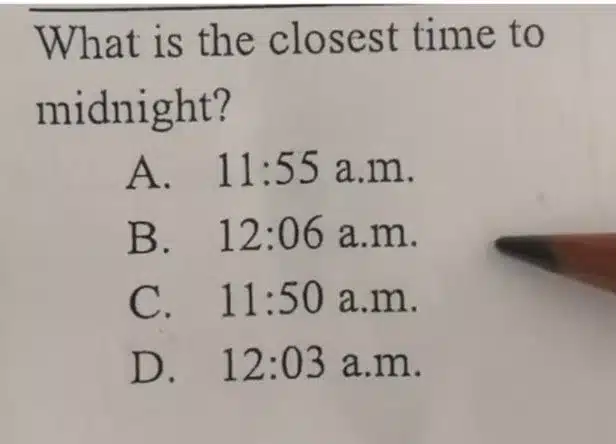
A seemingly simple question about telling time became a widely discussed online puzzle after it was shared on X, formerly known as Twitter, in June 2023. The question asked: “What’s the closest time to midnight?” The available choices were 11:55 a.m., 12:06 a.m., 11:50 a.m., and 12:03 a.m.
At first glance, the exercise appears to be a basic test of time reading. Yet it prompted a substantial debate because people approached the wording in different ways. Some respondents focused on the mathematical distance between each option and midnight. Others questioned whether “midnight” had been stated precisely enough, while a few treated the prompt as a wordplay challenge rather than a time-calculation problem.
When the question is interpreted using standard clock arithmetic, however, the answer is clear: 12:03 a.m. is the closest time to midnight. It is just three minutes after 12:00 a.m., while 12:06 a.m. is six minutes after midnight. The two daytime choices are many hours away.
How the Viral Midnight Question Started
In June 2023, the X account @yawdmontweet shared an image containing the time question and the four possible answers. The post attracted broad attention and generated extensive replies, reposts, and discussions. The popularity of the question reflected a familiar feature of social-media puzzles: a short prompt can reveal very different assumptions about language, mathematics, and everyday conventions.
The choices in the image were:
- 11:55 a.m.
- 12:06 a.m.
- 11:50 a.m.
- 12:03 a.m.
For people who read the prompt as a conventional time-distance question, option D, 12:03 a.m., is the best answer. Midnight is commonly represented as 12:00 a.m. in the 12-hour clock system, so 12:03 a.m. occurs three minutes later.
The original post used a lighthearted tone, but the reactions showed how easily an apparently elementary question can become complicated when participants interpret its wording differently. This is not necessarily a failure of mathematics. Instead, it demonstrates the importance of defining terms and applying consistent conventions.
The Correct Answer: 12:03 a.m.
To solve the problem, each time should be measured by its distance from midnight, or 12:00 a.m. The smallest number of minutes determines the closest option.
- 12:03 a.m. is 3 minutes after midnight.
- 12:06 a.m. is 6 minutes after midnight.
- 11:50 a.m. is 11 hours and 50 minutes before the following midnight.
- 11:55 a.m. is 11 hours and 55 minutes before the following midnight.
Because three minutes is less than six minutes, and dramatically less than nearly 12 hours, 12:03 a.m. is the closest listed time to midnight.
This answer follows the ordinary meaning of “closest” in mathematics: the value with the smallest difference from a reference point. In this case, the reference point is midnight. A useful way to visualize the problem is to imagine a number line representing the minutes around 12:00 a.m. On that line, 12:03 a.m. sits only three minutes from the central point, while 12:06 a.m. is twice as far away.
Why Did So Many People Disagree?
Although the arithmetic is straightforward, the online debate was driven by language and presentation. Some users suggested that the wording could be interpreted in ways other than a standard distance calculation. For example, a few comments treated “closest time to midnight” as a phrase that might invite a visual or verbal association rather than a numerical answer.
Others focused on the potential ambiguity of the 12-hour clock itself. The labels “a.m.” and “p.m.” can be confusing, particularly at noon and midnight. Under common usage in the United States and many other places that use the 12-hour clock, midnight is written as 12:00 a.m. and noon as 12:00 p.m. Still, some style guides and technical organizations prefer the 24-hour clock because it avoids uncertainty.
In 24-hour notation, midnight is 00:00. The four choices would be easier to compare if written in that format:
- 11:55 a.m. = 11:55
- 12:06 a.m. = 00:06
- 11:50 a.m. = 11:50
- 12:03 a.m. = 00:03
Once written this way, the intended answer becomes especially apparent. At 00:03, only three minutes have passed since 00:00. At 00:06, six minutes have passed. The two late-morning options are much farther from midnight.
The Difference Between Mathematical Reasoning and Wordplay
Many viral puzzles gain attention because they sit at the boundary between formal reasoning and informal language. A classroom math question normally has an intended rule: compare the elapsed time between midnight and each answer. If that is the rule, there is one correct option.
On social media, however, participants may introduce alternative rules. Some may look at the written word “midnight” and consider which answer appears physically closest to it in an image. Others may interpret “to midnight” as referring to the amount of time remaining until the next midnight. These approaches can be creative, but they do not follow the conventional mathematical interpretation of the question.
This distinction matters in education. A well-designed assessment should make its intended task unambiguous. If a teacher wants students to identify the time nearest to 12:00 a.m., wording such as “Which time is the fewest minutes away from midnight?” would reduce room for misunderstanding. Clear phrasing helps students demonstrate their mathematical knowledge instead of guessing what type of interpretation the question writer expects.
What the Puzzle Can Teach About Time and Measurement
Despite its online controversy, the question offers a useful opportunity to review how time is measured. Time calculations require a reference point, a shared unit, and a consistent format. In this puzzle, the reference point is midnight and the unit is minutes.
One practical method is to convert each choice into minutes relative to midnight. Midnight equals zero minutes. Therefore, 12:03 a.m. equals three minutes, and 12:06 a.m. equals six minutes. By comparison, 11:50 a.m. is 710 minutes after the previous midnight, while 11:55 a.m. is 715 minutes after it. If the task is to find the smallest distance from midnight, three minutes remains the smallest result.
These kinds of exercises can help learners build confidence with elapsed time, clock notation, and numerical comparison. They also reinforce a broader lesson: before solving a problem, identify exactly what is being compared. In science, finance, travel planning, and daily life, a correct calculation depends on understanding the question as well as performing the arithmetic.
Why the 24-Hour Clock Can Reduce Confusion
The debate also highlights one advantage of 24-hour time. Unlike the 12-hour clock, the 24-hour system does not use a.m. or p.m. Midnight is 00:00, one minute after midnight is 00:01, and noon is 12:00. This sequence is particularly useful in transportation, medicine, emergency services, computing, and international communication, where precision is essential.
Technical guidance from organizations such as the U.S. National Institute of Standards and Technology notes that expressions involving noon and midnight can be unclear. Using 00:00 for the start of a day and 12:00 for noon helps reduce misinterpretation. In a multiple-choice exercise, presenting times as 00:03 and 00:06 would likely have made the intended comparison more immediate.
That does not mean the 12-hour clock is incorrect. It remains widely used in everyday conversation and in many countries. The key is to recognize its conventions and to write times carefully when clarity is important.
Social Media Reactions and the Appeal of Simple Puzzles
Short logic and math questions frequently spread online because they are easy to share and invite instant participation. People can answer quickly, compare their reasoning with others, and defend their interpretation in a public forum. The format can be entertaining, but it can also expose how assumptions shape apparently obvious answers.
In this case, many commenters selected 12:03 a.m. after calculating the number of minutes from midnight. Others challenged the wording or proposed humorous alternatives. Some users also asked artificial intelligence tools for an answer. AI systems can often perform the basic comparison correctly, but their responses should still be checked against the exact wording, the applicable time convention, and reliable reference material.
The larger lesson is not that a viral puzzle must have hidden complexity. Rather, it is that precision matters. A question may have a simple numerical solution while still encouraging broader discussion about terminology, formatting, and communication.
Final Answer to the Closest Time to Midnight Question
Under standard clock conventions, the closest time to midnight is 12:03 a.m. It is three minutes after 12:00 a.m. The next closest choice, 12:06 a.m., is six minutes after midnight. The two a.m. late-morning times are almost 12 hours away.
The viral discussion surrounding the question is a useful reminder that good mathematics begins with clear definitions. Once midnight is understood as 12:00 a.m. and “closest” is understood as the smallest time difference, the solution is straightforward.
Sources
Disclaimer: This content is intended for entertainment purposes only and is not based on real events.