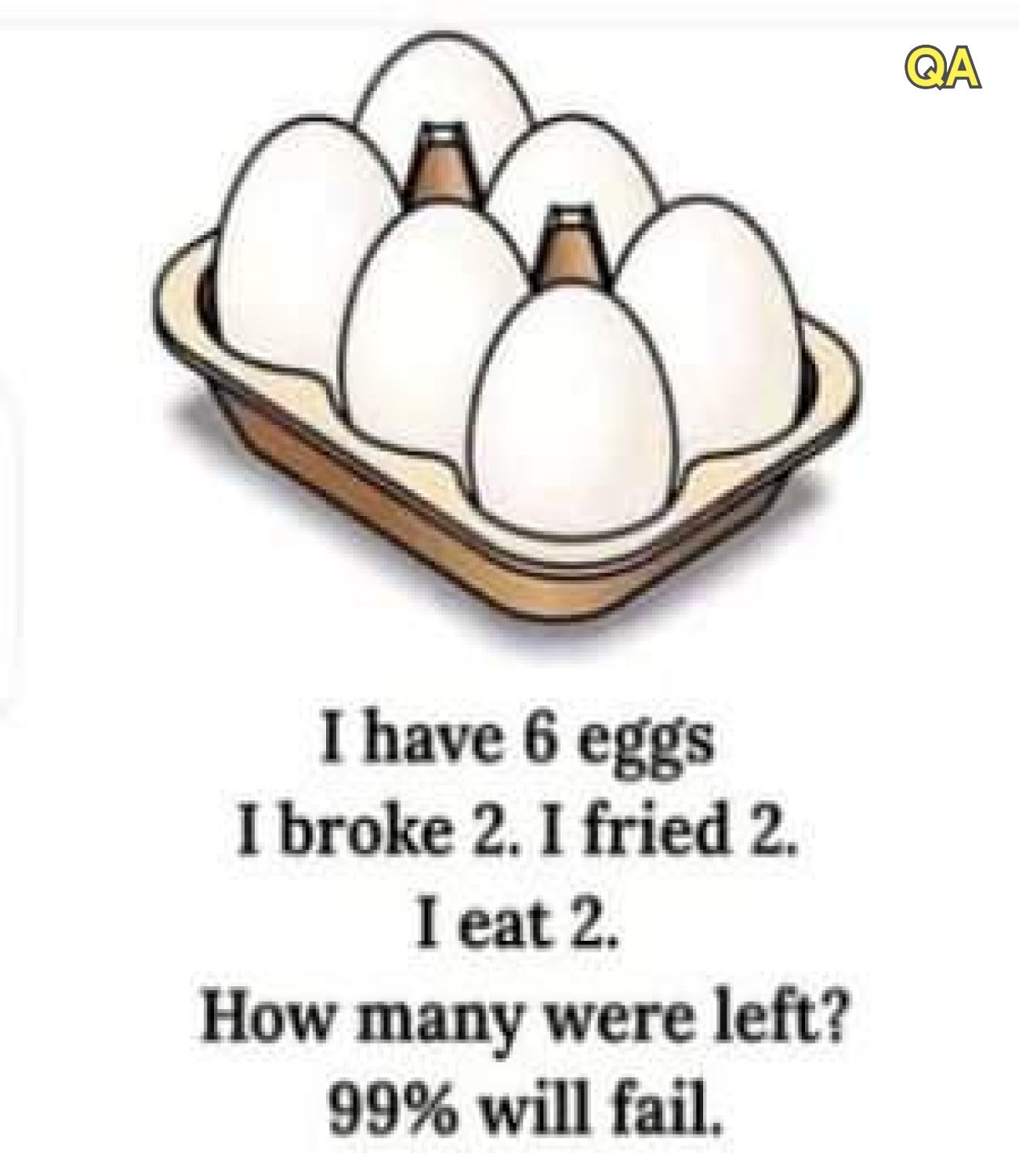
You Began with 6 Eggs

You began with 6 eggs.
You broke 2 eggs.
You fried 2 eggs.
You ate 2 eggs.
This short egg puzzle is a familiar example of a question designed to test careful reading rather than complicated mathematics. At first glance, the sequence may seem to require subtracting two eggs three separate times. That approach would suggest that no eggs remain. However, breaking and frying eggs do not necessarily remove them from the total number of eggs you possess. The key action that permanently reduces the number of eggs available is eating them.
The standard answer is that 4 eggs are left, assuming the two eggs that were broken were then fried and eaten. This is the most natural interpretation because an egg is normally broken before it is fried, and a fried egg is normally eaten afterward. The same two eggs can therefore be involved in all three actions.
Understanding the Six-Egg Puzzle
Word puzzles involving food, objects, or everyday activities often rely on the difference between an item’s condition and its existence. An egg can be intact, broken, cooked, or eaten. These descriptions do not all affect the count in the same way. Breaking an egg changes its physical state. Frying it changes its state again. Eating it is the step that removes it from the collection.
Starting with six eggs, imagine selecting two eggs from the group. You crack those two eggs into a pan, fry them, and then eat them. Although the two eggs went through three stages, they were still only two individual eggs. Once they are eaten, four eggs remain.
The calculation is therefore simple:
6 eggs − 2 eaten eggs = 4 eggs remaining.
The actions of breaking and frying provide context about what happened to the two eggs that were eventually eaten. They are not additional losses from the original group.

Why Breaking an Egg Does Not Reduce the Egg Count
When an egg is broken, it does not disappear. It becomes a broken egg, with the shell separated from the contents. If someone owns six eggs and breaks two, that person still has the material from six eggs, although two are no longer intact. In a practical kitchen context, people might distinguish between “four unbroken eggs” and “two broken eggs,” but the total number of eggs represented remains six until some are used, discarded, or consumed.
This distinction is important because many word problems use verbs that describe transformation rather than removal. Examples include cutting fruit, opening a package, peeling a banana, or folding paper. Each action changes the object, but it does not automatically mean the object has been subtracted from the total.
In the egg puzzle, breaking two eggs leaves four unbroken eggs and two broken eggs. At that stage, there are still six eggs in total, though they are in different conditions.
Why Frying an Egg Does Not Create a Second Loss
Frying an egg is another transformation. The egg is cooked, but it is still the same egg that was previously broken. If the two broken eggs are fried, the number of eggs has not changed. There are simply four raw, unbroken eggs and two cooked eggs.
A common mistake is to treat each verb in the puzzle as an instruction to subtract a new pair of eggs. That would count the same eggs multiple times. In basic arithmetic and logical reasoning, an item should only be removed once unless the wording clearly says that different items are used at each stage.
For example, consider the sentence: “I picked two apples, washed two apples, and ate two apples.” Most readers would understand that the same two apples were picked, washed, and eaten. It would be unreasonable to assume that six separate apples were involved without additional information. The egg puzzle follows the same logic.
The Correct Answer: Four Eggs Remain
Under the usual interpretation, the sequence is straightforward:
- You begin with 6 eggs.
- You break 2 of those eggs.
- You fry those same 2 broken eggs.
- You eat those same 2 fried eggs.
- You have 4 eggs remaining.
The four remaining eggs are presumed to be unbroken and uncooked because they were not used in the preparation of the meal. The two eggs that were broken, fried, and eaten are no longer available.
This answer reflects the intended logic of the riddle. The wording is concise because it invites the reader to recognize that one pair of eggs can move through several actions in sequence.
Could There Be Other Interpretations?
In strictly formal terms, the wording does not explicitly state that the broken eggs, fried eggs, and eaten eggs are the same eggs. A reader could construct a less typical scenario in which different eggs were used at each step. For instance, a person could break two eggs, fry two other eggs, and eat two additional eggs. In that case, the final result would depend on exactly which eggs remained available and whether the broken eggs were discarded or retained.
However, this interpretation is not how classic versions of the puzzle are generally intended to be solved. Everyday language relies on reasonable context. Because frying ordinarily requires eggs to be broken first, and because eating naturally follows cooking, the simplest and most coherent assumption is that the same two eggs are involved throughout.
Good problem-solving often involves identifying the interpretation that best fits the ordinary meaning of the words, while avoiding unsupported assumptions. Here, the ordinary sequence is break, fry, and eat the same two eggs.
Lessons in Reading Comprehension and Logical Reasoning
Although the six-egg question is simple, it demonstrates useful reasoning skills. It shows why readers should separate actions that alter an object from actions that remove it. It also encourages people to follow the order of events rather than treating every phrase as an independent subtraction problem.
These skills apply beyond riddles. In school mathematics, students often need to identify whether information describes a quantity, a change in condition, or an actual increase or decrease. In daily life, people use similar reasoning when following recipes, managing inventory, tracking household supplies, or interpreting instructions.
For example, if a recipe says to wash three potatoes, peel three potatoes, and boil three potatoes, it does not call for nine potatoes. It describes three potatoes passing through three preparation stages. Likewise, the egg puzzle describes two eggs passing through the stages of breaking, frying, and eating.
How to Solve Similar Word Puzzles
A helpful approach to word puzzles is to identify the starting quantity first. Next, determine which actions genuinely remove objects from the group. Finally, check whether later actions likely refer to the same objects mentioned earlier.
For this puzzle, the starting quantity is six. Breaking and frying are changes of state, while eating is the action that removes eggs from the available supply. Since only two eggs are eaten, the remaining quantity is four.
It can also help to create a simple mental table:
- Starting eggs: 6
- Eggs broken: 2, but still present
- Eggs fried: 2, but still present
- Eggs eaten: 2, removed from the total
- Eggs left: 4
This method prevents double-counting. It also makes clear why the answer is not zero, two, or six. The eggs are counted as removed only when they are eaten.
Final Answer
If you began with six eggs, broke two, fried those two, and ate those same two eggs, you have 4 eggs left.
The puzzle’s central idea is that breaking and frying do not subtract additional eggs. They are simply steps in preparing the same two eggs that are ultimately eaten.
Sources
Disclaimer: This content is intended for entertainment purposes only and is not based on real events.