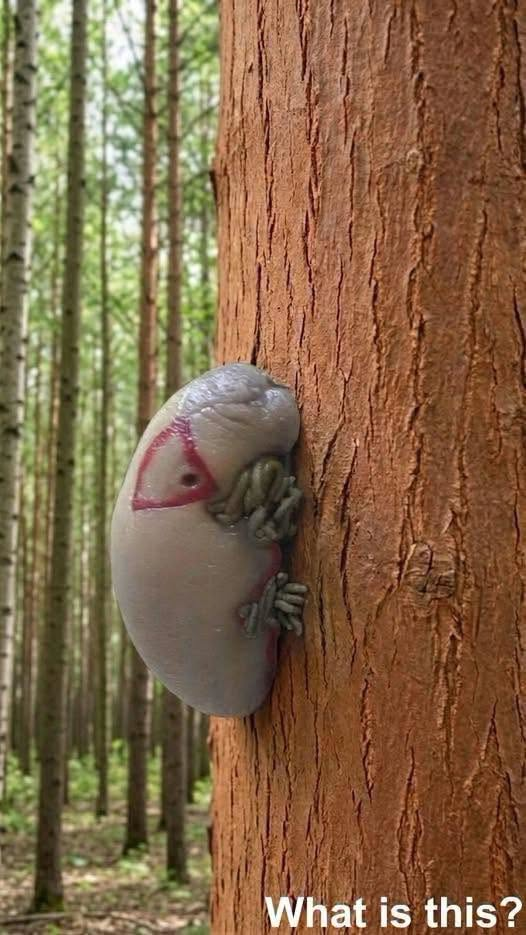
Found Something Strange Growing on a Tree
Discovering a large, twisted mass on the side of a tree can be surprising, especially when its folds and ridges resemble a brain or another familiar shape. Such findings often attract attention on forest walks because they appear unusual against the regular pattern of bark, branches, and leaves. In many cases, however, these dramatic-looking growths are natural features of a tree or signs of an ecological relationship involving fungi, insects, bacteria, or environmental stress.
Photographs alone are rarely enough to identify an unusual tree growth with certainty. The same broad appearance can be produced by several different processes, and accurate identification may require details about the tree species, location, texture, colour, season, and whether the growth is part of the wood or attached to the bark. A qualified arborist, forest manager, local extension service, or mycological society can help provide a more reliable answer.
One of the most common explanations for a large, rounded, brain-like mass in wood is a tree burl. Burls are natural growth abnormalities that can create highly irregular wood grain and striking shapes. Other possibilities include fungal fruiting bodies, woody galls, callus tissue formed after damage, or clusters of shoots caused by disease or stress. Understanding the differences can turn an unsettling forest mystery into an interesting lesson in tree biology.
What Is a Tree Burl?
A burl is a rounded or irregular swelling that develops on a tree trunk, branch, or root area. It is made of wood, usually covered by bark, and may be small or exceptionally large. Some burls have a knotted, folded surface that can look like a brain, a stone, or a mass of roots. They occur on many kinds of trees, including oak, maple, walnut, redwood, birch, and elm.
Inside a burl, the wood grain is often distorted and tightly interwoven. This unusual grain pattern has made burl wood valuable for decorative woodworking, furniture veneers, bowls, musical instruments, and artistic objects. However, the appearance and potential value of burl wood do not mean that people should remove it from living trees. Cutting a burl can damage the tree, create an entry point for decay organisms, and may be illegal on public land or without the property owner’s permission.
Scientists do not attribute every burl to one single cause. Research and forestry guidance indicate that burls may be associated with injury, environmental stress, fungal or bacterial activity, insect damage, genetic factors, or combinations of these influences. In some situations, dormant buds may begin growing in an unusual pattern, producing the dense, distorted tissue characteristic of a burl.
Why Tree Growths Can Look So Unusual
Trees respond to damage and changing conditions differently from animals. They do not heal by replacing damaged tissue in the same way human skin repairs a cut. Instead, trees can form new tissue around injuries and isolate damaged areas through a process often described in arboriculture as compartmentalization. This response can produce ridges, swelling, callus growth, and other irregular forms.
Over years or decades, repeated growth around a wound, a broken branch, or an infection site can create a complex shape. Rain, shade, moss, lichens, and weathering may further change its appearance. A growth that seems mysterious at first glance may therefore reflect a long history of the tree responding to its surroundings.
Forests also contain a remarkable range of fungi. Some fungi form shelf-like structures on trunks, while others develop rounded, folded, or coral-like fruiting bodies. A fungus may be harmless, may help decompose already-dead wood, or may indicate that parts of a living tree are decaying. The visible structure is only one part of a much larger organism that can extend through wood or soil.
Other Possible Explanations for a Brain-Like Growth on a Tree
Although burls are a likely explanation for many large woody lumps, they are not the only possibility. Careful observation can help distinguish among several natural phenomena.
Fungal Fruiting Bodies
Many fungi produce visible fruiting bodies on trees. These may look like shelves, brackets, blobs, rosettes, cups, or folded masses. Unlike a burl, a fungal structure is usually separate from the tree’s wood, even if it is firmly attached to the bark. Its texture may be soft, leathery, spongy, brittle, or moist depending on the species and weather conditions.
Some fungi colonize dead branches or fallen logs and play an essential role in nutrient cycling. Others can be associated with internal wood decay in living trees. The presence of a fungal fruiting body does not automatically mean a tree will fall or die, but it can be a reason to seek professional assessment if the tree is near a house, footpath, playground, road, or other area where falling branches could create a safety concern.
Tree Galls
Galls are abnormal plant growths that can be triggered by insects, mites, fungi, bacteria, or other organisms. They are common on leaves, twigs, acorns, and stems. Many galls are small and have little effect on the overall health of the host tree. Some can become large or woody, particularly on certain species.
Gall-forming insects and other organisms can influence plant tissue as they develop, leading the tree to create a protective structure around them. This is a highly specialized biological interaction, and the precise shape of a gall can sometimes help experts identify the organism involved. As with other tree growths, photographs can be useful, but a close examination is often needed for a confident diagnosis.
Callus Tissue and Wound Responses
When a branch breaks or bark is damaged, a tree may produce callus tissue around the affected area. Over time, the wound edges can thicken and roll inward. If the injury occurred repeatedly or the tree grew around an object, the result may look unusually lumpy or contorted.
These responses demonstrate a tree’s ability to remain functional despite injuries. Still, a closed-looking wound does not always mean the interior wood is unaffected. Decay can exist behind apparently intact bark, which is why mature trees with large wounds should be evaluated by a trained arborist when there are concerns about structural stability.
Witch’s Brooms
A witch’s broom is a dense cluster of small branches or shoots that grows from one point on a tree. It can be caused by fungi, insects, mistletoe, genetic mutation, or other stressors. Unlike a burl, it looks more like a compact nest or ball of twigs than a solid mass. These formations are another reminder that unusual tree shapes can have several origins.
How to Observe an Unusual Tree Growth Safely
Nature enthusiasts can document unusual tree features without disturbing them. Start by noting the tree’s location, approximate size, surrounding habitat, and whether it is living, dead, standing, or fallen. If possible, photograph the entire tree as well as close-up images of the growth from several angles. Include an object for scale, such as a ruler or a person standing at a safe distance.
Important details include whether the growth has bark that matches the tree, whether it feels woody or soft, whether it is dry or wet, and whether it has pores, gills, cracks, or visible spores. It can also help to record the season, since many fungi appear only during particular weather conditions.
Avoid cutting, peeling, pulling, or tasting unknown material. Some natural organisms can cause skin irritation, while handling a growth may also damage it or disturb habitat for insects and other wildlife. It is especially important not to climb or lean on trees that show signs of decay, cracking, hanging branches, or instability.
When Should You Contact an Arborist?
Most unusual growths in a forest setting can be observed and left alone. The situation is different when a tree is close to places used by people. Consider contacting a certified arborist or local tree professional if the tree has a large cavity, extensive fungal growth, deep cracks, dead limbs, lifting roots, a pronounced lean, or recent changes following a storm.
An arborist can inspect the tree’s condition, evaluate potential hazards, and recommend management options. Responsible tree care focuses on preserving healthy trees where possible while reducing avoidable risks. Removing a tree solely because it has an unusual-looking growth is not always necessary, and professional assessment is preferable to assumptions based on appearance.
In parks, nature reserves, and public forests, report concerns to the land manager rather than attempting to intervene personally. Many areas have rules protecting trees, fungi, and natural features. A large burl or unusual fungal specimen may also have educational or ecological value.
The Ecological Importance of Old and Unusual Trees
Irregular trees are often important parts of healthy ecosystems. Cavities, rough bark, deadwood, and decaying sections can provide shelter or feeding opportunities for birds, insects, bats, fungi, and microorganisms. Forest ecosystems depend on decomposition to return nutrients to the soil and support new plant growth.
Large, mature trees can be especially valuable because they provide habitat features that young trees do not yet possess. Conservation organizations and forestry agencies increasingly recognize the importance of retaining habitat trees and deadwood where it is safe to do so. Their presence can support biodiversity and offer clues to a forest’s history.
For visitors, unusual growths can also encourage curiosity about the natural world. Rather than treating every strange form as something alarming, it is useful to view it as an opportunity to learn how trees grow, respond to injury, and interact with other living organisms.
Why Online Identification Can Be Difficult
Internet searches and image-sharing platforms can be helpful starting points, but they can also lead to mistaken identifications. Lighting, camera angles, and image quality can make bark, fungi, and wood structures look very different from their real appearance. Descriptions such as “brain-like” are useful for communicating a first impression, but they are not scientific diagnoses.
Reliable identification often depends on details that a photograph may not show. For fungi, experts may need to examine the underside, spore-bearing surface, host tree, growth pattern, and microscopic features. For burls and galls, the species of tree and the relationship between the growth and bark are important clues. Local experts may also recognize organisms that are common in a particular region.
If sharing an observation online, it is best to describe it cautiously: note what was seen, where it was found, and what remains uncertain. This approach supports accurate discussion and avoids turning a natural curiosity into an unsupported claim.
Appreciating the Science Behind a Strange Forest Discovery
A large twisted mass on a tree may look extraordinary, but nature regularly produces forms that challenge expectations. A burl, fungal fruiting body, gall, or wound response can tell a story about time, stress, growth, decay, and resilience. Each possibility reflects the complex biology of trees and the ecosystems around them.
The most useful response to an unfamiliar forest growth is careful observation, respect for the site, and a willingness to consult credible sources. By leaving the growth undisturbed and seeking guidance when necessary, visitors can protect both the tree and the natural processes that make forests so diverse.
Sources
Disclaimer: This content is intended for entertainment purposes only and is not based on real events.