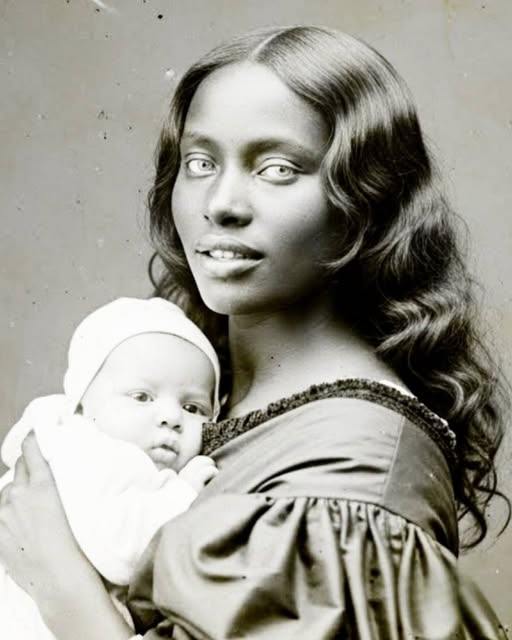
In the mid-19th century American South, enslaved women experienced a system that controlled nearly every aspect of their lives, including family formation and reproduction. Historical records from states such as Mississippi document how enslaved women were valued not only for their labor but also for their ability to bear children, who were legally defined as property under state and federal law prior to 1865.
One such case, recorded in an 1855 Mississippi plantation ledger, lists an enslaved woman identified only as Mary, approximately 36 years old, and noted as the mother of 22 children. While records of this kind are incomplete and often lack personal detail, they provide critical evidence of how slavery functioned as an economic system that incentivized forced reproduction. This article examines what is historically verifiable about such cases and places them within the broader context of slavery, reproductive coercion, and economic exploitation in the United States.
The Historical Context of Enslaved Reproduction
Under U.S. law before the abolition of slavery, the legal principle of partus sequitur ventrem governed the status of children born to enslaved women. This doctrine, adopted widely in colonial and later state laws, established that a child inherited the legal status of the mother. As a result, every child born to an enslaved woman automatically became the property of the enslaver.
Historians have extensively documented how this legal framework encouraged enslavers to view reproduction as a means of increasing wealth. By the early 19th century, especially after the 1808 federal ban on the transatlantic slave trade, domestic population growth became the primary way slavery expanded within the United States. Enslaved women’s reproductive lives were therefore subject to intense control, pressure, and surveillance.
Plantation Records and Economic Valuation
Plantation ledgers, tax inventories, and probate records from the period frequently listed enslaved individuals alongside monetary values. These records were used for estate planning, debt collateral, and sale transactions. Women were often described in terms of age, physical condition, and number of children, reflecting how enslavers assessed economic “productivity.”
In cases like Mary’s, the listing of numerous children does not indicate consent, agency, or well-being. Instead, it reflects the administrative language of slavery, where human lives were reduced to entries in account books. Reputable historians note that such records must be read critically, as they were written solely from the perspective of enslavers and rarely preserve the voices or experiences of the enslaved themselves.
Reproductive Coercion and Lack of Autonomy
Scholarly research confirms that enslaved women had no legal right to refuse sexual exploitation or to make autonomous decisions about marriage or childbearing. While experiences varied by location and individual circumstances, the power imbalance inherent in slavery meant that consent, as understood today, was not possible.
Medical historians and social historians have also documented the severe physical toll of repeated pregnancies under conditions of forced labor, inadequate nutrition, and limited medical care. High maternal and infant mortality rates were common among enslaved populations, making cases of very large numbers of births particularly indicative of prolonged exploitation rather than exceptional health or choice.
Language and Dehumanization
Historical correspondence and account books sometimes used terminology that stripped enslaved women of individuality and reduced them to economic functions. Modern scholarship emphasizes that such language reflects the ideology of slavery rather than the humanity of the people described. Contemporary historians avoid repeating these terms except when analyzing how dehumanization operated as part of the system itself.
It is important to distinguish between documenting historical language and endorsing it. Responsible historical writing contextualizes harmful terminology to explain how slavery normalized exploitation and denied basic human dignity.
Limits of the Historical Record
While plantation ledgers can confirm that a woman identified as Mary was recorded as having borne many children, they do not provide information about her personal experiences, emotional life, or relationships with her children. Many children born into slavery were sold, separated from their families, or died young, facts well-documented in census data and slave sale records.
Historians caution against filling these gaps with speculation. Instead, Mary’s story should be understood as representative of broader, well-documented patterns rather than as a fully recoverable individual biography.
Slavery as an Economic System
Economic historians widely agree that slavery in the United States was a profit-driven system integrated into global markets. Cotton, sugar, and other commodities produced by enslaved labor were central to national and international trade. Enslaved women’s reproductive capacity played a measurable role in sustaining this system, particularly in the Upper and Lower South during the 19th century.
This reality challenges narratives that frame slavery solely as a labor system while overlooking its reliance on family separation and forced reproduction. Modern scholarship treats these factors as central, not incidental, to how slavery functioned.

Why These Histories Matter Today
Understanding cases like Mary’s is essential for an accurate account of American history. Reputable educational institutions, museums, and academic researchers emphasize that confronting the realities of slavery—including reproductive exploitation—helps explain long-term social, economic, and demographic consequences that persisted after emancipation.
This history is not about assigning sensational labels or generating outrage. It is about documenting how laws, economic incentives, and social norms combined to deny millions of people control over their own lives and bodies.
Conclusion
The 1855 record of an enslaved woman identified as Mary, noted as the mother of 22 children, stands as a documented example of how slavery reduced human lives to economic calculations. While the historical record cannot fully restore her voice, it provides sufficient evidence to understand the system that shaped her life.
By relying on verified archival sources and established scholarship, historians can examine these realities responsibly—without speculation, exaggeration, or dehumanizing language. Doing so ensures that discussions of slavery remain accurate, ethical, and suitable for educational and public discourse, including platforms governed by modern content and advertising standards.