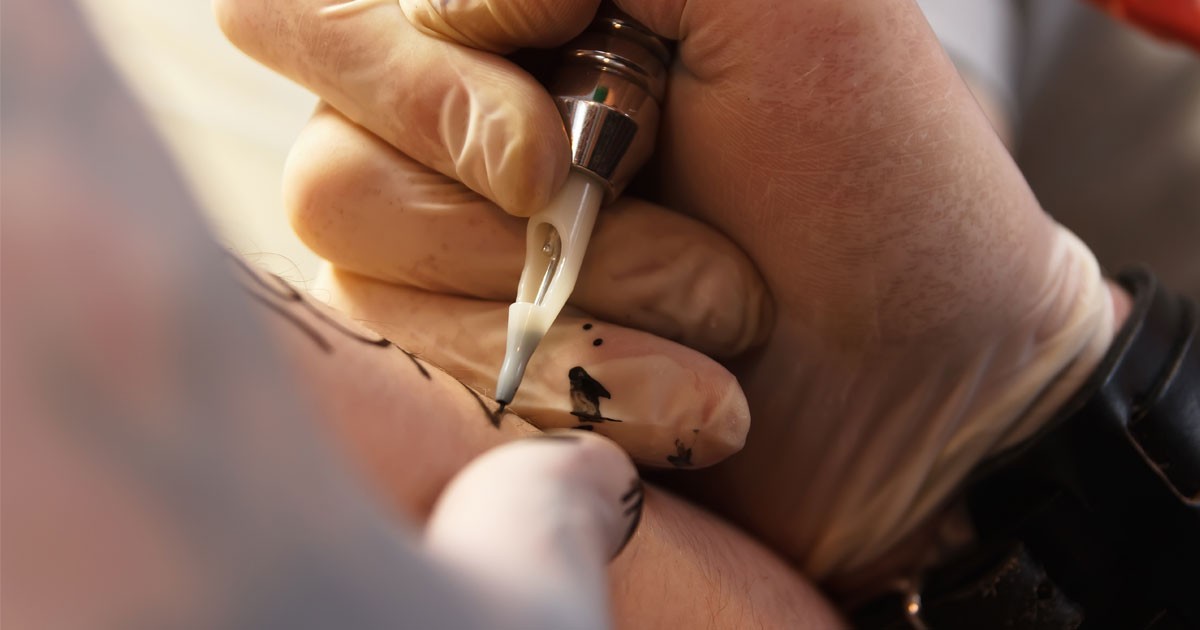
At first glance, the photographs of Tristan Weigelt appear to show two completely different people.
One image shows a young man with an ordinary appearance. Another reveals a tattoo apprentice whose skin has become almost entirely covered in intricate body art.
The transformation is striking, but behind the dramatic visual difference is a much more personal story about individuality, artistic expression, commitment, and how dramatically our appearance can change over time.
Weigelt began his tattoo journey when he was 20. Over the following years, he gradually transformed his body into what he describes as a canvas for his artistic interests.
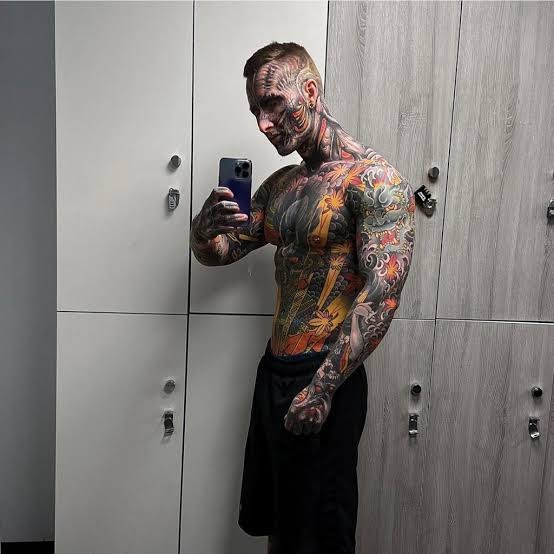
By the time his story attracted international attention, approximately 95 percent of his body was covered in tattoos.
Yet despite the remarkable change in his appearance, Weigelt has said that he still feels essentially the same person on the inside.
That contrast between appearance and identity is what makes his story particularly fascinating.
The Beginning of Tristan Weigelt’s Tattoo Journey
Weigelt’s transformation did not happen overnight.
According to interviews about his experience, his interest in extensive tattooing began when he was around 20 years old.
What started as a form of body art gradually became a much larger project.
Over approximately five years, he invested considerable time and money into his tattoos, eventually spending around $50,000.
For many people, a tattoo represents a specific memory, relationship, belief, or important moment.
Weigelt approaches his tattoos differently.
He has explained that his body art does not necessarily contain hidden messages or deep symbolic meanings.
Instead, the artwork itself became part of his personal aesthetic and identity.
This is an important distinction because tattoos can mean very different things to different people.
For some, they are deeply sentimental.
For others, they are primarily artistic.
And for people like Weigelt, extensive tattooing can become a long-term creative project.
The Before and After Transformation
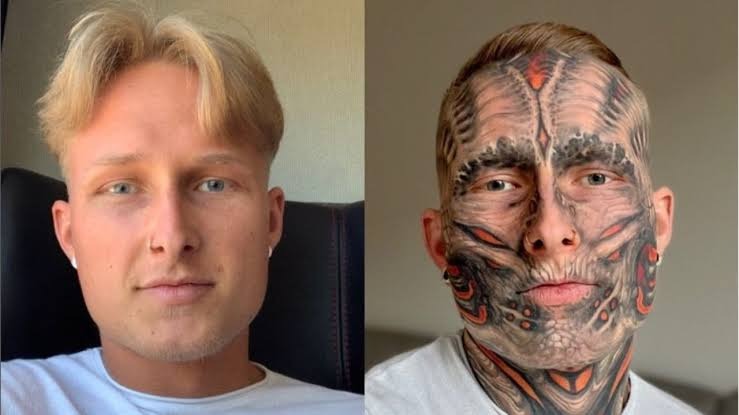
The photographs showing Weigelt before he became heavily tattooed attracted considerable attention because the contrast is so dramatic.
Without tattoos, his appearance is relatively conventional.
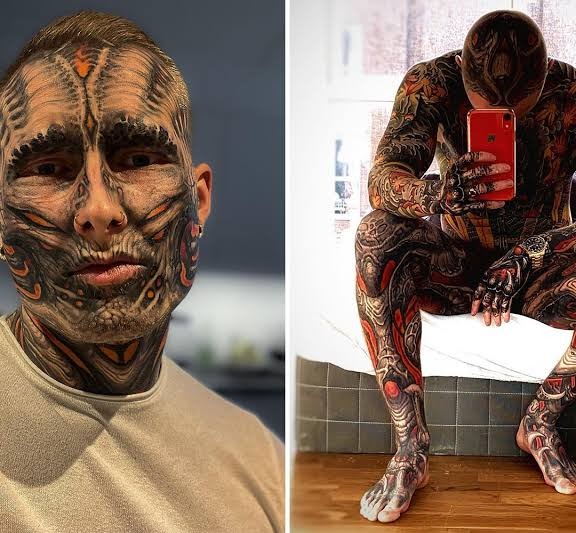
After years of tattooing, his face, neck, torso, arms, legs, and other areas of his body display extensive artwork.
The visual effect demonstrates just how powerful tattoos can be in changing someone’s appearance.
A person does not necessarily change their personality when they change their appearance, however.
That is something Weigelt himself has emphasized.
Looking at old photographs may feel strange to him, but he has said that internally he still feels like the same person.
That observation raises an interesting question about identity.
How much of who we are comes from our appearance, and how much comes from the way we think, behave, and experience the world?
Why His Face and Head Tattoos Were Particularly Difficult
Tattooing different parts of the body can produce very different experiences.
According to Weigelt, some of the most challenging areas were his face and head.
He compared the sensation to being scraped with a metal brush and described the experience as extremely uncomfortable.
The work was completed over multiple lengthy sessions.
This highlights something that can easily be overlooked when looking at photographs.
A finished tattoo may appear visually simple to an observer, but creating extensive body art requires significant time, patience, and tolerance for discomfort.
Large-scale tattoo projects can involve many separate appointments rather than a single session.
For someone covering most of their body, the process can therefore become a years-long commitment.
Five Years of Transformation
One of the most remarkable aspects of Weigelt’s story is the amount of time involved.
Rather than deciding one morning to completely change his appearance, he gradually built his collection of tattoos.
Five years is a substantial period of someone’s life.
During that time, individual tattoos accumulated until they eventually formed a much larger visual transformation.
The process also illustrates how personal styles can evolve.
Someone may begin with one tattoo and later discover that they enjoy the artistic process enough to continue.
Eventually, tattooing can become less about one particular image and more about creating a consistent overall aesthetic.
For Weigelt, that appears to have been the case.
Turning His Body Into a Canvas
Artists often describe their work in terms of canvases.
Painters use fabric or paper.
Sculptors use stone, metal, wood, or other materials.
Tattoo artists work with something very different: human skin.
For a tattoo apprentice such as Weigelt, extensive body art also has an artistic dimension.
The human body has curves, contours, movement, and natural proportions that make it unlike a traditional flat canvas.
A design has to work with those physical characteristics.
This can make large-scale tattooing an especially complicated artistic discipline.
The result is not simply a collection of separate images. When tattoos cover large portions of the body, individual pieces can become part of a much larger composition.
Not Every Tattoo Has a Hidden Meaning
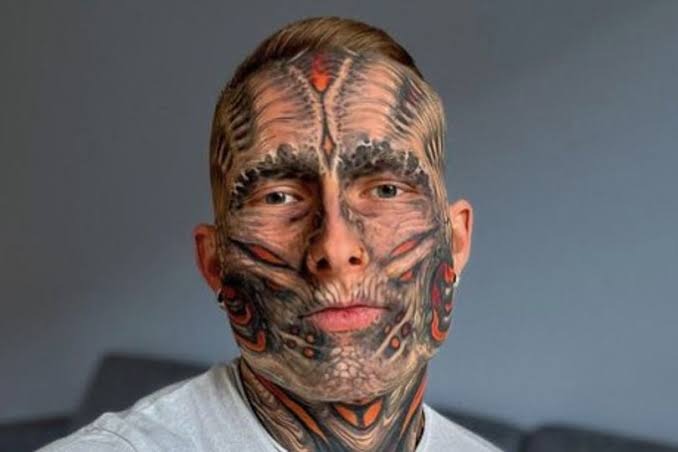
One common assumption about tattoos is that every design must represent something important.
Weigelt challenges that idea.
He has explained that his tattoos do not have hidden messages or specific meanings behind them.
Instead, he focuses on what he likes visually.
This is a useful reminder that there is no single reason people choose body art.
A tattoo can commemorate a person.
It can represent a personal belief.
It can celebrate a particular period of life.
Or it can simply be something the person enjoys looking at.
The meaning ultimately belongs to the person wearing it.
The Financial Commitment
Extensive tattooing can also become a significant financial investment.
Weigelt reportedly spent approximately $50,000 on his tattoos over five years.
That figure illustrates how large-scale body art can involve much more than simply purchasing a single tattoo.
The cost can depend on the artist, design complexity, location, session length, and amount of work required.
For someone covering most of their body, the total cost can become substantial.
The financial side is therefore another consideration for anyone thinking about extensive tattooing.
What Weigelt Says to People Considering Tattoos
Despite his extreme level of body art, Weigelt’s advice to people considering tattoos is surprisingly straightforward.
His philosophy is essentially to choose artwork that you genuinely like rather than becoming overly concerned about whether a particular design perfectly matches a temporary fashion trend.
That advice reflects an important principle when considering permanent body art.
Trends change.
Personal preferences can change.
A design that seems appealing today may feel different years later.
For that reason, taking time to think about a tattoo before getting it can be valuable.
People may also want to consider the artist’s experience, hygiene standards, aftercare instructions, placement, and how the design will work with existing tattoos.
Tattoos as a Form of Individual Expression
Throughout history, people have used body decoration to communicate identity, belonging, status, spirituality, or personal expression.
Modern tattoo culture has expanded dramatically, and tattooing is now practiced in many different artistic styles.
Some people prefer minimalist designs.
Others choose traditional imagery.
Some enjoy colorful compositions, while others prefer monochrome artwork.
There is no universal definition of what a tattoo should look like.
Weigelt’s transformation represents one extreme end of this spectrum.
Rather than using tattoos as a small addition to his appearance, he made them a dominant part of his visual identity.
That makes his story especially interesting because it demonstrates how far personal expression can develop when someone commits themselves to a particular aesthetic.
The Difference Between Appearance and Identity
Perhaps the most interesting part of Weigelt’s story has little to do with tattoos themselves.
It is the idea that someone can look dramatically different while still feeling like the same person.
Humans often use appearance as a quick way to make assumptions about other people.
Hair, clothing, makeup, piercings, tattoos, and other forms of self-expression can influence our first impressions.
But appearance does not necessarily tell us what someone is like internally.
Weigelt’s statement that he feels the same on the inside despite his dramatically different appearance illustrates this perfectly.
The person in an old photograph and the person in a heavily tattooed photograph may look completely different.
Yet both photographs can represent the same individual at different stages of life.
What Makes the Transformation So Fascinating?
The fascination surrounding Weigelt’s story comes largely from the contrast.
People naturally notice dramatic changes.
When an image shows the same person before and after years of extensive tattooing, our brains immediately focus on the difference.
The transformation also raises questions about personal choice.
Would someone who chooses to cover 95 percent of their body with tattoos make the same decision again?
How does it feel to see old photographs?
Does such a dramatic appearance affect everyday interactions?
And what motivates someone to continue the process for years?
These questions make the story more than simply a collection of before-and-after photographs.
It becomes a story about how people construct and express their identities.
A Reminder That Personal Style Is Personal
There is no requirement for everyone to understand or appreciate the same style.
For one person, extensive tattoos may represent beautiful artwork.
For another, a single small tattoo may feel like the perfect amount.
Someone else may prefer not to have tattoos at all.
All of these choices are valid expressions of personal preference.
Weigelt’s story is remarkable precisely because he chose a path far outside what many people consider conventional.
His transformation demonstrates how dramatically the human body can become part of an artistic identity.
Final Thoughts
Tristan Weigelt’s journey from an almost completely tattoo-free appearance to approximately 95 percent body coverage is certainly striking.
But the most interesting part of his story may not be the number of tattoos, the money invested, or even the dramatic photographs.
It is his observation that despite the enormous change in his appearance, he still feels like the same person inside.
That idea reminds us that identity is far more complicated than appearance.
Our styles can change.
Our clothes can change.
Our hair can change.
Even our bodies can become dramatically different over the course of several years.
Yet the person experiencing those changes may still recognize the same personality, memories, interests, and ambitions underneath.
For Weigelt, tattoos became a major form of artistic expression and a defining part of his appearance.
For everyone else, his story offers an interesting reminder that individuality can take countless forms, and sometimes the most fascinating transformations are not about becoming someone new, but about finding a visual language that feels authentically your own.