How Much Does the Shop Owner Lose? Solving the $100 Money Puzzle
This classic money riddle looks straightforward, but it often produces several different answers. By following the cash and merchandise carefully, the puzzle becomes an easy lesson in avoiding double counting.
The $100 Shop Theft Puzzle
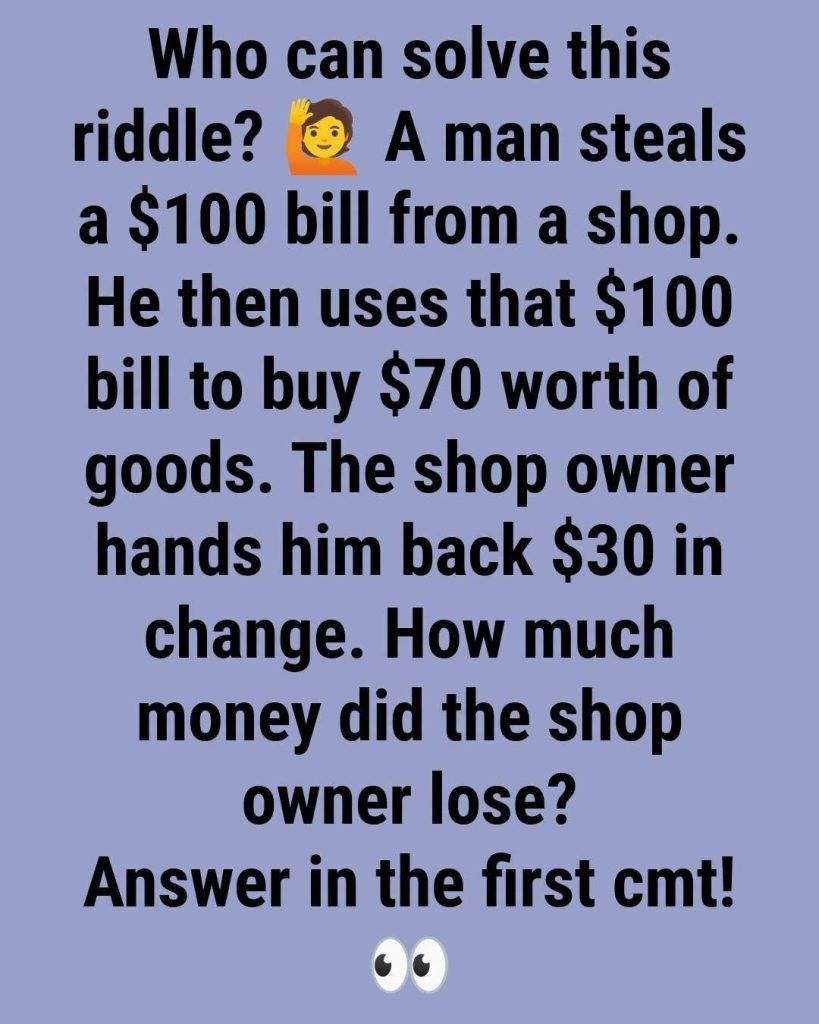
A man enters a shop and takes a $100 bill from the cash register. He then uses that same $100 bill to buy $70 worth of merchandise. The shop owner accepts the bill, not realizing that it was previously taken from the register, and gives the man $30 in change.
The question is: how much does the shop owner lose in total?
This is a popular brain teaser because it combines a theft, a purchase, and a cash transaction involving the same bill. Many people instinctively add the original $100 taken from the register, the $70 in merchandise, and the $30 in change. That calculation produces $200. Others may count only the merchandise and mistakenly answer $70. A common alternative answer is $170.
The correct answer is $100.
The shop owner ultimately loses $70 worth of merchandise and $30 in cash. Together, those items have a total value of $100. The original bill should not be added again because it returns to the register during the purchase. Counting it separately would mean counting the same loss twice.
The Correct Answer: The Shop Owner Loses $100
At the end of the transaction, the customer leaves with two things that belong to the shop:
- $70 worth of merchandise
- $30 in cash as change
The total is simple:
$70 + $30 = $100
That final inventory of what leaves the shop is the most reliable way to solve the riddle. The shopkeeper no longer has the merchandise, and the cash register is short by $30. The $100 bill itself is back in the register, but it was already the owner’s money before the man took it. Its return restores the cash that was initially removed; it does not create an additional gain.
In practical accounting terms, the business is left with $100 less in value than it had before the customer entered. The loss is divided between physical goods and cash, but the total loss remains $100.
Step-by-Step Breakdown of the Transaction
Looking at each stage separately can help explain why the answer is not $170 or $200.
Step 1: The man takes $100 from the cash register
At this moment, the shop owner is down $100 in cash. If the story ended here, the loss would indeed be $100.
Step 2: The man uses the same $100 bill to make a purchase
The man returns the stolen $100 bill to the shopkeeper as payment. The owner now has that $100 bill back in the register. This eliminates the initial $100 cash shortage.
However, the shopkeeper gives the man $70 worth of merchandise and $30 in change. Those two items are now outside the shop and in the man’s possession.
Step 3: Calculate the final loss
After the transaction is complete, the owner has recovered the original bill. Therefore, the original theft is no longer an additional cash loss. What remains missing is:
- Merchandise worth $70
- Cash worth $30
The final loss is $100.
Why $170 Is Not the Right Answer
The $170 answer usually comes from adding the value of the merchandise to the original stolen cash:
$100 stolen + $70 merchandise = $170
That reasoning overlooks an important fact: the stolen $100 bill is used to pay for the goods and is returned to the register. The store is not still missing that specific $100 at the end of the situation.
The shop owner does give back $30 in change, so the final cash loss is $30 rather than $100. The $70 merchandise and $30 change together account for everything the man actually keeps.
Another way to see the issue is to imagine that the man had never stolen the bill and instead paid with his own legitimate $100 bill. In an ordinary $70 purchase, the owner would receive $100 and return $30, producing a net receipt of $70 for the goods. In this puzzle, the $100 payment came from the owner’s own cash drawer, so the business does not receive a genuine payment. It simply gets its own bill back while giving away goods and change.
Why $200 Is Also Incorrect
The $200 answer generally comes from adding all three figures mentioned in the puzzle:
$100 + $70 + $30 = $200
This approach double counts the $100 bill. The bill is first removed from the register and then placed back into the register as payment. It does not disappear twice. Once it is returned, the initial $100 cash loss has been reversed.
Only the value that remains missing after every part of the transaction should be included. That is why the final calculation is not based on every number in the story. It is based on the shop’s final position compared with its starting position.
The business has lost $70 in inventory and $30 in cash. No additional $100 is missing. Therefore, the total remains $100.
Using Net Change to Solve Money Riddles
This puzzle is an example of a broader mathematical idea: determining a net change. Rather than adding every amount that appears in a scenario, a solver should compare the starting condition with the ending condition.
For the shop owner, the starting point includes a $100 bill in the register and merchandise valued at $70. At the end, the original $100 bill has returned, but the merchandise is gone and an additional $30 has left the register as change.
The net change is:
- Cash: negative $30
- Merchandise: negative $70
- Total value lost: negative $100
This method is useful beyond riddles. It can help people assess refunds, discounts, exchange transactions, inventory differences, and everyday budgeting questions. The key is to identify what was present at the beginning, what remains at the end, and what has genuinely changed.
The Difference Between Cash Flow and Actual Loss
One reason the riddle can feel confusing is that cash moves in more than one direction. First, $100 leaves the register. Then that same $100 comes back. Finally, $30 leaves as change. Tracking each movement can make the transaction seem more complicated than it is.
Cash flow describes money moving into and out of a business. Actual loss, meanwhile, concerns the value that the business does not recover. In this example, the temporary removal and return of the $100 bill cancel each other out. The owner’s remaining loss comes from the $30 change and the $70 in goods.
This distinction is important in basic financial reasoning. A large amount of money can move through a business without representing profit or loss. What matters is the final balance after all payments, returns, costs, and goods are accounted for.
In the puzzle, the $100 bill is part of the story, but it is not part of the final loss because it ends up back where it started: in the cash register.
A Simple Inventory Method
For people who prefer a visual or practical approach, the puzzle can be solved by making a short list of the items the man has when he leaves the shop.
He leaves with:
- A product or products worth $70
- $30 in change
He does not leave with the original $100 bill because he hands it back to the shopkeeper. Therefore, the bill should not be included among the items that remain in his possession.
The inventory method leads directly to the answer:
Value taken away = $70 in goods + $30 in cash = $100.
This approach works especially well for word problems involving exchanges. Instead of becoming distracted by the order of events, identify the final assets held by each person or business.
Common Mistakes When Solving the Shop Owner Puzzle
Money puzzles often test attention rather than advanced mathematics. The arithmetic in this example is basic, but the wording encourages several common errors.
Counting the same bill twice
The biggest mistake is treating the original $100 theft and the later $100 payment as separate losses. Since the same bill returns to the register, it cannot remain a separate loss.
Ignoring the change
Some answers focus only on the $70 worth of goods. This misses the $30 cash payment given as change. The shop owner loses both forms of value.
Adding every number in the question
Not every number mentioned in a word problem belongs in the final equation. Numbers may describe temporary movements that are later reversed. In this case, the $100 appears twice in the story but represents one bill that ends in the shop’s possession.
Confusing a sale with a genuine payment
The shop owner appears to complete a $70 sale, but the payment comes from the shop’s own cash register. The business has not received outside money in exchange for its products. It has only recovered property that was temporarily removed.
Why Brain Teasers Like This Are Useful
Classic money riddles are often shared as entertainment, but they can also support useful reasoning skills. They encourage readers to slow down, organize information, and distinguish between temporary events and final outcomes.
Mathematics education frequently emphasizes the value of representing a problem in more than one way. A person might use a timeline, a list of assets, a simple equation, or a beginning-and-ending balance sheet. Each method can reveal the same result.
For this particular puzzle, the most effective question is not “How much money changed hands?” Instead, ask: “What does the man have at the end that belongs to the shop?” The answer is $70 in merchandise and $30 in cash.
That shift in perspective transforms a seemingly tricky riddle into a straightforward accounting exercise.
Final Answer: The Shop Owner’s Total Loss Is $100
The shop owner loses $100 in total.
The loss consists of $70 in merchandise and $30 in change. Although the man initially takes a $100 bill from the cash register, he returns that exact bill when making the purchase. As a result, it should not be counted again as a separate final loss.
The lesson is simple: follow the value that remains missing after the entire transaction is complete. Once the duplicate counting is removed, the answer is clear.
Sources
- Khan Academy: Arithmetic and word-problem learning resources
- National Institute of Standards and Technology: Measurement and mathematical reference information
- MIT OpenCourseWare: Open educational materials in mathematics and related subjects
- Encyclopaedia Britannica: Overview of accounting concepts
Disclaimer: This content is intended for entertainment purposes only and is not based on real events.