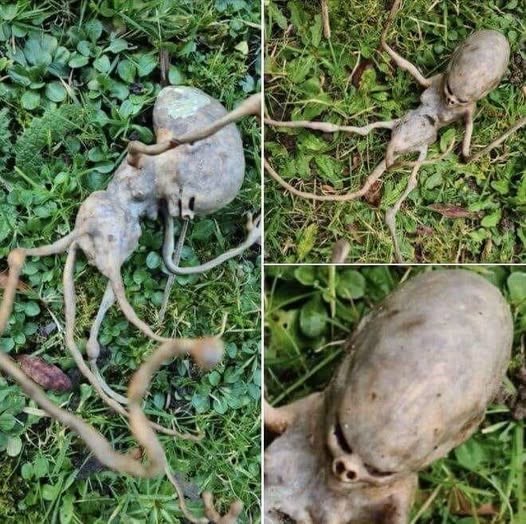
Mysterious Garden Discovery Sparks Online Speculation
Slug: mysterious-garden-discovery-online-speculation
A reportedly unusual object found in a woman’s garden has generated widespread online curiosity after images and descriptions of it were shared on social media. The object was said to have an oblong, skull-like shape, a narrow central section, and several protrusions that observers compared to limbs. Its unfamiliar appearance led some users to speculate about fungi, garden ornaments, discarded props, and other possible explanations.
Although online discussions often move quickly toward dramatic theories, there is no verified evidence that the object was extraordinary or biological in any unusual sense. The original account, as described in the draft, did not establish where the object came from, what material it was made of, whether it was examined by a qualified specialist, or whether it was ultimately identified. Those missing details are important. Without a physical inspection, clear photographs, location data, or expert analysis, a definitive conclusion would not be responsible.
The episode nevertheless highlights a familiar phenomenon: natural objects can sometimes look remarkably lifelike, especially when they are viewed out of context. Fungi, decaying plant material, roots, seed pods, clay, garden debris, and manufactured objects can develop shapes that people interpret as faces, bodies, animals, or other recognizable forms. This tendency is known as pareidolia, a normal feature of human perception in which the brain finds meaningful patterns in ambiguous visual information.
Why an Unusual Garden Object Can Look So Convincing
Gardens are environments where living organisms, weather, soil, and human activity constantly interact. Wood decomposes, fungi spread through organic matter, leaves compact into unusual shapes, and rain can alter the surface of objects over time. A small ornament or piece of household material can also become stained, cracked, overgrown, or partially buried, making its origin difficult to recognize.
Many fungi are particularly capable of producing surprising forms. Some grow as shelves, cups, balls, fingers, nets, or branching structures. Others emerge from underground material, rotting wood, mulch, or old roots. Their size, texture, and color can change rapidly as they mature. According to the Royal Botanic Gardens, Kew, fungi are a highly diverse kingdom of organisms, with many species still not formally described by science. That diversity means gardeners may occasionally encounter forms they have never seen before.
However, an unfamiliar appearance alone does not mean an object is a rare fungus. The description in the original draft included features that some viewers interpreted as anatomical. Such interpretations can be strongly influenced by lighting, image angle, compression, shadows, and the expectations of the person viewing the image. A protrusion may resemble an arm from one angle and a broken branch from another. A rounded surface may suggest a face even when it is simply an irregular growth pattern or weathered material.
Online Speculation Is Not a Scientific Identification
The object was reportedly posted in online communities focused on mushrooms and extraterrestrial themes after friends were unable to identify it. Social media can be useful for gathering suggestions, especially when participants include experienced gardeners, naturalists, or mycologists. But crowd-sourced discussion is not a substitute for a verified identification.
Reliable identification normally depends on more than a single image. Specialists may consider the object’s location, dimensions, texture, smell, growth pattern, surrounding plants, season, soil conditions, and whether it is attached to wood, roots, or another material. For fungi, experts may also need to examine spores under a microscope or use DNA testing. In cases involving an unknown manufactured object, determining the material and tracing its source may be more relevant than studying its appearance.
For that reason, claims that an object is definitely a specific mushroom, an artificial prop, or something more unusual should be treated cautiously unless they are supported by evidence. The available account does not provide confirmation of any one explanation. The most accurate conclusion is simply that the object remained unidentified in the reported online discussion.
Potential Explanations for Strange Objects Found Outdoors
When an unfamiliar item appears in a garden, several ordinary explanations are worth considering before drawing conclusions. One possibility is fungal growth. Fungi can emerge from mulch, compost, buried timber, animal waste, and plant roots. Some species have soft bodies that collapse or distort as they age, while others form structures that appear sculpted or ornamental.
Another possibility is decaying vegetation. Roots, bulbs, gourds, seed heads, and pieces of wood can take on human-like or animal-like shapes as they dry, split, or rot. Soil organisms and insects can further change the material’s appearance. In a damp environment, algae, molds, and soil particles may coat a surface and obscure what it originally was.
Human-made materials are also common sources of confusion. A broken figurine, Halloween decoration, toy, packaging component, craft item, or discarded household object may be altered by sun, rain, dirt, and plant growth. If an item has been outdoors for a long time, its original color and texture can disappear almost completely.
Finally, some objects can be moved by wildlife, flooding, landscaping work, or wind. A garden discovery does not necessarily originate in that garden. An item might have been carried from a neighboring property, exposed after digging, or washed into place during heavy rain.
How to Safely Handle an Unknown Garden Find
Experts generally advise people not to touch or consume an unidentified fungus, mushroom, plant, or object. Most garden discoveries are harmless, but some mushrooms and plants can be toxic if eaten, and unknown materials may contain irritants, sharp fragments, or contaminants. Caution is especially important around children and pets, who may be more likely to handle or taste something unusual.
If an unknown object needs to be moved, wearing disposable gloves and washing hands afterward are sensible precautions. It is also useful to keep pets away until the item has been assessed or removed. If someone suspects a child or animal has eaten a mushroom, plant, or unknown substance, they should contact local emergency services, a poison control center, or a veterinarian promptly. In the United States, Poison Control can be reached at 1-800-222-1222.
For identification, clear documentation is more useful than speculation. Photographs should show the object from several angles, include a familiar item for scale, and capture its surroundings without disturbing it. Notes about the date, recent weather, garden materials, nearby trees, and whether the object was growing or simply lying on the ground can help experts assess the situation.
When to Contact a Local Expert
A local extension service, botanical garden, natural history museum, mycological society, or environmental organization may be able to provide guidance. In many regions, agricultural extension offices offer practical information on mushrooms, plant diseases, pests, and soil conditions. A qualified expert can help distinguish between a fungus, plant material, animal-related remains, mineral formation, or manufactured debris.
It is important to remember that even skilled identifiers may decline to name a specimen from a photograph alone. This is not a sign that the object is mysterious in an extraordinary sense. It reflects good scientific practice. Accurate identification requires enough evidence to rule out lookalikes, particularly when advice could affect health, safety, or environmental decisions.
The Role of Pareidolia in Viral Garden Mysteries
The strong public reaction to the garden object also reflects the way people interpret uncertain images online. Human beings are highly attentive to faces and body-like forms. This ability is useful in everyday life, but it can also lead people to see familiar patterns in clouds, rock formations, tree bark, stains, and fungi. A shape that vaguely resembles a head or limb can become much more convincing once viewers begin discussing it in those terms.
Online platforms amplify this effect. Comments can guide later viewers toward a particular interpretation, whether that interpretation involves a fictional creature, a television reference, a rare organism, or a hidden prop. As the discussion grows, uncertainty itself can become part of the attraction. The absence of a confirmed answer often encourages more theories rather than fewer.
That does not mean people should avoid sharing unusual natural finds. Garden observations can be educational and can sometimes lead to genuine discoveries about local biodiversity. The key is to separate curiosity from certainty. A responsible approach is to describe what can actually be observed, identify what remains unknown, and seek qualified advice when necessary.
What Can Be Concluded About the Garden Discovery?
Based on the information available in the original account, the object’s identity was not confirmed. It was initially thought to be a mushroom, but no expert finding was reported. Online users proposed several possibilities, including natural growth and artificial material, yet none was established as fact. There is also no credible basis in the available description for extraordinary claims.
The most useful lesson from this unusual garden story is that nature and weathered objects can be visually surprising. A strange-looking find may be a fungus, plant matter, garden debris, or an item altered by time and exposure. Careful observation, safe handling, and expert consultation offer much better answers than viral speculation.
For gardeners, the event is also a reminder to look closely at the ecosystems just outside their doors. Soil, decomposing wood, insects, plants, and fungi form a complex environment that often goes unnoticed until something unexpected appears. Not every mystery will have an immediate answer, but a measured, evidence-based approach can turn a puzzling discovery into an opportunity to learn more about the natural world.
Sources
Disclaimer: This content is intended for entertainment purposes only and is not based on real events.